 (208) 991-3502
 Meridian, ID




Package thieves, prowling raccoons, and the occasional nosy neighbor all show up on your property line before they ever reach your front door. That's exactly why outdoor cameras for home security have...
Package thieves, prowling raccoons, and the occasional nosy neighbor all show up on your property line before they ever reach your front door. That's exactly why outdoor cameras for home security have become the first upgrade most Treasure Valley homeowners ask us about. With so many models flooding the market, from budget wireless kits to full subscription-based systems, picking the right one for your driveway, backyard, or front porch takes more than a glance at star ratings.
This guide cuts through the noise and gets straight to what matters: which cameras actually hold up to Idaho winters, deliver clear night vision, and give you real-time alerts without a confusing app. We've compared battery-powered and wired options, subscription-free models, and systems built for whole-property coverage, so you can match a camera to your actual layout instead of guessing.
We install and support security systems across Boise, Meridian, Eagle, and Nampa every week, so this list reflects what we see perform well in real homes, not just spec sheets. Below you'll find our picks for the 10 best outdoor cameras for home security in 2026, including standout choices for renters, large properties, and anyone who wants professional installation instead of a DIY headache.
1. Custom outdoor camera systems from Treasure Valley Solutions
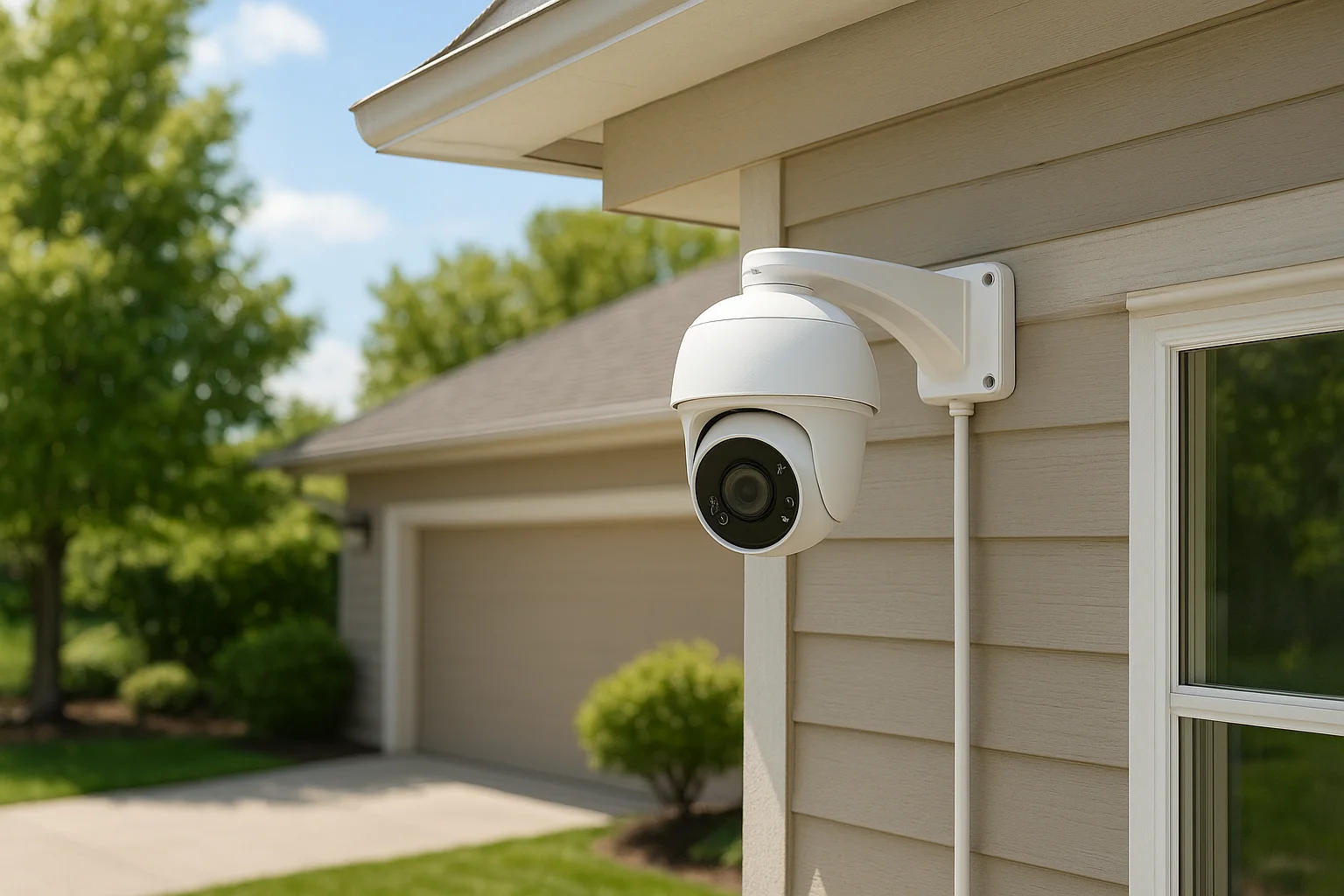
Most outdoor camera lists start with the same five retail brands you've already seen at Costco. We're putting our own systems first because they solve the actual problem homeowners bring us: a mismatched pile of consumer cameras that don't cover the blind spots on their specific property. When you work with Treasure Valley Solutions, you're not picking a box off a shelf and hoping it fits your driveway angle or that oddly shaped side yard. We design a custom outdoor camera system around your home's layout, then install and program it ourselves.
Key features
Every system we build starts with a walkthrough of your property, not a generic camera kit. We map sightlines for your driveway, entry points, and backyard, then select camera types (fixed, varifocal, or pan-tilt-zoom) that actually match those distances instead of forcing one lens to do everything. Integration is where this setup pulls ahead of plug-and-play brands: your cameras can trigger smart lighting, lock doors automatically, or sync with whole-home audio to play an audible warning when someone lingers too long near the garage.
- 4K and low-light sensors chosen per camera location, not a one-size spec across your whole property
- Wired power and PoE options for cameras that never need battery swaps or recharging trips up a ladder
- Integration with smart locks, lighting, and voice control so cameras do more than just record
- Weatherproof housings rated for Idaho winters, tested against snow load and freeze-thaw cycles
A camera system built for your actual property beats a universal kit every time.
Who it's best for
This option fits homeowners who've already tried a big-box camera and found the coverage patchy, along with anyone building new construction who wants outdoor security cameras for the home pre-wired before drywall goes up. Property managers overseeing multiple units also lean on us here, since a centrally managed, professionally installed system is far easier to maintain than a dozen tenant-owned Ring accounts.
Pricing and monitoring
Pricing runs on a project basis because no two homes need the same camera count or cable runs. Most single-family installs land between $1,500 and $6,000 depending on the number of cameras, whether you add access control, and how much of the home you're wiring at once. There's no forced subscription. You can self-monitor through the app we set up, or we'll connect you with local monitoring partners if you want a professional watching feed. Every install includes programming and a walkthrough, and our Meridian-based team handles support directly, so you're not stuck on hold with a call center in another state.
2. SimpliSafe outdoor security camera
SimpliSafe built its reputation on DIY alarm kits, and its outdoor camera line carries that same plug-and-play philosophy. The SimpliCam Outdoor pairs with SimpliSafe's base station and app, giving you a straightforward option if you already run one of their alarm systems or want security and cameras bundled under one brand instead of stitching together separate products.
Key features
The camera offers 1080p HD video, color night vision, and a built-in spotlight that activates when motion is detected after dark. It also includes a live guard feature during monitored plans, where an agent can view your feed in real time and speak through the camera to warn off an intruder before police even arrive. Weather resistance is rated for outdoor use, though the housing is smaller and less rugged than commercial-grade options.
- 1080p HD with color night vision for identifiable footage after sunset
- Built-in spotlight triggered by motion detection
- Live guard protection available with monitored plans
- Simple app pairing with existing SimpliSafe alarm hardware
A bundled alarm and camera system works best when you want one app running your whole setup.
Who it's best for
This camera suits homeowners already invested in SimpliSafe's alarm ecosystem or anyone who wants a wireless security camera system for home outdoors without dealing with multiple apps or brands. It's less suited to larger properties needing multiple long-range cameras, since coverage per unit is modest compared to varifocal or PTZ options.
Pricing and monitoring
The camera itself typically costs around $170, with professional monitoring plans starting near $20 to $28 monthly depending on features like live guard response. You can self-monitor for free through the app, but you'll lose cloud video storage and live guard access unless you subscribe. SimpliSafe doesn't require a long-term contract, which appeals to renters or anyone hesitant to commit.
3. Ring outdoor security cameras
Ring practically invented the doorbell camera category, and its outdoor lineup has grown into a full suite of battery, plug-in, and solar-powered options. If you already own an Echo device or a Ring doorbell, adding a Ring Stick Up Cam or Spotlight Cam to cover your backyard or driveway keeps everything inside one familiar app.
Key features
Ring's outdoor cameras record in 1080p or 4K depending on the model, with color night vision, two-way talk, and motion zones you can customize to ignore the street and focus on your porch or gate. The Spotlight Cam adds a built-in siren and floodlight, useful for driveways or side yards where you want deterrence, not just footage. Battery models swap out in minutes, while wired versions skip the recharging cycle entirely.
- 1080p to 4K resolution across different models and price points
- Motion zone customization to reduce false alerts from passing cars
- Built-in siren and spotlight on higher-tier models
- Battery, plug-in, and solar options for flexible placement
Ring works best when you're already inside its ecosystem and want one app for doorbell and yard cameras alike.
Who it's best for
Ring fits homeowners who want wireless cameras for home security outdoor use without running new wiring, especially renters or anyone who might move the cameras later. It's a solid match for smaller lots and single-entry monitoring, though larger properties with multiple blind spots often need more cameras than Ring's per-unit pricing makes practical.
Pricing and monitoring
Cameras range from about $60 for basic battery models to $250 for solar-powered, 4K options. Ring Protect plans start around $4 monthly for basic cloud storage per camera, or roughly $10 for unlimited cameras plus professional monitoring add-ons. You can view live feeds free without a plan, but recorded history requires a subscription.
4. Google Nest outdoor cameras
Google Nest cameras lean on artificial intelligence to do more than just record motion. If your home already runs on Google Home speakers or displays, adding a Nest Cam Outdoor gives you facial recognition alerts and package detection that feel a step ahead of simpler motion-triggered systems. It's a strong pick for anyone deep in the Google ecosystem who wants their outdoor security cameras for the home talking to the same app as their thermostat and smart speakers.
Key features
Nest's outdoor cameras record in 1080p to 4K depending on the model, with intelligent alerts that distinguish between people, packages, vehicles, and animals instead of flagging every leaf blowing across your lawn. The Cam with floodlight adds bright, motion-activated lighting for driveways and side entrances, while battery models offer flexible placement without new wiring.
- AI-based alerts for people, packages, and vehicles, not just generic motion
- Familiar face recognition with a Nest Aware subscription
- Floodlight and battery models for different mounting needs
- Google Home integration for voice control and shared alerts across devices
Smarter alerts matter more than more alerts, and Nest's AI filtering proves it.
Who it's best for
This camera suits homeowners already using Google Home devices or anyone who wants security outdoor cameras for home use that reduce false notifications through smarter filtering. It's less ideal if you want a fully self-contained system without a subscription, since most of Nest's best features live behind Nest Aware.
Pricing and monitoring
Cameras run roughly $180 to $280 depending on resolution and whether they include a floodlight. Nest Aware subscriptions start around $8 monthly for 30 days of event video history, climbing to about $15 for longer storage and multi-camera households. Without a subscription, you lose recorded history and most AI-based alert features, leaving only live viewing.
5. Arlo wireless outdoor cameras
Arlo built its name on truly wireless, weatherproof cameras that don't need a hub near an outlet to work. If you're comparing wireless outdoor security cameras for the home that prioritize picture quality over brand ecosystem lock-in, Arlo's Pro and Ultra lines consistently rank near the top for resolution and color night vision, even in Idaho's darker winter evenings.
Key features
Arlo's higher-end models shoot in 2K to 4K with HDR, which pulls out detail in high-contrast scenes like a porch light against a dark yard. Battery life runs three to six months per charge depending on activity, and the magnetic mounts make repositioning simple if you realize your first placement missed the side gate. Arlo also builds in a 160-degree field of view on its Ultra cameras, wider than most competitors, which cuts down on the number of units you need for a single sightline.
- 2K to 4K HDR recording with strong color night vision
- 160-degree field of view on Ultra models
- Rechargeable, magnetic-mount batteries for easy repositioning
- Built-in siren and spotlight on select cameras
Wider field of view means fewer cameras doing more of the work.
Who it's best for
Arlo suits homeowners who want wireless cameras for home security outdoor use without sacrificing video quality, particularly on properties with long driveways or wide backyards where fewer, wider-angle cameras beat several narrow ones. It's a weaker fit if you want free cloud storage, since most of Arlo's smart features sit behind a paid plan.
Pricing and monitoring
Cameras range from about $100 for entry models to $300 for 4K Ultra units, often sold in two or three-camera kits. Arlo Secure plans start near $5 monthly for a single camera or $15 for unlimited cameras across the home, covering 30-day cloud storage and AI object detection. Without a subscription, you keep live viewing but lose recorded clips.
6. Lorex outdoor camera systems
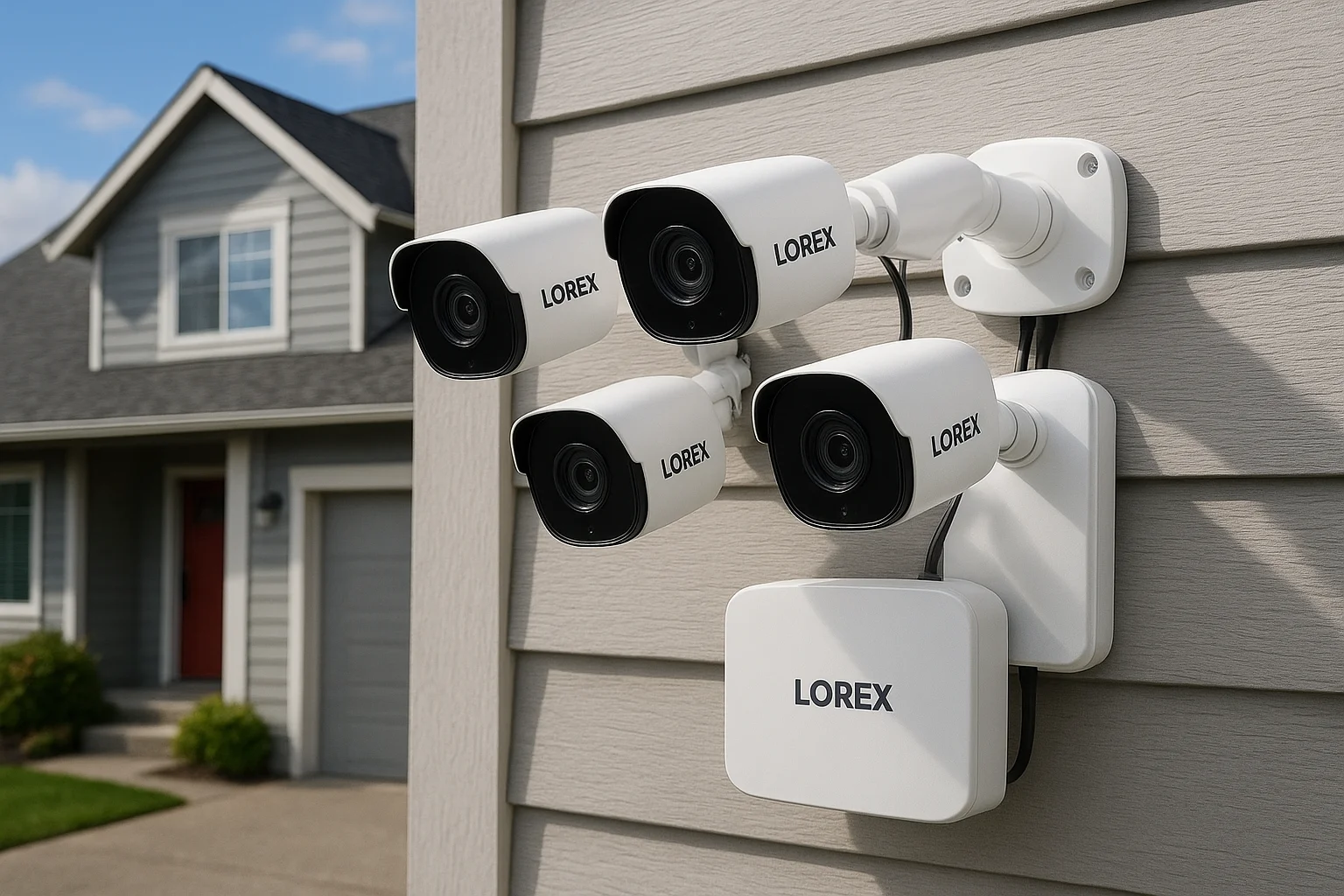
Lorex takes a different approach than Ring or Nest by focusing on wired, no-subscription camera systems built for homeowners who want full ownership of their footage. If you're comparing outdoor security cameras for the home that record locally instead of leaning on cloud storage, Lorex's NVR-based kits give you months of stored video without a monthly bill eating into the value of your purchase.
Key features
Lorex systems typically ship as multi-camera kits paired with a network video recorder, storing footage on a physical hard drive rather than the cloud. Resolution options run from 1080p up to 4K, with some models offering smart motion detection that separates people and vehicles from general movement. Two-way audio and color night vision come standard on newer cameras, and the NVR lets you view every camera on one screen instead of switching between app tabs.
- Local NVR storage with no required subscription for video history
- Multi-camera kits built for whole-property coverage from one purchase
- 4K resolution options with smart person and vehicle detection
- Wired power for cameras that never need battery charging
Owning your footage outright beats renting cloud storage every month.
Who it's best for
Lorex fits homeowners with larger properties who want home security cameras for outside covering a driveway, backyard, and side yard from a single connected system. It suits buyers who don't mind running cable during installation in exchange for skipping recurring fees, though renters and anyone wanting a quick DIY setup may find the wiring requirement inconvenient.
Pricing and monitoring
Multi-camera kits with an NVR generally run between $400 and $900 depending on camera count and resolution. There's no mandatory subscription, since footage saves locally, though Lorex offers an optional cloud backup plan for a monthly fee if you want off-site storage as backup protection against theft or damage to the recorder itself.
7. ADT professionally monitored outdoor cameras
ADT built its name on decades of professional monitoring, and its outdoor camera lineup carries that same emphasis on trained agents watching your feed instead of leaving alerts to an app on your phone. If you want outdoor security cameras for the home backed by a company with actual dispatch relationships to local police and fire departments, ADT's cameras integrate directly into that monitoring infrastructure rather than acting as standalone devices.
Key features
ADT's outdoor cameras record in 1080p to 4K depending on the model, with color night vision, two-way talk, and motion-activated alerts that route straight to ADT's monitoring centers on eligible plans. Many installs pair cameras with ADT's broader alarm system, so a triggered door sensor pulls up the matching camera feed automatically for the monitoring agent. Professional installation is standard rather than optional, which means fewer mounting mistakes and properly aimed sightlines from day one.
- 24/7 professional monitoring with direct dispatch capability
- Integration with ADT alarm sensors for automatic camera pull-up on alerts
- Professional installation included on most packages
- Battery and wired camera options depending on placement needs
Professional monitoring matters most when you want a trained agent reacting, not just an app notification.
Who it's best for
ADT suits homeowners who want exterior security cameras for home protection bundled with round-the-clock human monitoring, particularly those who travel often or manage a second property and can't check alerts themselves. It's a weaker fit for anyone who wants a low-cost, self-monitored setup, since ADT's value depends heavily on committing to a monitoring plan.
Pricing and monitoring
Camera equipment often bundles into a broader alarm package rather than selling standalone, with monitoring plans typically starting around $45 to $60 monthly. Contracts commonly run 24 to 36 months, though month-to-month options exist at a higher rate. Installation fees vary by package, and most contracts include the camera equipment cost folded into the monitoring price.
8. Wyze Cam Outdoor v2
Wyze built its reputation on affordable smart home gear, and the Cam Outdoor v2 keeps that same budget-first approach while still covering the basics most homeowners want from wireless cameras for home security outdoor use. It's a fully battery-powered, weatherproof camera that pairs with a base station rather than needing Wi-Fi range at the camera itself, which helps in spots where your router signal gets thin, like a detached garage or back fence line.
Key features
The camera records in 1080p with color night vision and a wide 130-degree field of view, wide enough to catch most driveway or backyard activity in one frame. Battery life runs around three to six months depending on activity, and the magnetic mount makes repositioning easy if your first placement doesn't quite line up. Wyze also includes free 14-day cloud storage with every camera, a rarity among competitors.
- 1080p color night vision with a 130-degree field of view
- Battery-powered design paired with a base station instead of direct Wi-Fi
- Free 14-day cloud storage included with no subscription required
- Magnetic, weatherproof mount for flexible outdoor placement
Free cloud storage is rare in this category, and Wyze makes it standard.
Who it's best for
Wyze fits budget-conscious homeowners or renters who want security cameras for outside home coverage without committing to a monthly plan, especially for smaller properties or single-entry monitoring like a side gate or shed. It's less suited to larger properties needing long-range detail or advanced AI filtering, since the resolution and processing lag behind pricier brands like Arlo or Nest.
Pricing and monitoring
A single camera typically costs around $50, with the required base station selling separately for about $35 if you don't already own one. Wyze's optional Cam Plus subscription starts near $2 monthly per camera, adding person detection and longer video history beyond the free 14-day window. There's no professional monitoring option, so alerts route only to your phone, not a monitoring center.
9. Blink outdoor cameras
Blink, owned by Amazon, targets the same budget-conscious buyer as Wyze but leans harder into long battery life over premium image quality. If you want wireless security cameras for home outdoors that run for years on two AA batteries instead of a rechargeable pack, Blink's Outdoor 4 line is built around that exact promise, making it a low-maintenance pick for anyone who doesn't want a recurring charging chore.
Key features
Blink's cameras record in 1080p with infrared night vision, motion detection, and two-way audio, all synced through an app that also runs Amazon's Alexa integration for voice announcements when someone approaches. Battery life claims run up to two years on standard batteries, a rare figure among competitors that typically need charging every few months. A sync module extends storage options and lets you add local video backup via a USB drive, sidestepping cloud fees entirely if you choose.
- Up to two years of battery life on standard AA batteries
- 1080p infrared night vision with motion-triggered recording
- Alexa voice integration for announcements and smart home routines
- Optional local USB storage through the sync module, no subscription required
Two years without a battery swap makes Blink one of the lowest-maintenance outdoor cameras available.
Who it's best for
Blink suits homeowners already inside Amazon's ecosystem who want outside cameras for home security that require almost no upkeep once mounted. It fits smaller properties, rental units, or vacation homes where visiting to recharge a battery isn't practical, though the 1080p resolution and narrower field of view fall short of Arlo or Nest for larger, detail-heavy sightlines.
Pricing and monitoring
Cameras typically cost between $70 and $100, often discounted in multi-camera kits during Amazon sales events. Blink's subscription plans start around $3 monthly per camera for cloud storage, or roughly $10 for unlimited cameras across the home. Local storage through the sync module and a USB drive avoids subscription costs altogether, though you lose remote cloud backup if the drive fails or gets removed.
10. Eufy no-subscription outdoor cameras
Eufy, made by Anker, built its outdoor lineup around local storage from the start, so you're never forced into a monthly fee just to keep recorded footage. If you've been comparing outdoor wireless security cameras for home use and keep getting stopped by subscription pricing, Eufy's HomeBase system stores video on a local hard drive instead, giving you full history without recurring costs eating into what you already paid for the hardware.
Key features
Eufy's cameras record in 2K to 4K depending on the model, with color night vision and on-device AI that tells apart people, vehicles, and animals without sending footage to the cloud for processing. The HomeBase hub stores up to 16TB locally, which translates into months of continuous recording rather than the 14 or 30-day windows common with cloud-only competitors. Battery life runs four to six months per charge, and solar panel accessories exist for spots where you don't want to climb a ladder every season.
- Local storage via HomeBase, up to 16TB, with no required subscription
- On-device AI detection for people, vehicles, and pets
- 2K to 4K resolution with color night vision
- Optional solar panel accessories for maintenance-free battery charging
Storing footage locally means you own your security history outright, not just a rental copy of it.
Who it's best for
Eufy suits homeowners who want wireless security cameras systems for home outdoors without ongoing fees, especially anyone burned before by a subscription price hike on another brand. It's a strong match for multi-camera setups on larger properties, since adding cameras to an existing HomeBase doesn't multiply your monthly costs the way cloud plans typically do.
Pricing and monitoring
Cameras run roughly $130 to $220 each, with the HomeBase hub adding another $150 to $200 upfront. There's no mandatory subscription, though Eufy offers an optional cloud plan starting around $3 monthly if you want off-site backup alongside local storage.
11. Key features to compare before you buy
Once you narrow your list, the real decision comes down to a handful of specs that matter more than brand names. Resolution determines whether you can identify a face or read a license plate, not just confirm that something moved. Field of view decides how many cameras you actually need to cover a driveway or backyard without gaps. And storage, whether local or cloud, dictates your ongoing costs long after the initial purchase.
Night performance separates a useful camera from a decorative one. Idaho evenings get dark fast in winter, so color night vision paired with a built-in spotlight or infrared beats a camera that only shows grainy black-and-white shapes after sunset. Power source matters just as much: battery models save you a wiring job but add a recurring maintenance chore, while wired or PoE cameras run constantly without you thinking about them again.
The camera with the best marketing photos isn't always the one that performs on your actual property.
Smart detection is where the newer models earn their price premium. Filtering out cars, trees, and pets means you get alerts worth checking instead of a notification every ten minutes. Two-way audio adds a practical layer too, letting you speak to a delivery driver or warn off someone loitering near your garage.
| Feature | Why it matters |
|---|---|
| Resolution (1080p to 4K) | Determines if footage is usable as evidence |
| Field of view | Fewer cameras needed for wide driveways or yards |
| Storage type | Local avoids fees; cloud adds convenience |
| Night vision | Color and spotlight beat basic infrared |
| Power source | Wired skips battery swaps entirely |
| Smart detection | Cuts false alerts from cars and animals |
Verify these specs against your specific layout before buying, since the best security cameras for home outdoor use vary by property, not just by review score.
12. Best placement and mounting height for cameras
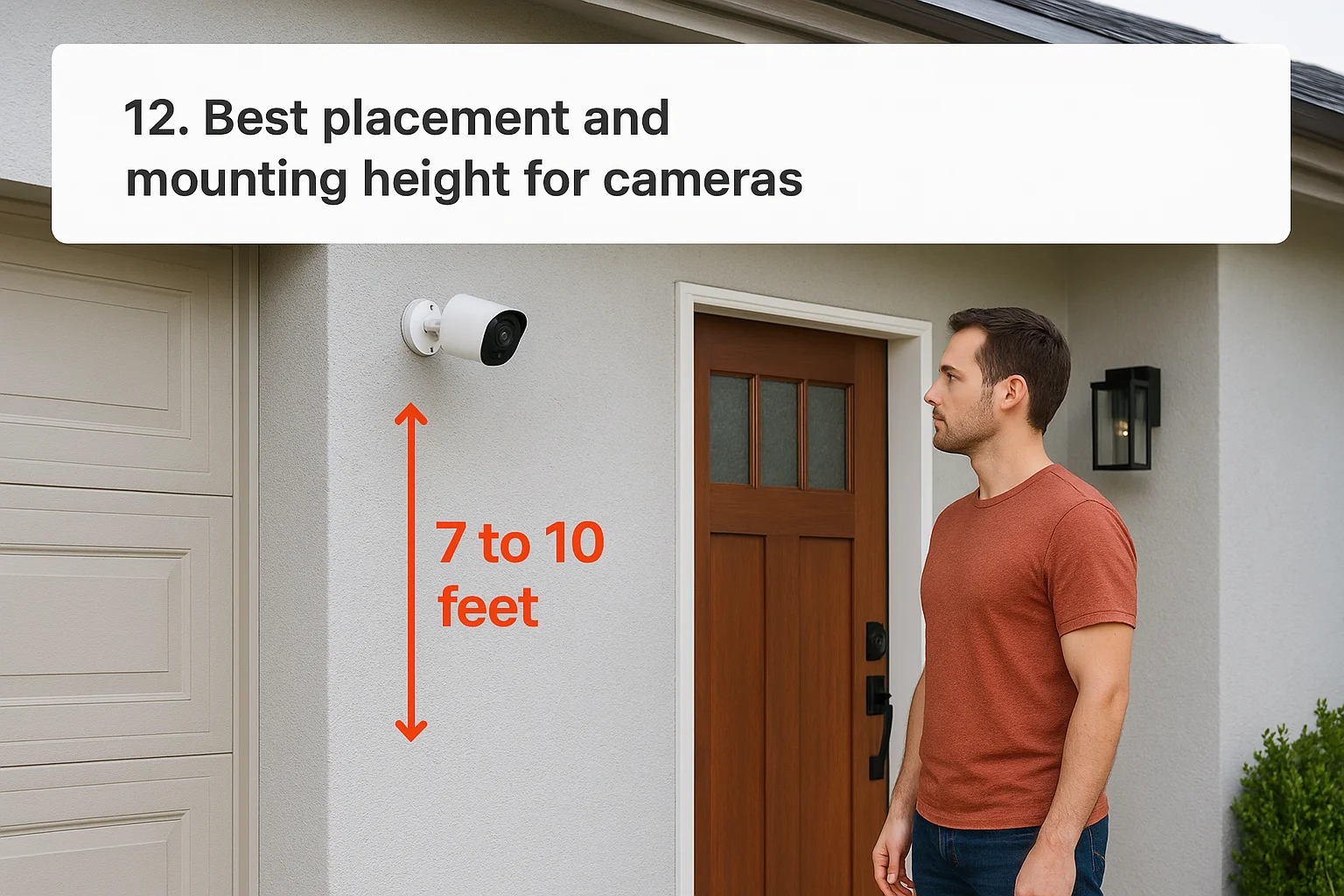
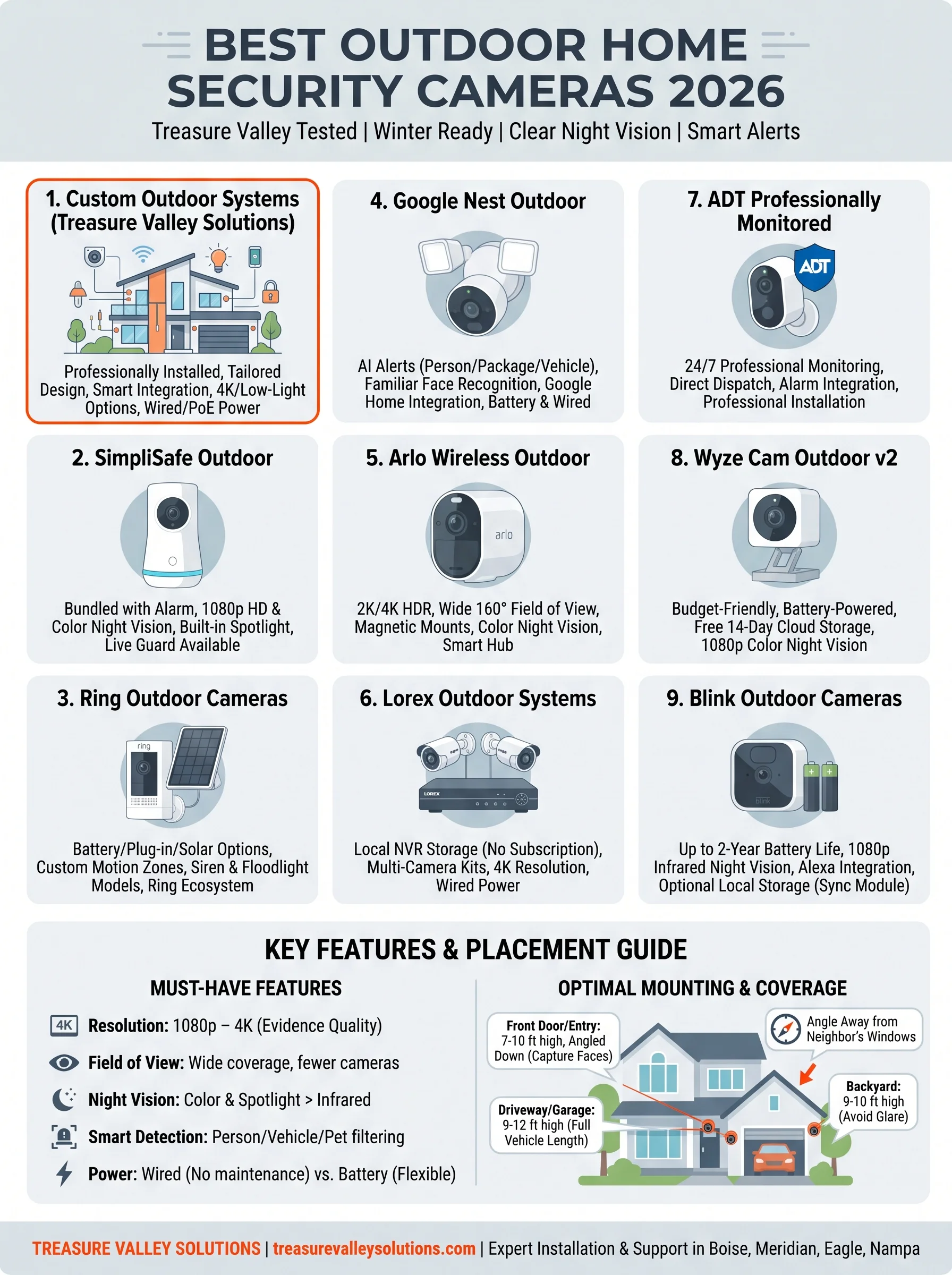
Mounting height determines whether your camera captures a usable face or just the top of someone's hat. Most installers aim for 7 to 10 feet off the ground at entry points like front doors and garages, high enough to avoid tampering but low enough to keep faces in frame. Driveways and backyards can go a bit higher, up to 12 feet, since you're covering distance rather than close-range detail. Angling the camera slightly downward, around 15 to 30 degrees, keeps the sky out of the shot and prevents backlighting from washing out faces during sunrise or sunset.
Coverage gaps cause more missed footage than bad camera quality ever does. Walk your property before drilling anything and note where outdoor security cameras for the home would actually catch foot traffic: front door, driveway entrance, side gates, and any detached structure like a shed or garage. Overlapping fields of view at corners eliminates blind spots where someone could slip past unseen.
A camera mounted at the wrong height gives you motion alerts without ever showing you a usable face.
A quick placement checklist we use on every install:
- Front door and porch: 7 to 9 feet, angled slightly down
- Driveway: 9 to 12 feet, wide field of view to catch full vehicle length
- Backyard and side yards: 9 to 10 feet, positioned to avoid direct sunlight glare
- Garage or shed doors: 8 to 9 feet, close enough for package or tool theft detail
- Second-story mounts: reserve for wide overview shots, not identification
Avoid pointing any camera directly into a streetlight or your own porch light, since glare at night creates more false alerts than it prevents. If you're unsure about sightlines on an irregular lot, a quick walkthrough with an installer catches blind spots faster than trial and error after the cameras are already drilled in.
13. Wired vs. wireless vs. solar-powered cameras
Power source shapes your maintenance schedule more than any other spec on this list. Wired cameras pull constant power, so they never drop offline because of a dead battery, but they require a cable run during installation, either to an outlet or a PoE switch. Wireless battery cameras skip that installation step entirely, which makes them the fastest option to get running, though you're signing up for a recurring charging chore every three to six months depending on activity levels at that spot.
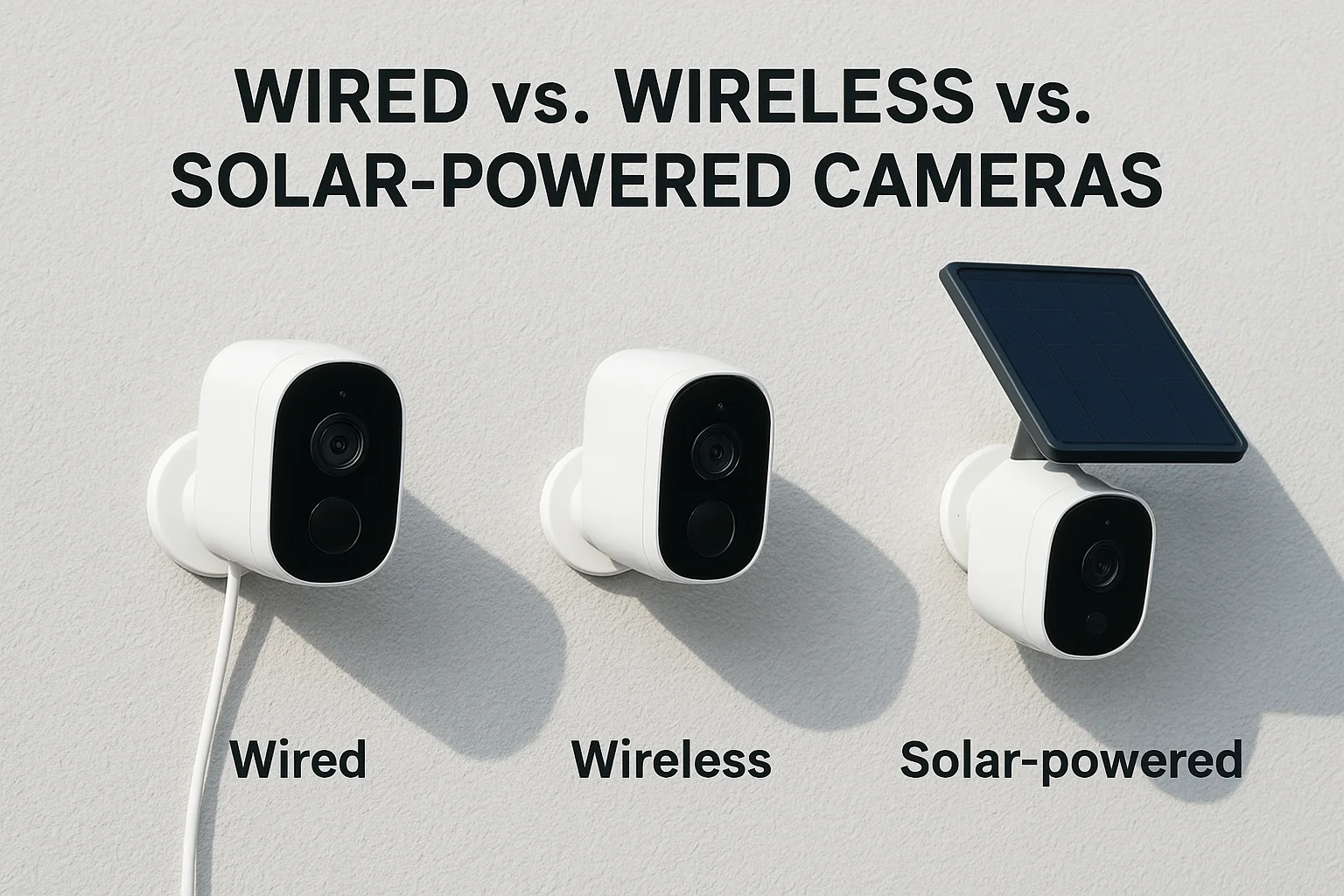
Solar-powered cameras split the difference, using a small panel to trickle-charge the battery so you rarely, if ever, pull the camera down to recharge it. This works well in Idaho for most of the year, but shorter winter daylight and snow covering the panel can drain the battery faster than the sun can refill it, so a south-facing mount with minimal obstruction matters more here than with any other setup.
Wired power removes one more thing you have to remember to maintain.
| Power type | Maintenance | Best for |
|---|---|---|
| Wired/PoE | None once installed | Permanent installs, high-traffic areas |
| Battery wireless | Recharge every 3-6 months | Rentals, flexible placement |
| Solar-powered | Occasional panel cleaning | Remote spots without nearby power |
Property layout usually decides this for you faster than preference does. A detached garage or back fence line far from any outlet practically demands battery or solar power, while a front porch near existing wiring makes a wired camera the easier, more permanent choice. If you're mixing power types across one property, which most larger installs do, map out which spots get daily sun exposure before committing a camera to solar, since a shaded corner will leave that unit undercharged no matter how good the panel is.
14. Outdoor security camera FAQs
Homeowners ask us the same handful of questions on nearly every install, so here are the answers that come up most often when someone is choosing outdoor cameras for home security.
Do outdoor security cameras need Wi-Fi to work?
Most consumer models need a working Wi-Fi or cellular connection to send alerts and store footage remotely, though some, like Lorex's NVR kits, record locally and only need internet for remote viewing. If your Wi-Fi signal is weak near the garage or back fence, a base station or mesh extender solves more problems than switching brands ever will.
How long do wireless camera batteries actually last?
Battery life ranges from a few months to nearly two years depending on the brand and how much motion the camera detects daily. Cameras placed near a busy sidewalk or street drain faster than ones covering a quiet side yard, so expect the low end of any manufacturer's estimate in a high-traffic spot.
Battery life claims assume light use, so a busy driveway camera will always need charging sooner than the box suggests.
Can police use my outdoor camera footage?
Yes, most departments accept footage from residential cameras as supporting evidence in theft or vandalism cases, and many local agencies now run voluntary camera registries to speed up requests. Saving footage locally or backing it up promptly matters here, since some cloud plans only retain clips for a limited window before they're overwritten.
Are outdoor cameras legal to point at a neighbor's yard?
Generally no. Courts and most local ordinances treat cameras aimed directly into a neighbor's private space, like a fenced backyard or bedroom window, as a privacy violation, so angle your cameras toward your own property lines instead.
Securing your home's exterior
Every camera on this list can catch a package thief or spot a prowler, but the right choice depends on your property, not the review score. A budget wireless kit solves a different problem than a whole-property camera system wired into your smart locks and lighting. Match the camera to your driveway, your entry points, and your actual tolerance for monthly fees, and you'll end up with coverage you trust instead of a gadget you second-guess every time the wind sets off a motion alert.
If you've read through this list and still aren't sure whether a DIY kit or a custom-installed system fits your home better, that's exactly the conversation we have with homeowners across Boise, Meridian, Eagle, and Nampa every week. We'll walk your property, point out the blind spots you'd miss on your own, and build a plan around what you actually need. Get in touch with our team to start that conversation.
Compare your options
Your next step
Plan Outdoor Camera PositionsReady for professional help? Request an estimateOur Services
High-definition surveillance for peace of mind.
Comprehensive security solutions for home and business.
Serving the Treasure Valley
Local installation in your city