 (208) 991-3502
 Meridian, ID



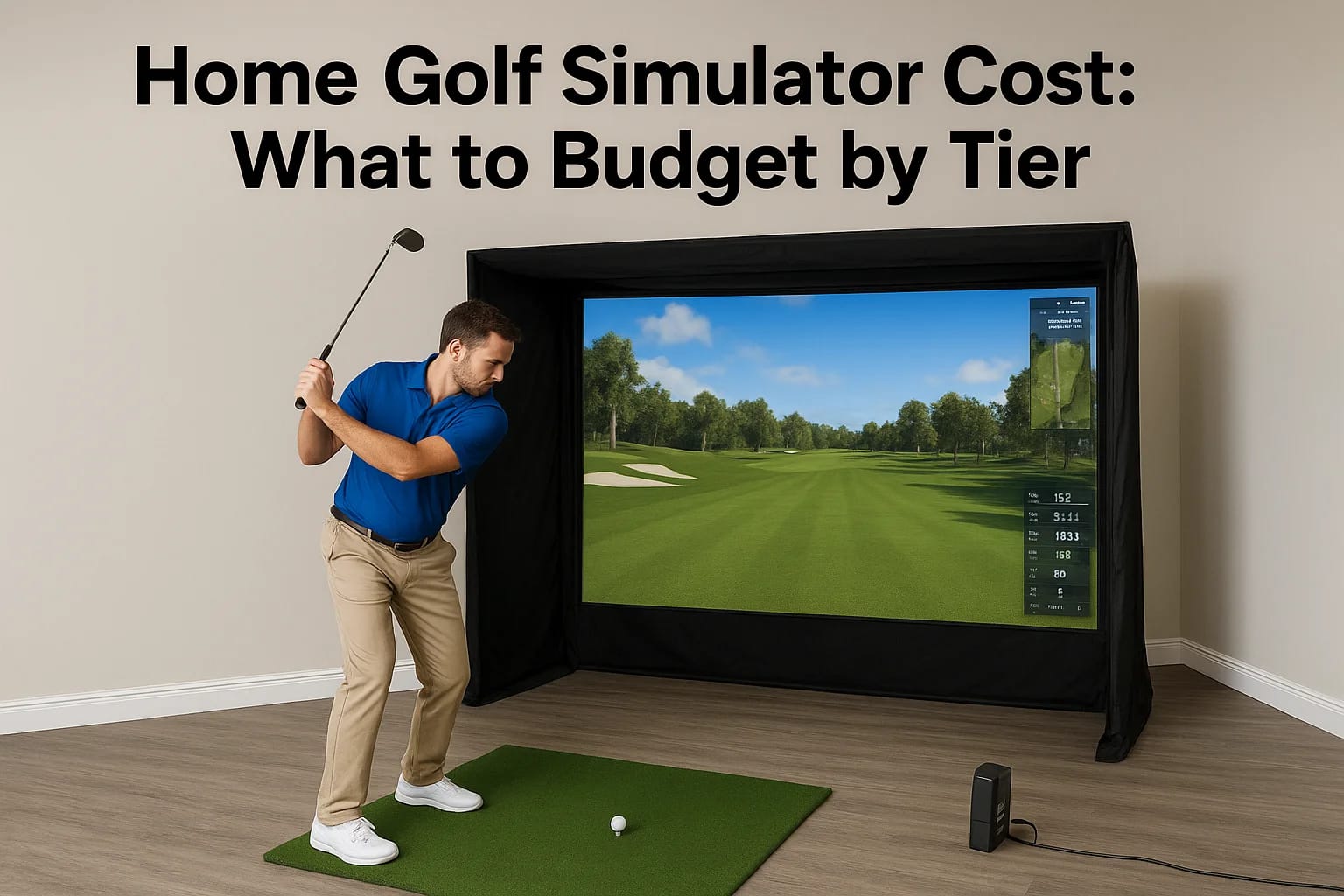

Pricing out a home golf simulator cost usually starts with a Google search and ends with more confusion than you started with. Some sites quote $2,000 packages, others show $50,000 rooms, and nobody e...
Pricing out a home golf simulator cost usually starts with a Google search and ends with more confusion than you started with. Some sites quote $2,000 packages, others show $50,000 rooms, and nobody explains why the gap is so wide. That gap comes down to launch monitor accuracy, projection quality, and whether you're paying someone to install it correctly or hoping a DIY setup holds together.
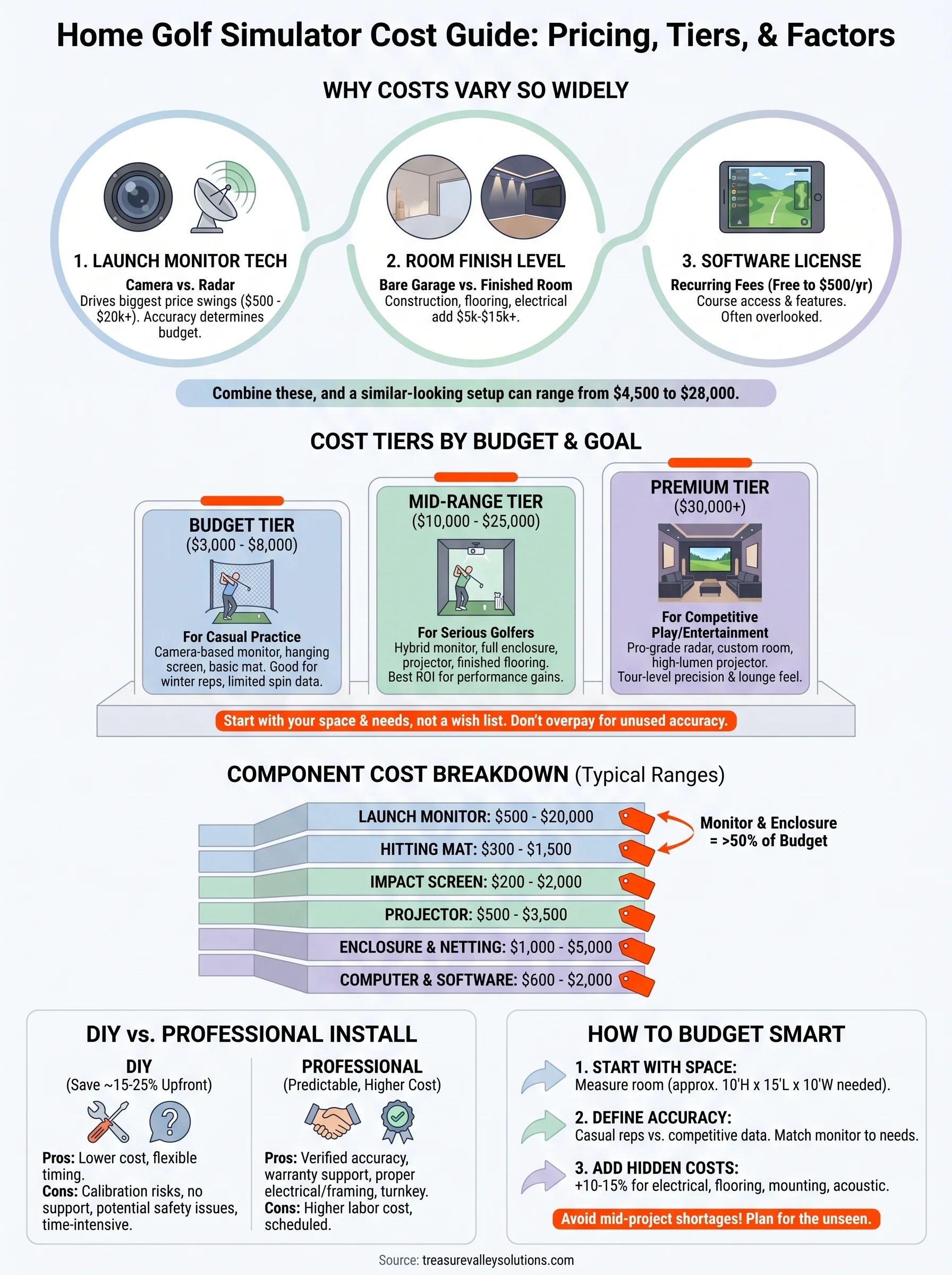
Here's the direct answer: budget setups run $3,000 to $8,000, mid-range builds land between $10,000 and $25,000, and premium rooms with enclosures, high-end projectors, and pro-grade launch monitors push past $30,000. Where you land depends on whether you want casual practice swings or tournament-level ball data, and whether the space needs finished walls, flooring, and proper lighting to feel like a real room instead of a garage corner.
Below, we break down exactly what you get at each tier, from entry-level enclosures to fully custom builds, plus the hidden costs like electrical work and screen mounting that most price lists skip. If you're in the Treasure Valley and want a simulator that's professionally installed rather than pieced together, this breakdown gives you the numbers to plan your budget before you call anyone.
Why home golf simulator costs vary so widely
Three factors create most of the price spread you see online: the launch monitor technology, the finish level of the room, and the software license you choose. Skip any one comparison and you'll end up comparing a $4,000 garage setup to a $40,000 media room and wondering why the numbers don't match.
Launch monitor technology drives the biggest price swings
Camera-based launch monitors read your swing and ball flight using high-speed cameras, while radar-based units track the ball's actual flight path through Doppler radar. Radar units like TrackMan or Foresight's radar line cost more because they capture spin rate, launch angle, and carry distance with tour-level precision, which is the heart of how accurate golf simulators really are. Camera-based options, such as entry SkyTrak or Mevo units, cost less but sacrifice some accuracy on spin and short-game shots, and it helps to compare the launch monitors built for simulator play side by side before committing. This single choice can swing your budget by $10,000 or more before you've touched the screen, projector, or enclosure.
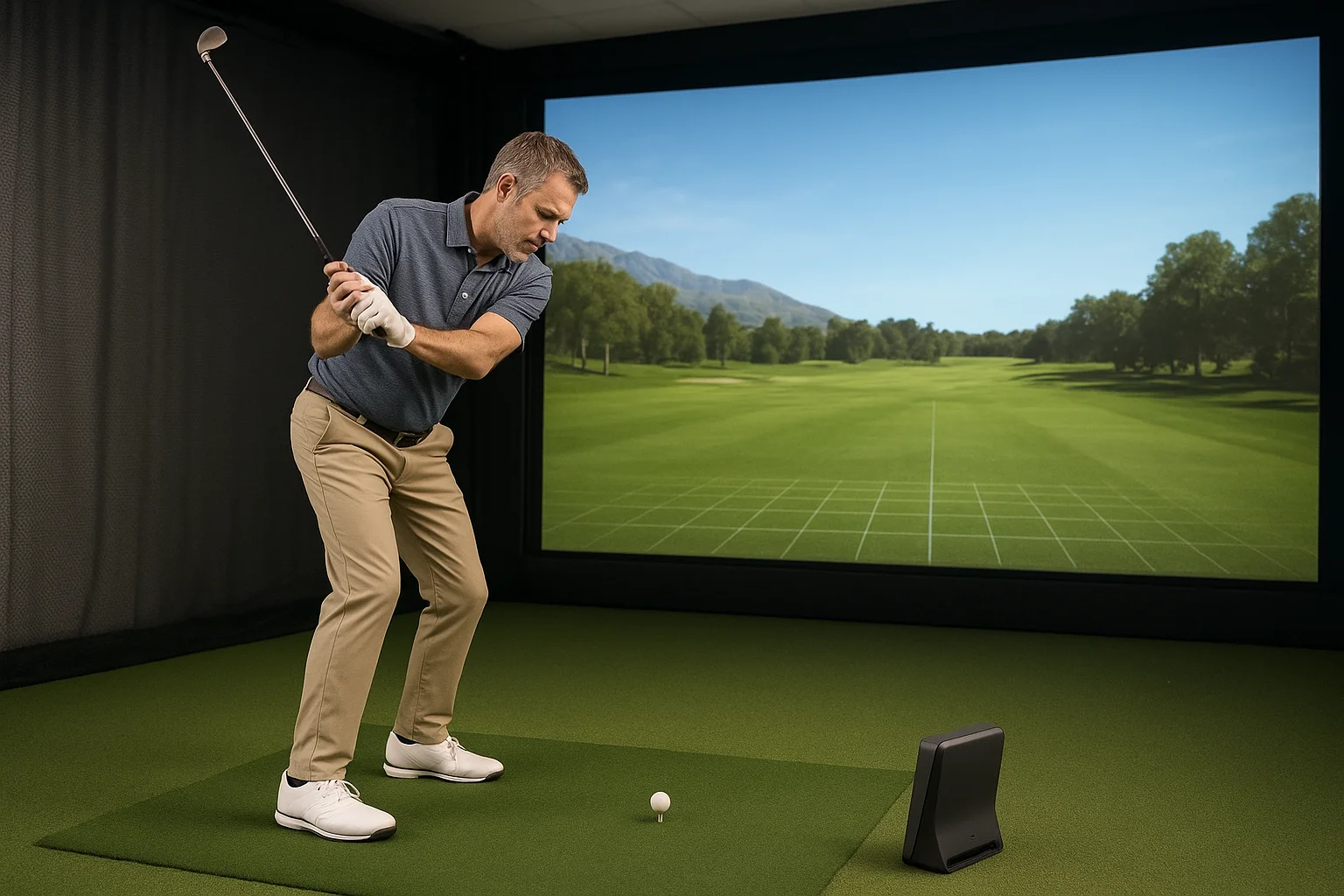
The launch monitor you pick determines your entire budget more than any other single decision.
| Launch Monitor Type | Typical Price Range | Accuracy Level |
|---|---|---|
| Entry camera-based | $500 - $2,000 | Good for practice, limited spin data |
| Mid-tier camera/radar hybrid | $2,000 - $6,000 | Solid for serious golfers |
| Pro-grade radar | $10,000 - $20,000+ | Tour-level precision |
Space size and finish level add up fast
A bare garage bay with a hanging screen costs almost nothing beyond the screen and mounting hardware. A finished room with acoustic panels, proper flooring, recessed lighting, and a built enclosure can add $5,000 to $15,000 before any golf equipment enters the picture. Builders and property managers often underestimate this line item because it looks like general construction rather than part of the golf simulator setup cost. Electrical work matters too. Most projectors and launch monitors need dedicated outlets, and some rooms need additional circuits to avoid tripping breakers during long practice sessions.
Software and course access change the math
Once the hardware is installed, you're paying for the golf itself. Simulator software licenses run from free (basic swing analysis) to $200-$500 per year for full course libraries with dozens of real-world layouts, and platforms like E6 Connect packages and pricing show how that fee structure works in practice. Some launch monitor brands bundle a year of software with the hardware purchase, then charge renewal fees that catch buyers off guard. This is one of the most overlooked pieces of the simulator golf cost puzzle, since it's a recurring expense rather than a one-time purchase.
Add these three variables together and you can see why one homeowner spends $4,500 while their neighbor spends $28,000 for what looks like a similar setup from the outside. The room, the tracking accuracy, and the ongoing software fees are doing all the heavy lifting behind that price tag.
How to budget for your home golf simulator
Budgeting for a simulator works backward from your goals, not forward from a price list. Start with your space and your actual practice needs, then let the equipment follow. Buying a $15,000 launch monitor for a garage bay you'll use twice a month wastes money you could put toward better projection or a proper enclosure.
Start with your space, not your wish list
Measure the room before you price anything. You need roughly 10 feet of ceiling height, 15 feet of length, and 10 feet of width for a comfortable swing with mid-irons and driver. Cramped rooms force compromises on screen distance and swing safety, and no launch monitor fixes that. Golf simulator dimensions dictate screen size, projector throw distance, and whether you need a full enclosure or just a hanging screen and net.
Decide what data actually matters to your game
Casual golfers who want reps in the winter don't need TrackMan-level spin data. Competitive players chasing a lower handicap do. Be honest about this before you shop, because launch monitor pricing scales directly with accuracy, and overpaying here is the single fastest way to blow a budget.
Buy the accuracy your game actually needs, not the accuracy the marketing pushes.
Build in the hidden costs before you shop
Electrical, flooring, and mounting hardware rarely show up in the sticker price of a launch monitor or projector bundle. Plan for these before you commit to a number:
- Dedicated electrical circuit: $300-$800
- Flooring (turf or hitting mat): $200-$1,500
- Screen and enclosure mounting hardware: $300-$1,200
- Acoustic treatment for noise control: $500-$2,000
Adding 10 to 15 percent on top of your hardware quote for these line items keeps you from running short mid-project, something we see on nearly every golf simulator installation in Boise. Every homeowner we've worked with in the Treasure Valley who skipped this step ended up back at the store buying an outlet extension or a roll of turf they hadn't budgeted for.
Home golf simulator cost by budget tier
Most buyers fall into one of three brackets once you separate the marketing fluff from the actual hardware and labor involved, which our full 2026 home setup price breakdown walks through line by line. Knowing which tier fits your goals before you start browsing keeps you from overspending on features you won't use or underspending on a launch monitor that frustrates you within a month.
| Tier | Total Cost | What You Get |
|---|---|---|
| Budget | $3,000 - $8,000 | Camera-based monitor, hanging screen, basic mat |
| Mid-range | $10,000 - $25,000 | Hybrid monitor, enclosure, projector, finished flooring |
| Premium | $30,000+ | Radar launch monitor, custom room, high-lumen projector |
Budget tier: $3,000 to $8,000
This range gets you a functional setup for winter practice and casual games with friends. Expect an entry camera-based launch monitor, a hanging impact screen, a basic hitting mat, and a consumer projector you likely already own or can source cheap. Accuracy on spin and short-game shots suffers at this price point, so treat it as a swing-improvement tool rather than a data lab.
Mid-range tier: $10,000 to $25,000
Here the picture sharpens, both literally and in terms of tracking data. You're looking at a hybrid camera/radar monitor, a proper enclosure with side and back netting, a short-throw projector built for simulator use, and finished flooring that handles heavy foot traffic. Most serious golfers land in this bracket because it balances golf simulator installation cost against real performance gains without chasing tour-level specs you'll never use.
Most homeowners get the best return on investment sitting squarely in the mid-range tier.
Premium tier: $30,000 and up
Premium builds add pro-grade radar monitors like TrackMan, custom cabinetry, acoustic treatment, and projectors bright enough to compete with ambient light. Rooms at this level often include finished walls, recessed lighting, and seating that makes the space feel like a lounge rather than a garage bay. This tier suits competitive players and anyone building a dedicated entertainment room where the simulator is the centerpiece, not an afterthought.
What each simulator component costs
Breaking a simulator down into its individual pieces makes it obvious where your money actually goes. Six components make up nearly every build, and each one has its own price range depending on quality and brand.
Launch monitor and hitting mat
The launch monitor is still the single biggest line item in most budgets, running from $500 for entry camera units to $20,000 for tour-grade radar systems for indoor golf play. Pair it with a hitting mat built for repeated impact, since a cheap mat wears through in months and throws off swing feel. Quality mats with turf zones and rough simulation run $300 to $1,500.
Screen, projector, and enclosure
Your impact screen for a home setup needs to handle full-speed shots without bouncing balls back at you, and prices range from $200 for a basic hanging screen to $2,000 for a tensioned, seamless model. Projectors add another $500 to $3,500 depending on lumens and short-throw capability, since dim or poorly placed projectors wash out in daylight rooms, so it pays to weigh the best projector picks for any budget. An enclosure kit for garages and rooms with side netting and framing typically adds $1,000 to $5,000, and this is where golf simulator installation cost estimates often go wrong, since framing labor gets quoted separately from the netting itself.
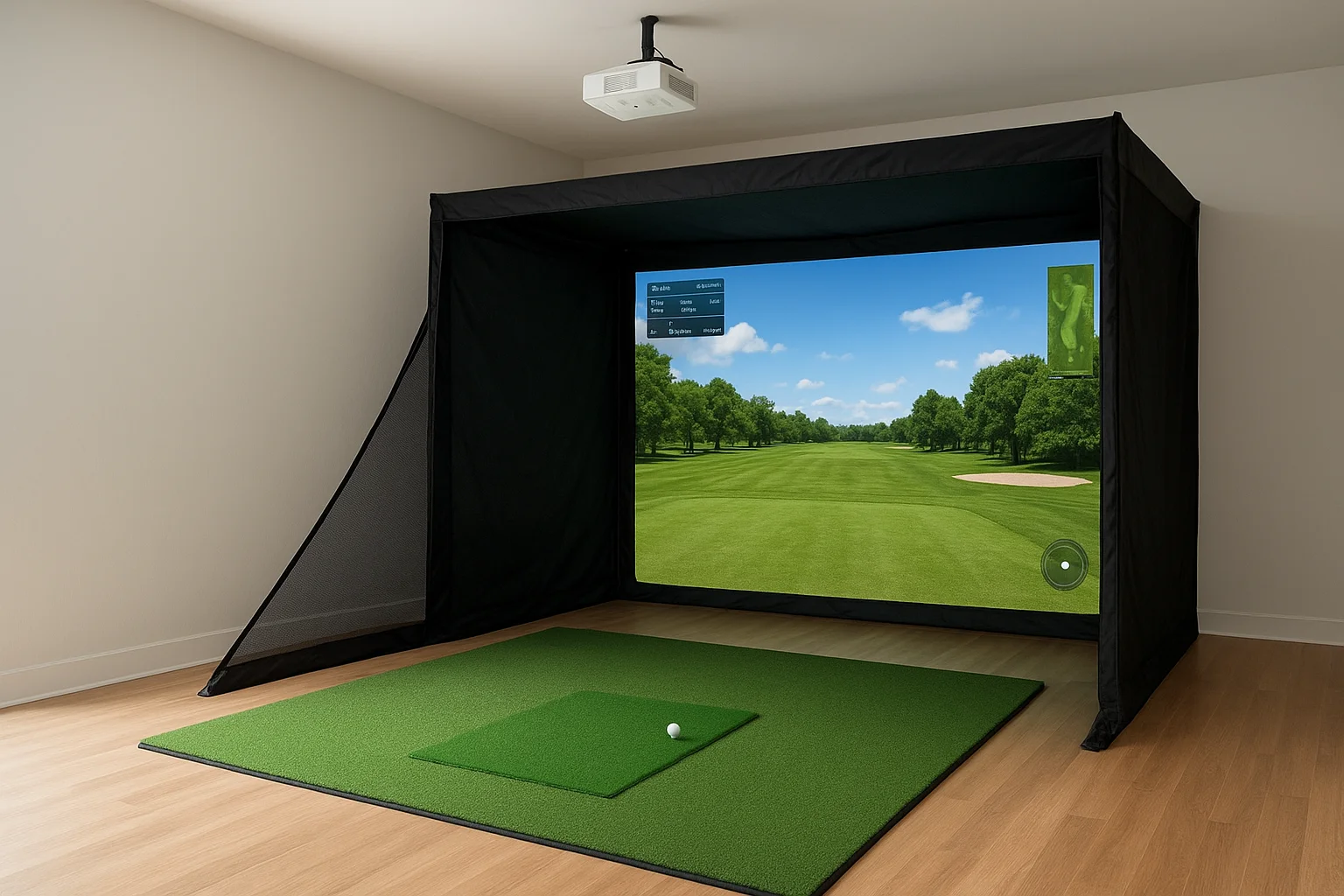
The launch monitor and enclosure together usually eat more than half your total budget.
Flooring, computer, and software
A dedicated computer to run simulator software costs $600 to $1,500 if you don't already have a suitable machine, and it needs enough graphics power to render courses smoothly. Flooring underneath the mat, whether turf or rubber matting, adds $200 to $1,000 depending on room size.
| Component | Typical Cost Range |
|---|---|
| Launch monitor | $500 - $20,000 |
| Hitting mat | $300 - $1,500 |
| Impact screen | $200 - $2,000 |
| Projector | $500 - $3,500 |
| Enclosure and netting | $1,000 - $5,000 |
| Computer and software | $600 - $2,000 |
See how these stack up before you commit to any single vendor's bundle price, since bundles often hide markup on the weakest component.
DIY build vs. professional installation costs
Buying every component yourself and installing it on a weekend saves money upfront, but it also shifts every risk onto you. DIY builds typically run 15 to 25 percent cheaper than professional installs on paper, until something goes wrong with mounting, calibration, or wiring and you're troubleshooting alone with no support line to call.
What DIY actually saves and costs
Going solo cuts labor costs entirely, and you can source components on sale over months instead of buying a bundle at once. But calibration errors are common with camera-based monitors, and a screen mounted six inches too close throws off swing analysis for months before anyone notices. Framing an enclosure without proper bracing also risks sagging netting that lets balls escape, which turns into a safety problem fast in a finished basement.
A DIY simulator that's miscalibrated costs you more in bad data than the labor you saved installing it.
What professional installation adds
Hiring a team for the golf simulator installation cost covers more than mounting a screen. It includes proper electrical planning, calibrated launch monitor placement, enclosure framing rated for repeated impact, and a walkthrough on using the software before you ever swing a club, all part of what a professional simulator install actually covers. Treasure Valley Solutions builds this into every project through our home theater and simulator installation services, so the room gets tested and tuned before we hand you the remote.
| Factor | DIY | Professional Install |
|---|---|---|
| Upfront cost | Lower by 15-25% | Higher, but predictable |
| Calibration accuracy | Variable, self-taught | Verified on-site |
| Warranty support | Often voided by self-install | Preserved |
| Time investment | 20-40 hours typical | 1-3 days scheduled |
| Ongoing support | None | Included or available |
Property managers and builders partnering with us on new construction in particular tend to skip DIY entirely, since a botched install in a spec home or rental unit becomes a liability nobody wants to explain to a buyer or tenant. Weigh the hours you'll actually spend troubleshooting against what a licensed install costs, and the math often favors professional work more than the sticker price suggests.
Finding your ideal simulator budget
Your home golf simulator cost ultimately comes down to three honest questions: how much accuracy your game demands, how finished you want the room to feel, and whether you're willing to gamble on a DIY install to save a few thousand dollars upfront. Budget setups get casual golfers off the couch in winter. Mid-range builds satisfy most serious players without chasing specs they'll never use. Premium rooms make sense when the simulator is the centerpiece of the house, not a garage afterthought.
Skip the guesswork and get numbers specific to your space instead of averages pulled from a spreadsheet. Treasure Valley Solutions has installed these systems across the Treasure Valley since 2014, and we can walk your room, talk through your goals, and quote real hardware instead of bundled markups. Learn more about our golf simulator installation services and start planning your build.
Need Expert Help?
Ready to implement these solutions in your own home or business?
Our Services
View All Services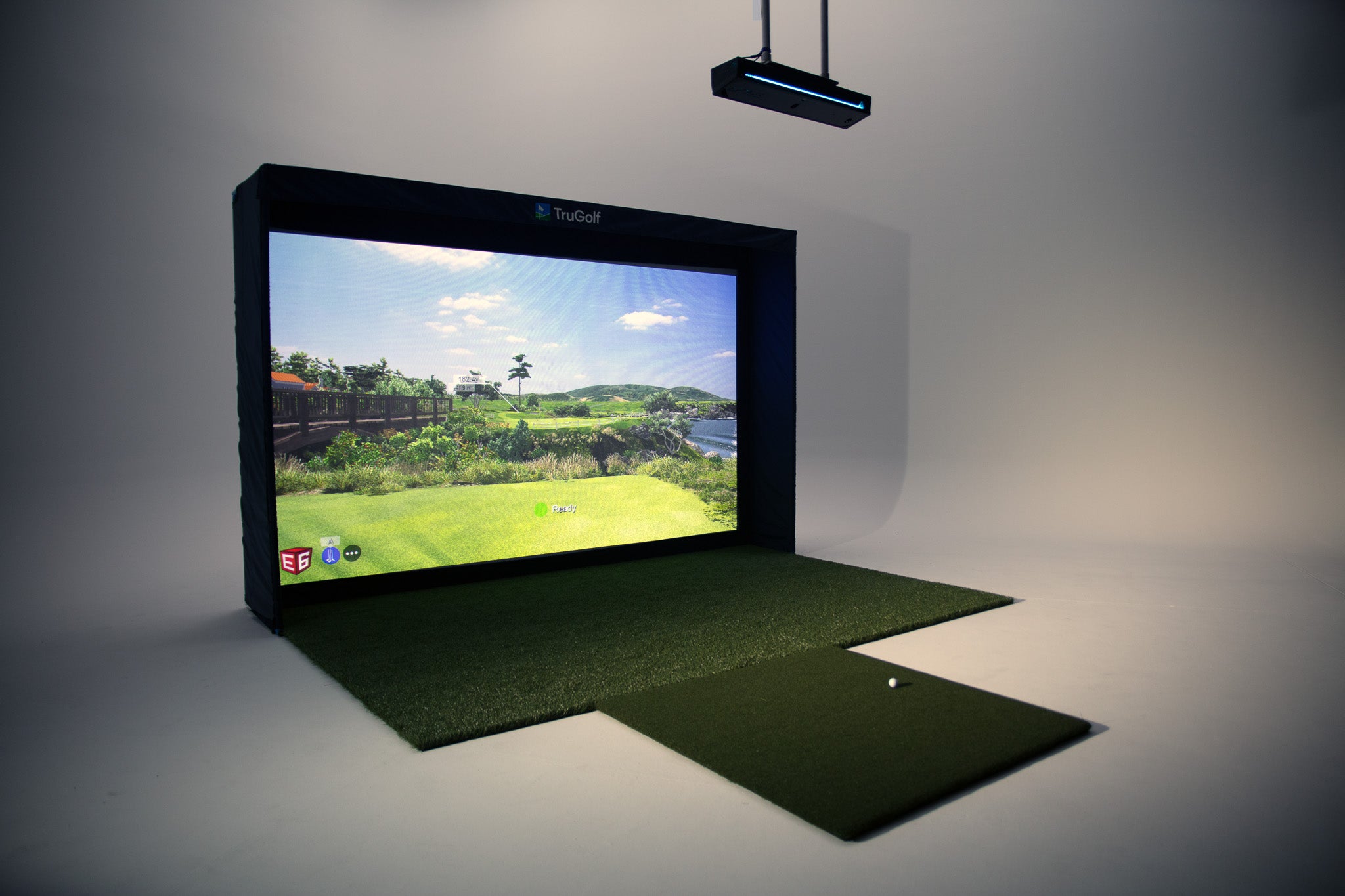
Serving the Treasure Valley
Local installation in your city