 (208) 991-3502
 Meridian, ID



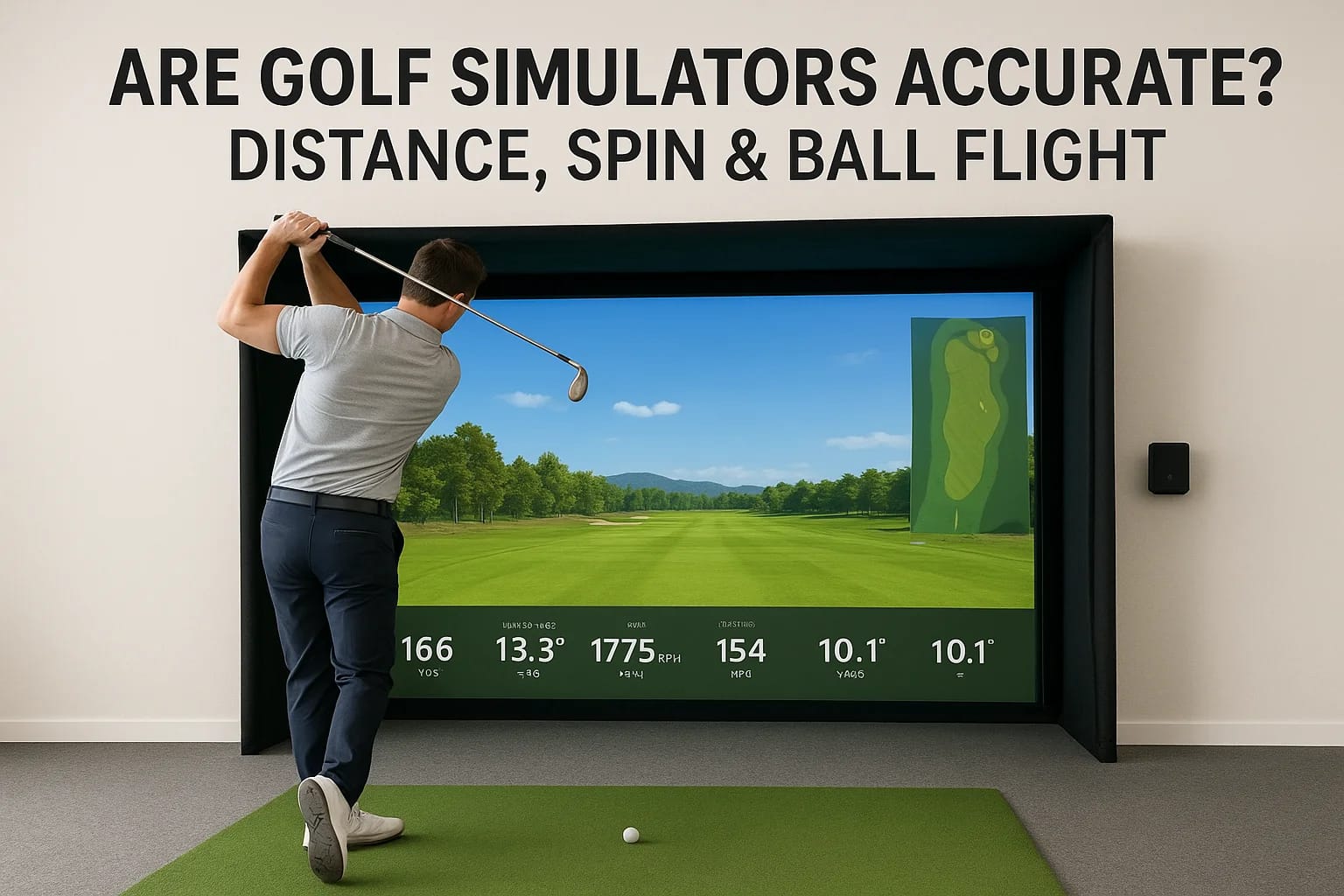

If you're considering a golf simulator for your home or commercial space, the first question worth asking is simple: are golf simulators accurate enough to justify the investment? After all, a simulat...
Are Golf Simulators Accurate? Distance, Spin & Ball Flight
If you're considering a golf simulator for your home or commercial space, the first question worth asking is simple: are golf simulators accurate enough to justify the investment? After all, a simulator that doesn't reliably track distance, spin, and ball flight isn't much more than an expensive video game.
The short answer is yes, modern golf simulators can be remarkably accurate, but the degree of precision depends heavily on the launch monitor technology, the quality of the installation, and how well the system is calibrated to your space. Not all setups are created equal, and cutting corners on hardware or installation can undermine the data you're relying on to improve your game.
At Treasure Valley Solutions, we design and install custom entertainment and AV systems across the Boise and Meridian area, including dedicated golf simulator rooms built for optimal sensor performance and an immersive experience. We've seen firsthand how much the installation environment matters. This article breaks down what affects simulator accuracy, how different tracking technologies compare, and what you should expect from distance, spin, and ball flight data before you commit.
What accuracy means in a golf simulator
When someone asks are golf simulators accurate, they're usually asking whether the numbers on screen match what would happen on a real course. But accuracy in a simulator actually covers several distinct layers: the precision of the raw sensor data, how well the software translates that data into a simulated shot, and whether the resulting ball flight reflects what you'd see outdoors. Getting all three right is what separates a reliable setup from one that breeds false confidence in your game.
Data accuracy vs. real-world feel
Raw data accuracy refers to how closely the simulator measures your actual club and ball metrics, including clubhead speed, launch angle, spin rate, and ball speed. These numbers feed directly into the simulation engine, so a sensor that misreads your spin rate by even a small margin will produce a virtual shot that curves differently than it would on a real fairway. Real-world feel is a separate matter entirely: even the most data-accurate simulator cannot replicate wind resistance, uneven turf, or the physical feedback you get through your feet and hands when you strike a ball outdoors. Recognizing this distinction helps you set realistic expectations before you invest.
The most useful way to think about simulator accuracy is as data reliability, not physical replication of outdoor conditions.
Distance, spin, and ball flight as accuracy benchmarks
Golfers typically judge simulator performance by three specific outputs: carry distance, spin rate, and ball flight shape. Carry distance tells you how far the ball travels before it lands, and even a consistent 5-yard error can skew your club selection habits over time. Spin rate determines how the ball curves and how it reacts post-landing, while ball flight shape shows you whether your swing produced the draw, fade, or straight flight you intended.
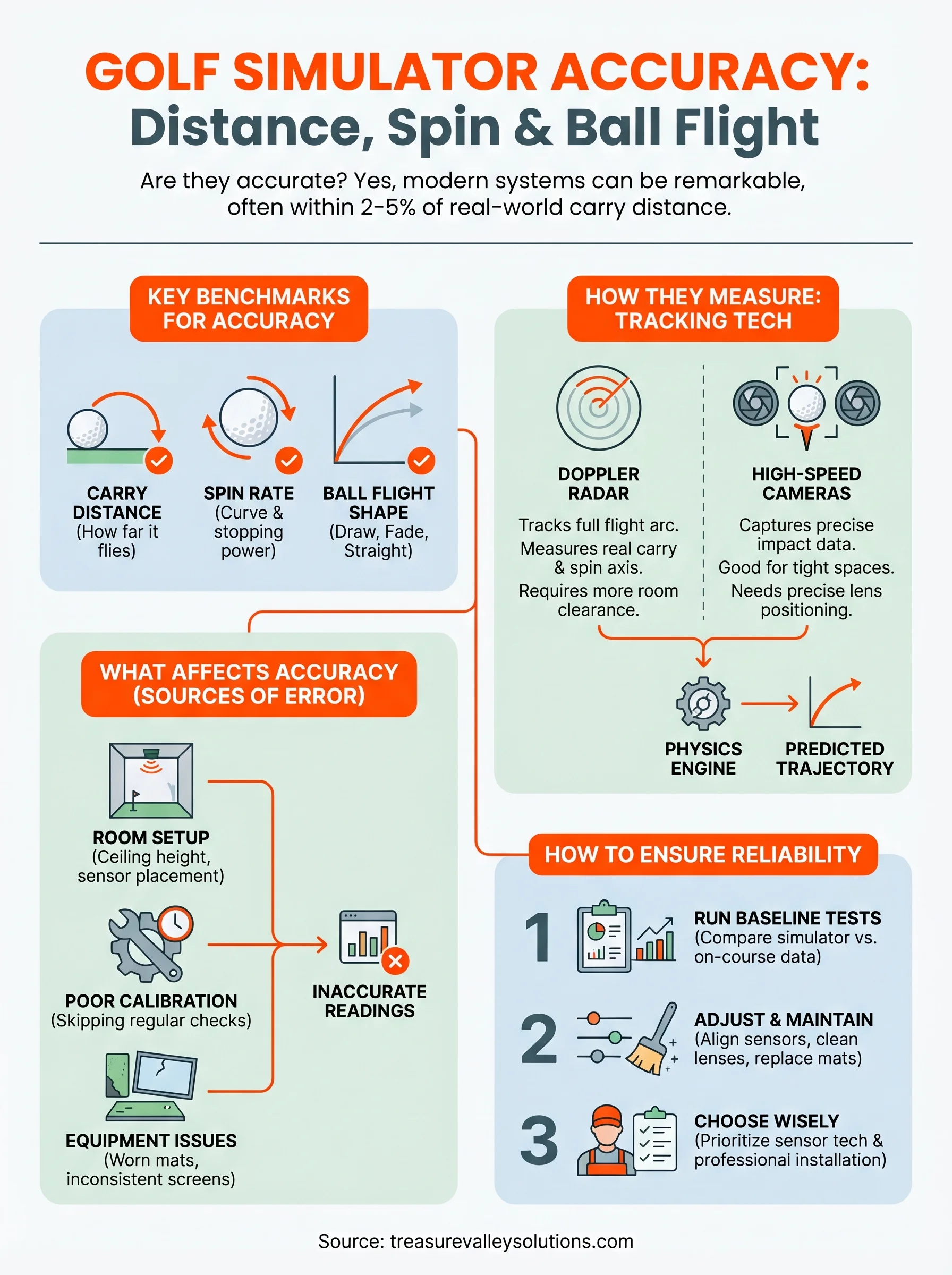
When all three outputs consistently align with your tracked on-course performance, you can trust the simulator as a genuine practice and analysis tool rather than a rough approximation. Top-tier systems using Doppler radar or high-speed camera technology typically come within 2 to 5 percent of real-world distance measurements, which is close enough for meaningful practice and club fitting decisions.
How simulators measure distance, spin, and ball flight
Understanding how your simulator captures data helps you evaluate whether the system deserves your trust for practice. Most simulators rely on one of two core technologies: Doppler radar or high-speed cameras. Each approach has distinct trade-offs in terms of cost, space requirements, and measurement precision.
Radar vs. camera-based tracking
Radar-based systems emit microwave signals that track the ball from impact through its full flight arc, measuring real carry distance and spin axis with high consistency outdoors and indoors. Camera-based systems use multiple high-speed lenses positioned around the impact zone to capture club and ball data at the moment of contact. Here is how they compare at a basic level:
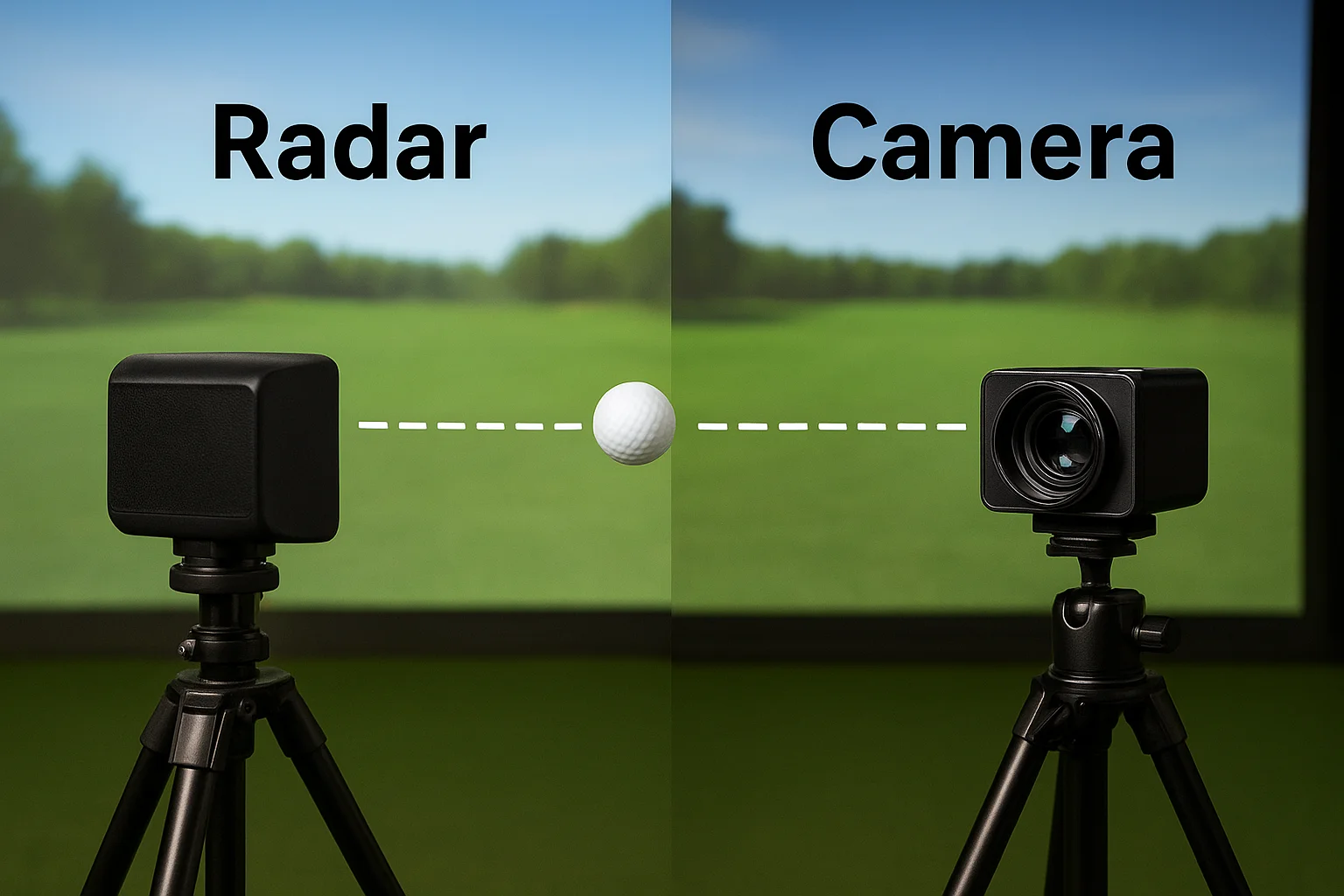
- Radar: Stronger at tracking full ball flight; requires more clearance in the room
- Camera: Better suited for tight indoor spaces; excels at capturing precise impact data
From raw data to simulated ball flight
Once the sensor captures your shot, the software processes launch angle, ball speed, and spin rate to calculate the predicted trajectory. This is where asking "are golf simulators accurate" gets more nuanced, because the simulation engine applies physics models that approximate real-world aerodynamics.
The quality of both the sensor hardware and the physics engine determines whether your simulated ball flight reflects your actual swing tendencies.
Better physics models produce trajectories that more closely mirror outdoor conditions, which makes higher-end systems worth the added investment if you rely on the data for club fitting or swing coaching.
What causes inaccurate simulator readings
Even if you ask are golf simulators accurate as a general question, the better question is what specific factors introduce error in your particular setup. Several variables can compromise the data quality of even a well-reviewed system, and most of them come down to installation choices and ongoing maintenance rather than flaws in the underlying technology.
Room setup and sensor placement
The physical environment plays a bigger role in measurement precision than most buyers expect. Ceiling height, screen distance, and sensor positioning all affect how cleanly a radar or camera system captures ball data. A radar unit mounted too low or angled incorrectly can miss critical spin axis data, while a camera placed outside its optimal range produces blurry impact frames that the software has to estimate rather than read directly.
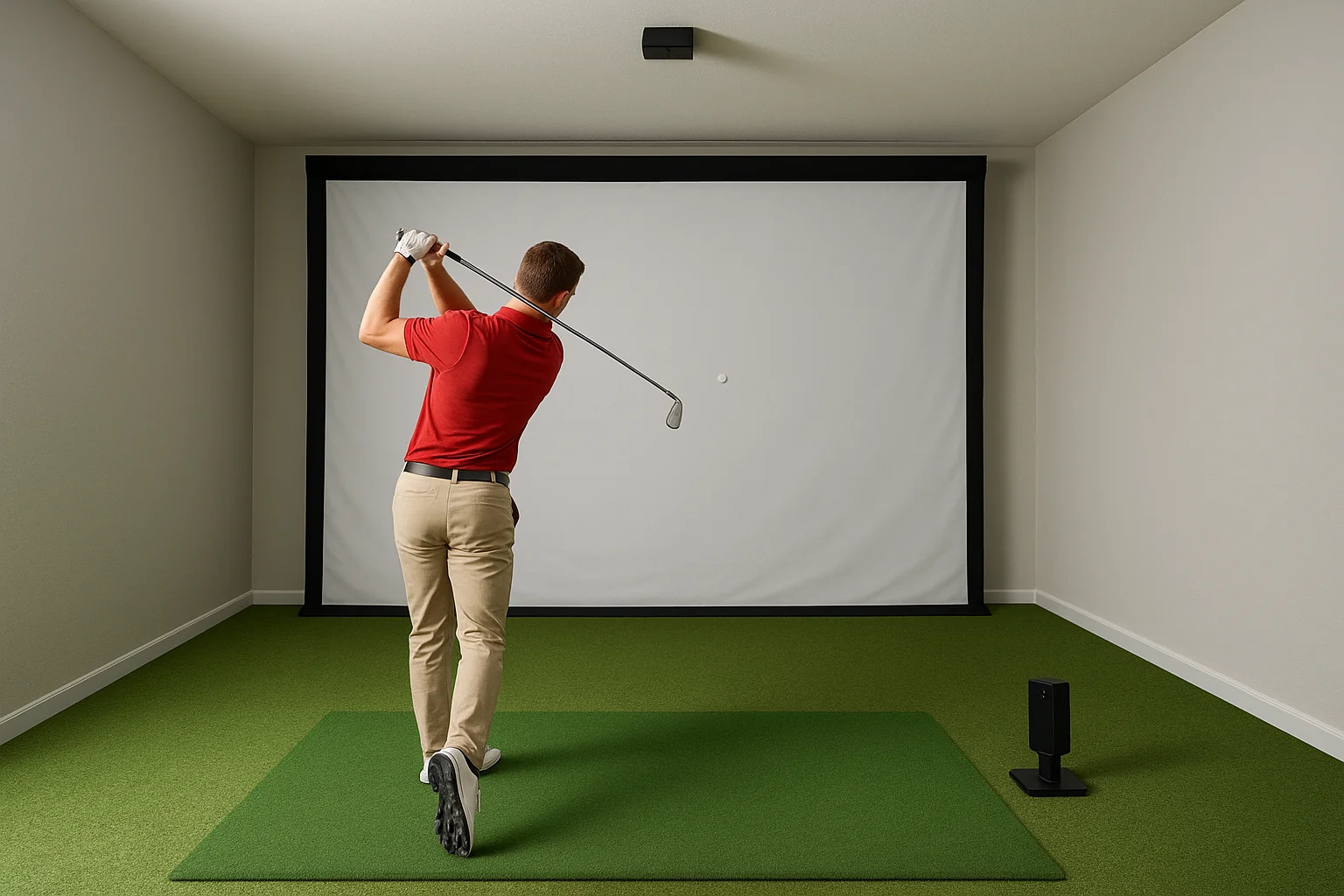
Getting your room dimensions and sensor placement right from the start is the single most reliable way to protect data accuracy.
Equipment and calibration issues
Worn or dirty hitting mats and impact screens introduce inconsistencies that the sensor cannot fully compensate for. A mat that sits unevenly changes your launch angle at contact, and a screen with inconsistent tension can scatter camera readings.
Regular calibration checks ensure the system continues to measure your actual swing rather than drifting over time. Skipping calibration, even on a quality system, compounds small errors into misleading data that quietly distorts your practice sessions without you noticing.
How to test and improve simulator accuracy
Before you accept your simulator's readings as reliable, run a few deliberate tests to confirm the data matches your real-world performance. If you're still wondering are golf simulators accurate for your specific setup, a structured comparison between simulator output and on-course measurements gives you a concrete answer rather than a general one.
Run baseline comparison shots
Start by hitting a set of 10 to 15 shots with each of your key clubs on an actual range that uses a launch monitor or trackman unit, and record your average carry distance, spin rate, and ball flight shape. Then replicate those same shots in your simulator and compare the results side by side. Consistent gaps between the two data sets tell you where your system needs adjustment, whether that is a sensor recalibration or a software settings correction.
A gap larger than 5 yards on average carry distance is a clear signal that your sensor placement or calibration is off.
Adjust and maintain your setup
Once you identify discrepancies, check sensor alignment and hitting mat condition first, since both are common sources of drift. Mats that compress unevenly over time alter your launch angle at impact, which cascades into inaccurate distance and spin readings. Cleaning camera lenses monthly and recalibrating your system every few months keeps the data tight and your practice sessions honest.
How to choose a simulator you can trust
When you're evaluating whether are golf simulators accurate for your specific use case, the buying decision comes down to two factors: the sensor technology inside the unit and the quality of the installation environment. A top-rated system installed carelessly in an undersized room will underperform a mid-tier system set up correctly every single time.
Prioritize sensor technology over software features
Marketing materials for simulators tend to spotlight graphics quality and course libraries, but those features have no bearing on data accuracy. Focus instead on whether the unit uses Doppler radar or a multi-camera array with a documented accuracy rating. Before you commit, ask the vendor these basic questions:
- What is the measured carry distance accuracy in yards?
- Has the system been independently benchmarked against on-course data?
- What calibration process does the manufacturer recommend and how often?
The sensor hardware determines whether your practice data reflects your real swing, not the number of courses in the software library.
Factor in room dimensions and professional setup
Your room size directly affects which systems are even viable for your space. Radar-based units need adequate ceiling height and throw distance to capture full ball flight data, while camera systems work in tighter rooms but require precise lens positioning during installation.
Skipping professional setup consistently produces measurement drift that undermines the data quality you're paying for, turning strong hardware into a system you can no longer rely on for accurate feedback.
Next steps
The question are golf simulators accurate doesn't have one universal answer, but it does have a clear framework. Sensor technology, room setup, and professional calibration determine whether the distance, spin, and ball flight data you see on screen reflects your real swing. A well-chosen system installed correctly in a properly sized room gives you reliable data you can actually use to improve your game.
Your next move is to get a realistic picture of what your space can support before you commit to any system. Room dimensions, ceiling height, and sensor placement requirements vary significantly between radar and camera-based units, and matching the right technology to your specific room saves you from expensive mistakes. If you're planning a dedicated simulator room in your home or commercial space in the Boise and Meridian area, the team at Treasure Valley Solutions can help you design and install a setup built for real performance. See examples of our completed projects to get a sense of what a professional installation looks like.
Need Expert Help?
Ready to implement these solutions in your own home or business?
Our Services
View All Services
Serving the Treasure Valley
Local installation in your city