 (208) 991-3502
 Meridian, ID



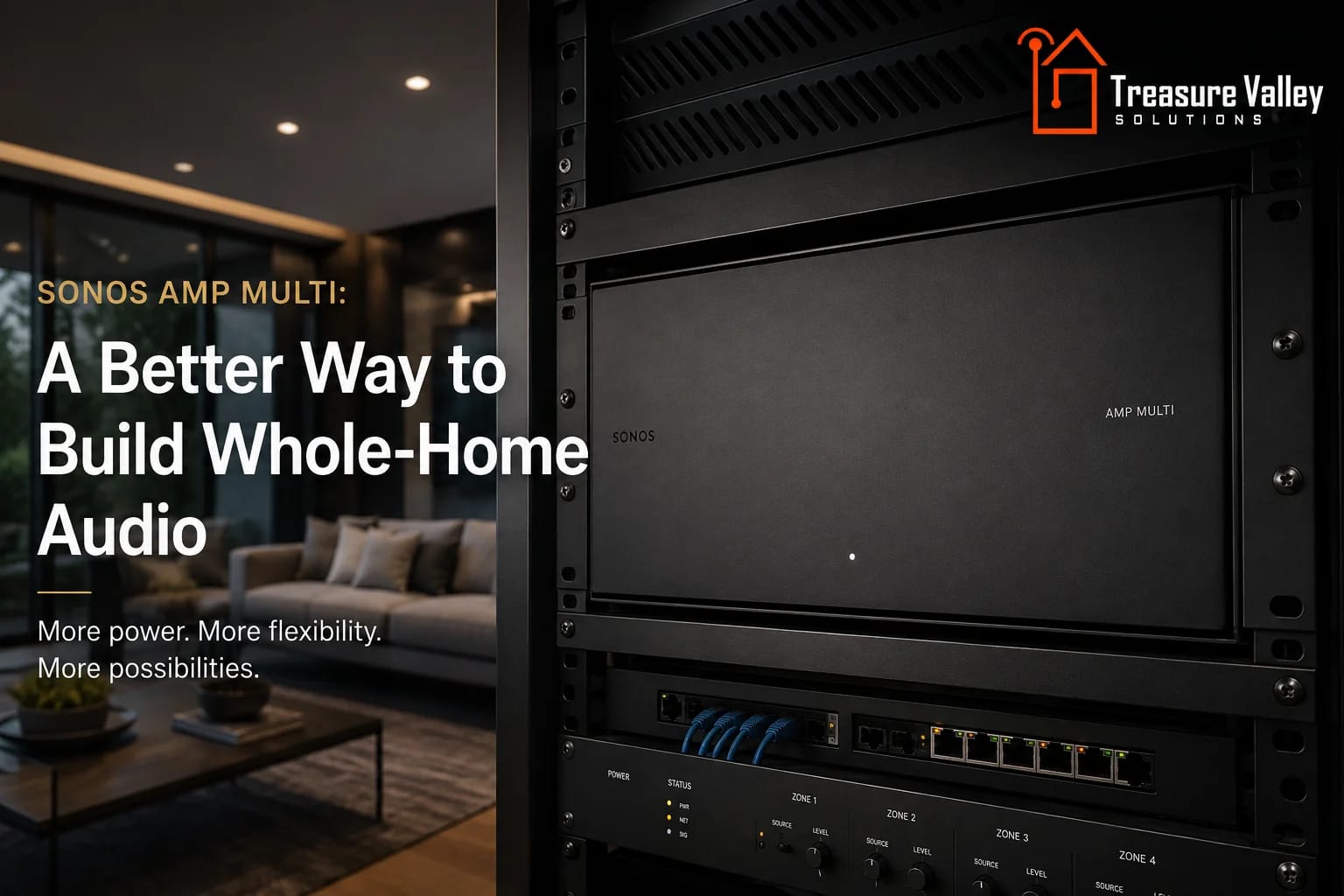

Sonos Amp Multi brings a new level of flexibility to professionally designed whole-home audio. With eight amplified outputs, up to four independent zones, and powerful tuning capabilities, it gives us more freedom to design audio around the unique needs of each space. The result is a cleaner, more scalable system behind the scenes while keeping the simple Sonos experience you already know. See why we think Amp Multi is a better way to build whole-home audio.
Whole-home audio sounds simple enough: put speakers throughout the house and make it easy to play whatever you want, wherever you want.
Behind the scenes, however, designing a great whole-home audio system takes considerably more thought.
Different rooms have different requirements. A kitchen with two in-ceiling speakers isn't the same as a large great room with six speakers. An outdoor living space presents completely different challenges than a bedroom. Some areas need independent control, while others should operate together. And all of that equipment needs to be powered, connected, cooled, configured, and ideally organized neatly in one location.
That's why we're excited about the new Sonos Amp Multi.
Sonos has taken many of the things we've always liked about the Sonos ecosystem and built a new amplifier specifically for larger, professionally installed audio systems.
Amp Multi gives us eight amplified outputs delivering 125 watts per channel, with those outputs configurable across as many as four independent audio zones. More importantly, it gives us considerably more flexibility in how we design those zones.
For our customers, that means we can build larger and more capable Sonos systems while keeping the experience of actually using them remarkably simple.
What Is Sonos Amp Multi?
At first glance, it would be easy to describe Amp Multi as an eight-channel version of the Sonos Amp.
Technically, that's not wrong.
But it misses what makes this product interesting.
The standard Sonos Amp is a two-channel amplifier. It's a product we've used to power everything from in-ceiling speakers to outdoor audio, and it remains a great solution for the right application.
Amp Multi is designed differently.
It has eight amplified outputs, each delivering 125 watts at 8 ohms with all channels driven. We can assign those outputs in different combinations across up to four independent Sonos zones.
That flexibility is the big deal.
Instead of designing a system around the limitations of individual two-channel amplifiers, we can configure the amplifier around the actual needs of the house.
What Does a "Zone" Actually Mean?
This is one of those terms we use every day that isn't necessarily obvious if you don't work with audio systems.
A zone is essentially an independently controlled audio area.
Your kitchen could be one zone. Your great room could be another. Your patio could be another. Your primary bedroom could be another.
Each can play something completely different at a different volume.
Or you can group them together and have the same music playing throughout the house.
Amp Multi can handle up to four of those independent zones from a single unit.
So, for example, we could configure one Amp Multi to handle:
Kitchen — 2 speakers
Dining Room — 2 speakers
Great Room — 4 speakers
Covered Patio — 4 speakers
Those spaces don't necessarily need the same number of speakers or amplifier outputs.
That's where Amp Multi gets interesting.
We Can Design the Amplification Around the Room
Traditionally, amplifier architecture has dictated a lot about how distributed-audio systems are designed.
Amp Multi gives us much more freedom.
Its eight outputs don't have to be divided into four identical pairs. We can assign outputs based on what a particular area actually requires.
That means when we're designing your system, we can think first about how the room should sound rather than simply how many amplifier boxes we need.
A smaller room might need two speakers.
A large open-concept kitchen and great room might need considerably more.
An outdoor space may need several speakers distributed across a patio, pool, or backyard to provide even coverage without having to turn any individual speaker up excessively loud.
Amp Multi gives us the flexibility to design those spaces appropriately while keeping them within the same Sonos ecosystem.
One Amp Multi Can Power Up to 24 Sonos Architectural Speakers
Here's where things get particularly interesting for larger homes.
When we pair Amp Multi with Sonos Architectural speakers and enable Optimize Sonos Speakers, Amp Multi automatically recognizes those speakers and applies appropriate DSP, EQ, and protection settings.
That also allows Amp Multi to safely operate down to 2.67 ohms.
In practical terms, we can connect as many as three compatible Sonos Architectural speakers to each of Amp Multi's eight outputs.
That means one Amp Multi can potentially power up to 24 Sonos Architectural speakers.
That's a lot of audio from one component.
It doesn't mean we're going to put 24 speakers on every Amp Multi we install. The right configuration depends on the speakers, rooms, desired volume, coverage, and how we want the zones to operate.
But having that capability gives us considerably more flexibility when designing larger distributed-audio systems.
More Speakers Isn't Necessarily About Making It Louder
This is another important distinction.
When we recommend additional speakers for a large room or outdoor area, the goal usually isn't to make the system ridiculously loud.
Often, it's exactly the opposite.
Good distributed audio is about creating even coverage.
Imagine trying to fill a large outdoor entertaining area with two speakers. People sitting near those speakers may find them too loud, while someone across the patio can barely hear them.
Adding properly positioned speakers allows us to distribute the sound more evenly.
The result is a space where music sounds consistent as you move around, without having to crank up a pair of speakers at one end of the room.
Amp Multi's ability to support higher speaker counts makes that type of design considerably easier.
We Can Actually Tune Each Output
This is one of the Amp Multi features we're particularly interested in.
Sonos added a feature called ProTune, which gives us a 10-band parametric EQ along with gain and delay adjustment for each output.
That's a much more professional level of control than simply adjusting bass and treble.
And it matters because rooms aren't acoustically perfect.
Hard floors, large windows, vaulted ceilings, open floor plans, speaker placement, furniture, and even where you normally sit can affect what you hear.
With ProTune, we have tools to compensate for those conditions and dial in the system more precisely.
If speakers are different distances from the primary listening area, for example, we can use delay adjustment to help align them.
If a particular speaker location creates too much energy within a certain frequency range, we have much finer EQ control available to address it.
The technology isn't there just to add another feature to the spec sheet.
It gives us better tools to make the finished system sound the way it should.
A Much Cleaner Equipment Rack
Amp Multi also solves something customers don't usually see but that we care about quite a bit: rack space.
Larger whole-home audio systems can require a lot of equipment.
Every component takes up physical space, generates heat, requires power, requires cabling, and eventually may need to be serviced.
Amp Multi allows us to consolidate what previously could have required several individual Sonos Amps into a much cleaner centralized installation.
Sonos also designed a dedicated 2U rack mount specifically for Amp Multi.
The mount creates airflow above and below the amplifier without requiring separate vent panels, while Amp Multi itself uses a fanless convection-cooling design. Sonos specifically designed the rack solution to maximize airflow while reducing wasted rack space.
That means we can build a cleaner rack with fewer individual components while still maintaining proper thermal management.
You may never see any of that once your system is installed.
That's kind of the point.
Why the Fanless Design Matters
Amp Multi uses Gallium Nitride, or GaN, technology along with Class D amplification and post-filter feedback.
Those are impressive terms, but what's more important is what they allow the amplifier to do.
GaN helps Sonos achieve high efficiency while producing less waste heat. Amp Multi consequently uses an entirely fanless, convection-cooled design and consumes less than 5.5 watts at idle with Wi-Fi disabled.
For us, less heat is always a good thing when we're designing an equipment rack.
And no fan means there isn't another moving component generating noise or eventually collecting dust and wearing out.
It's one of those engineering details that isn't particularly glamorous, but we appreciate products designed this way.
It Still Works Like Sonos
All of the technology behind Amp Multi would be considerably less interesting if it made the system harder to use.
Fortunately, it doesn't.
Once we've designed, installed, configured, and tuned everything, you still interact with the system through the familiar Sonos experience.
You can choose what you want to listen to, select where you want it to play, adjust the volume, and group areas together.
Amp Multi supports Sonos streaming along with Apple AirPlay 2 and Spotify Direct Control.
And each zone can operate independently.
So someone can be listening to music in the kitchen while someone else is listening to something completely different outside.
Then, when you're entertaining, those areas can be brought together.
The sophisticated part happens behind the scenes.
Using it remains simple.
It Also Integrates With the Rest of the Smart Home
For many of the systems we design, Sonos isn't operating by itself.
Audio is one part of a larger smart-home system that may include lighting, shades, climate control, security, televisions, networking, and other technology.
Amp Multi supports integration with major control platforms including Control4, Crestron, URC, RTI, and Nice.
That means we can incorporate Sonos into a broader control system when the project calls for it rather than forcing you to jump between different apps every time you want to do something.
What About the Regular Sonos Amp?
Amp Multi doesn't make the standard Sonos Amp obsolete.
We expect to continue using both.
The question is simply which product makes the most sense for a particular application.
For a single room, a pair of outdoor speakers, or a TV-based system where HDMI ARC is important, the standard Sonos Amp can still be an excellent choice.
When we're designing a larger centralized audio system with multiple rooms and numerous architectural speakers, Amp Multi gives us capabilities that the standard Amp simply wasn't designed to provide.
That's why we don't approach system design by deciding that one product is "better" than another.
We look at the entire project and choose the right equipment for each part of it.
Where We Think Amp Multi Really Shines
The projects where we're most excited about Amp Multi are larger whole-home audio systems.
Think about a home with audio in the:
Kitchen
Great room
Dining room
Primary suite
Office
Covered patio
Pool area
Garage
Bonus room
Now add multiple speakers to some of those areas.
It doesn't take long before you're dealing with a significant number of amplifier channels.
Amp Multi gives us a much cleaner architecture for building systems at that scale.
And it scales beyond a single unit. Sonos supports up to 32 zones within a system, and multiple Amp Multi units can be combined when a project requires additional outputs or larger zones.
That makes it equally interesting for a new home where we're designing the entire audio system from scratch and for an existing Sonos system that needs to grow.
Why We're Excited About Sonos Amp Multi
There are plenty of powerful multi-channel amplifiers on the market.
That's not what makes Amp Multi interesting to us.
What's interesting is the combination.
We get eight channels of amplification at 125 watts each. We get flexible zone assignments. We get detailed per-output tuning. We get high speaker-count capability. We get an efficient, fanless design. We get a purpose-built rack solution. And we get all of it inside the Sonos ecosystem.
Most importantly, we get more flexibility designing the system without making the system more complicated for you to use.
That's exactly the direction we like to see home technology moving.
The technology behind the scenes can be sophisticated.
Using it shouldn't be.
And we think Sonos Amp Multi gives us an excellent new tool for designing whole-home audio systems that work that way.
Need Expert Help?
Ready to implement these solutions in your own home or business?
Our Services

Home theater design and installation planned around your room, viewing goals, and equipment scope.

Expert TV Mounting Treasure Valley Homeowners & Businesses Trust

Explore whole-home audio, commercial sound, Sonos setup, and surround sound installation in the Treasure Valley.

Complete home automation and control.
Serving the Treasure Valley
Local installation in your city