 (208) 991-3502
 Meridian, ID



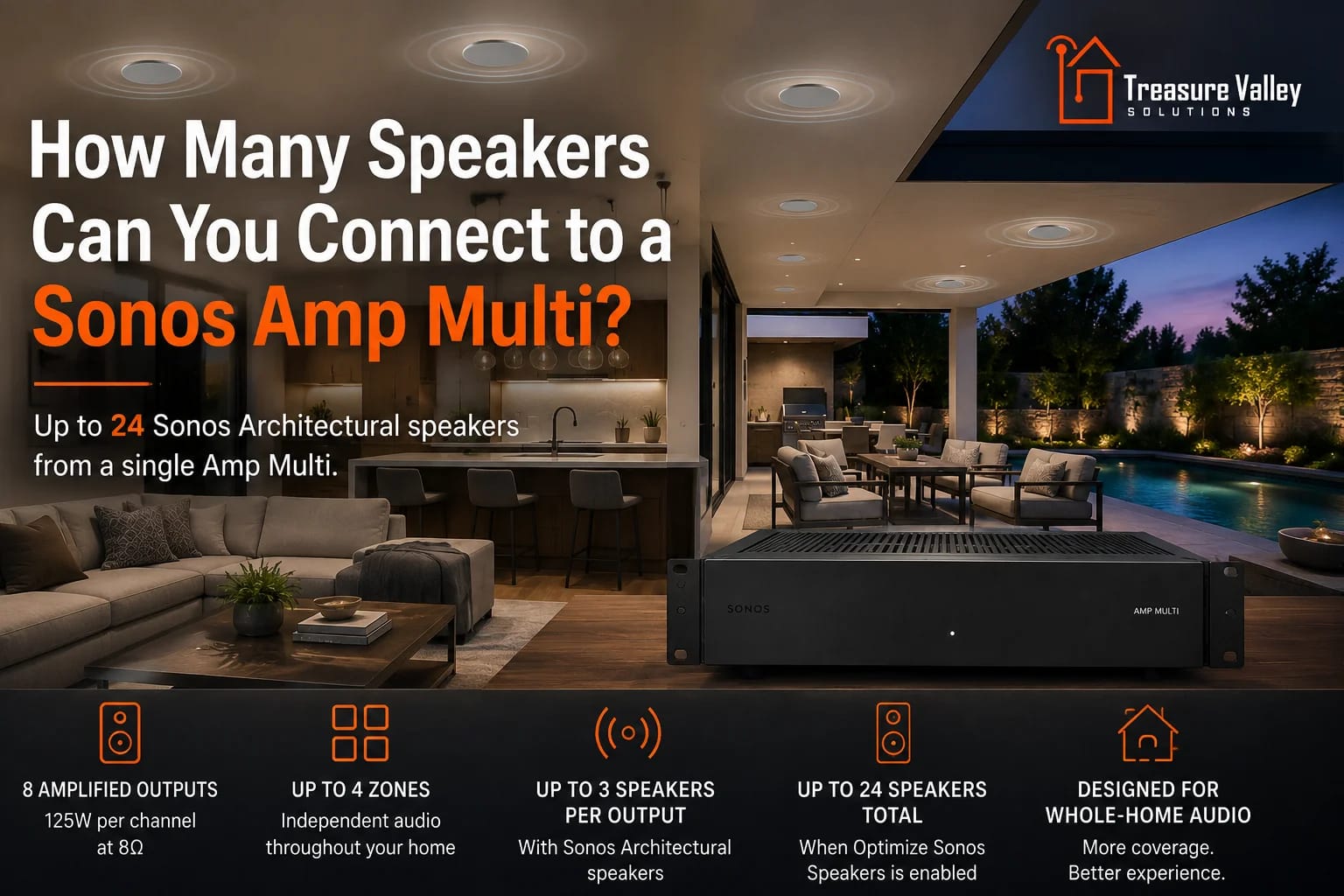

Sonos Amp Multi can power up to 24 compatible Sonos Architectural speakers from a single amplifier—but the maximum speaker count is only part of the story. Speaker placement, room size, audio zones, coverage, and how you actually use each space all play a role in designing the right system. We explain how Amp Multi's eight amplified outputs work and why great whole-home audio is about more than simply connecting as many speakers as possible.
One of the first questions people ask when they see the new Sonos Amp Multi is:
How many speakers can one Amp Multi actually power?
The short answer is impressive:
Up to 24 Sonos Architectural speakers from a single Amp Multi.
But there's an important qualifier to that number—and simply connecting the maximum number of speakers isn't necessarily how we'd design your system.
Amp Multi gives us eight amplified outputs, 125 watts per channel, flexible zone assignments, and the ability to support up to three compatible Sonos Architectural speakers per output when properly configured.
That creates a lot of possibilities.
The more useful question isn't just "How many speakers can we connect?"
It's "How many speakers should we use, and how should we distribute them throughout your home?"
Start With Eight Amplified Outputs
At its core, Sonos Amp Multi is an eight-output amplifier.
Each amplified output delivers 125 watts at 8 ohms with all channels driven, and each can be independently configured for mono or stereo operation.
Those eight outputs can then be assigned in different combinations across as many as four independent Sonos zones.
That last part is important.
We're not simply dealing with four fixed pairs of amplifier channels.
We can configure the outputs according to what different areas of the home actually need.
A smaller room might require a simple pair of speakers.
A large great room may benefit from four or six.
An outdoor entertaining area may need even more speakers to provide consistent coverage across the space.
Amp Multi gives us flexibility to design around those differences.
So Where Does the 24-Speaker Number Come From?
This is where Sonos Architectural speakers become particularly interesting.
When we pair Amp Multi with compatible Sonos Architectural speakers, we can enable a feature called Optimize Sonos Speakers.
Amp Multi detects the connected Sonos speakers and automatically applies custom EQ profiles, limiter settings, and DSP tuning designed to maximize performance while protecting the system.
It also allows Amp Multi to safely operate down to a 2.67-ohm load.
That means we can connect up to three compatible Sonos Architectural speakers per amplified output.
With eight outputs available:
8 outputs × 3 speakers = up to 24 speakers
That's where Sonos gets the 24-speaker maximum for a single Amp Multi.
It's a significant amount of audio capability from one amplifier.
But there's an important point here:
The 24-speaker capability does not mean every passive speaker can simply be connected three-per-output.
The published 2.67-ohm minimum and three-speaker-per-output capability specifically apply when Amp Multi is used with compatible Sonos Architectural speakers and Optimize Sonos Speakers.
Speaker impedance and amplifier load matter, so this is something we determine as part of the system design rather than treating "three speakers per output" as a universal rule.
More Speakers Doesn't Automatically Mean More Zones
Another distinction that's easy to miss is the difference between speakers and zones.
They're not the same thing.
A zone is an independently controlled audio area.
For example:
Kitchen
Great Room
Primary Suite
Patio
Those could be four separate zones.
Each zone can have its own volume and its own audio source.
But a zone can contain more than two speakers.
Imagine a large great room with six in-ceiling speakers.
Those six speakers don't necessarily need to appear as three separate rooms in your Sonos app. We can design them as part of the same great-room zone so they operate together.
That's one of the advantages of Amp Multi's flexible architecture.
Sonos allows us to assign any combination of its eight outputs across up to four zones.
So speaker count and zone count are two separate decisions.
Why Would a Room Need Four or Six Speakers?
This is where system design becomes much more important than simply reading an amplifier specification.
When people hear "six speakers in one room," they sometimes assume we're trying to make the room extremely loud.
Usually, that's not the reason at all.
We're trying to make the sound more even.
Consider a large open-concept kitchen and great room.
If we install only two ceiling speakers, those speakers have to cover a substantial area.
Turn them up enough for someone at the far end of the room to hear the music clearly, and they may become uncomfortably loud for someone standing directly underneath them.
Adding more speakers allows us to distribute the audio across the space.
Instead of asking two speakers to do all the work, we can have four or six speakers operating at lower individual levels.
The goal is that as you walk around the room, the music stays relatively consistent.
You shouldn't feel like you're moving toward and away from the sound system.
Good distributed audio should feel like it's coming from the room—not from one obvious speaker.
Outdoor Audio Makes This Even More Important
The same concept becomes even more important outdoors.
Outdoor spaces don't have walls and ceilings helping contain and reflect sound the way indoor rooms do.
Imagine a covered patio that extends into a pool area and backyard.
We could install two speakers near the house and turn them up.
But that creates exactly the problem we don't want.
It's loud near the house and increasingly quiet as you move farther away.
A better design is often to use more speakers distributed throughout the area and operate them at more moderate levels.
That gives us more consistent coverage while also reducing the likelihood that your neighbors get more of your music than you intended.
Amp Multi's ability to support multiple speakers and flexible output assignments gives us considerably more options when designing those spaces.
What Could a 24-Speaker System Actually Look Like?
It's helpful to put the maximum number into perspective.
Suppose we're designing a whole-home audio system using one Amp Multi and compatible Sonos Architectural speakers.
We might have something like:
Kitchen / Great Room — 6 speakers
A large open-concept space where even coverage is more important than simply having one stereo pair.
Dining / Entertaining Area — 4 speakers
Enough coverage to keep music comfortable throughout the space without making any single location excessively loud.
Primary Suite — 4 speakers
Speakers distributed between the bedroom and associated areas depending on how the space is laid out and how you want it controlled.
Outdoor Living — 6 speakers
Distributed across a covered patio or entertaining area.
That's already 20 speakers.
And depending on the specific system design, a single Amp Multi could still have capacity available.
The exact arrangement would depend on how we assign the amplifier outputs and zones, the speaker models we're using, and which areas need independent control.
That's why we don't start a project by trying to hit a particular speaker count.
We start with the spaces.
How Do We Decide How Many Speakers a Room Needs?
There isn't a universal formula that says a room of a certain square footage always needs a certain number of speakers.
We look at several things.
Room Size and Shape
A long, narrow room may need a different speaker layout than a square room of exactly the same size.
Open-concept spaces create another challenge because the kitchen, dining, and living areas may technically be one room while functioning as several different spaces.
Ceiling Height
Higher ceilings affect speaker coverage.
A speaker mounted in an eight-foot ceiling behaves differently in the room than the same speaker installed in a vaulted ceiling.
How You'll Use the Space
Background music and critical listening are different design goals.
A kitchen where you want music while cooking may need a different approach than a dedicated listening area.
Likewise, an outdoor entertaining space designed for parties may have different requirements than a quiet covered patio.
Speaker Placement
Architecture often determines where speakers can realistically go.
Lighting, HVAC registers, ceiling fans, beams, cabinetry, and other architectural elements all compete for ceiling space.
Part of our job is finding locations that make sense both acoustically and visually.
How Consistent You Want the Coverage
Sometimes two speakers technically can cover a room.
That doesn't mean two speakers will produce the best experience.
If we can achieve much more consistent audio by adding another pair of speakers, that may be the better design.
Stereo vs. Mono Also Matters
We also think about whether stereo separation makes sense in a particular space.
Traditional stereo assumes that you're positioned somewhere between a left and right speaker.
That works very well when you're sitting in a predictable listening position.
But that's not how people use many whole-home audio spaces.
You walk around a kitchen.
You move between the grill and seating area outside.
People mingle throughout a great room during a party.
In those situations, a carefully designed mono or distributed configuration can sometimes provide a more consistent experience than trying to maintain a traditional left/right listening position everywhere.
Amp Multi gives us flexibility here because each of its eight outputs can be configured for mono or stereo operation.
Again, the right answer depends on the space.
What If We Need More Than 24 Speakers?
We add more amplification.
Amp Multi isn't limited to standalone installations.
Sonos designed it to scale.
A Sonos system can support up to 32 zones, with up to four zones on each Amp Multi. Multiple Amp Multi units can be combined when we need additional zones, outputs, or coverage.
That means we're not trying to cram an entire large home onto one amplifier simply because the amplifier can support a lot of speakers.
For a larger project, we can distribute the system across multiple Amp Multi units.
That gives us room to design each area properly while keeping the equipment centralized and organized.
What About Subwoofers?
Amp Multi also gives us options when an area needs more low-frequency performance.
The amplifier has a dedicated line-level RCA subwoofer output that can be assigned to one of its four zones.
It can also work with Sonos wireless Subs, allowing up to one Sub per zone in the supported configuration. With four zones on one Amp Multi, that means up to four subs in total, with the wired subwoofer output taking the place of the wireless Sub in whichever zone it's assigned to.
We don't necessarily need a subwoofer in every room.
But for larger entertainment areas, great rooms, or spaces where music is more important, adding a subwoofer can make a substantial difference.
It allows the architectural speakers to handle the frequencies they're best suited for while the sub handles the low end.
The Number on the Spec Sheet Isn't the Goal
Amp Multi's ability to power up to 24 Sonos Architectural speakers is impressive.
But 24 isn't a target.
If your home needs 12 speakers, we're not going to recommend 24 because the amplifier can handle them.
Likewise, if properly covering the spaces requires 30 speakers, we're not going to force everything onto one Amp Multi just so we can say we're using one amplifier.
The goal is to design the audio system correctly.
That means determining:
Where you want audio
Which areas need independent control
How much coverage each space requires
Which speakers make sense
How those speakers should be positioned
How much amplification we need
Where the equipment should be located
How the system might expand in the future
Then we determine how many Amp Multi units—or other amplifiers—the system requires.
That's a much better way to design a whole-home audio system than starting with a maximum speaker count and working backward.
So, How Many Speakers Can Sonos Amp Multi Power?
The simple answer is:
Up to 24 compatible Sonos Architectural speakers from one Amp Multi when Optimize Sonos Speakers is enabled and the system is configured appropriately.
But the better answer is:
As many speakers as we determine the spaces actually need, within the electrical and configuration limits of the amplifier.
That's what makes Amp Multi interesting to us.
The headline number is impressive, but the real advantage is the flexibility behind it.
Eight amplified outputs, flexible zone assignments, detailed tuning controls, support for high speaker counts, and the ability to scale across multiple units give us a lot more freedom to design the system around your home.
And that's ultimately much more important than seeing how many speakers we can connect to one box.
Planning Whole-Home or Outdoor Audio?
If you're building a new home, remodeling, expanding an existing Sonos system, or adding audio to an outdoor living space, speaker quantity is only one part of the design.
At Treasure Valley Solutions, we look at the spaces, how you use them, the coverage you want, and how everything should operate together before determining the speaker and amplifier configuration.
The result should be simple:
You walk through your home, the music sounds great, and you don't have to think about everything happening behind the scenes.
Need Expert Help?
Ready to implement these solutions in your own home or business?
Our Services

Home theater design and installation planned around your room, viewing goals, and equipment scope.
Expert TV Mounting Treasure Valley Homeowners & Businesses Trust

Explore whole-home audio, commercial sound, Sonos setup, and surround sound installation in the Treasure Valley.

Complete home automation and control.
Serving the Treasure Valley
Local installation in your city