 (208) 991-3502
 Meridian, ID



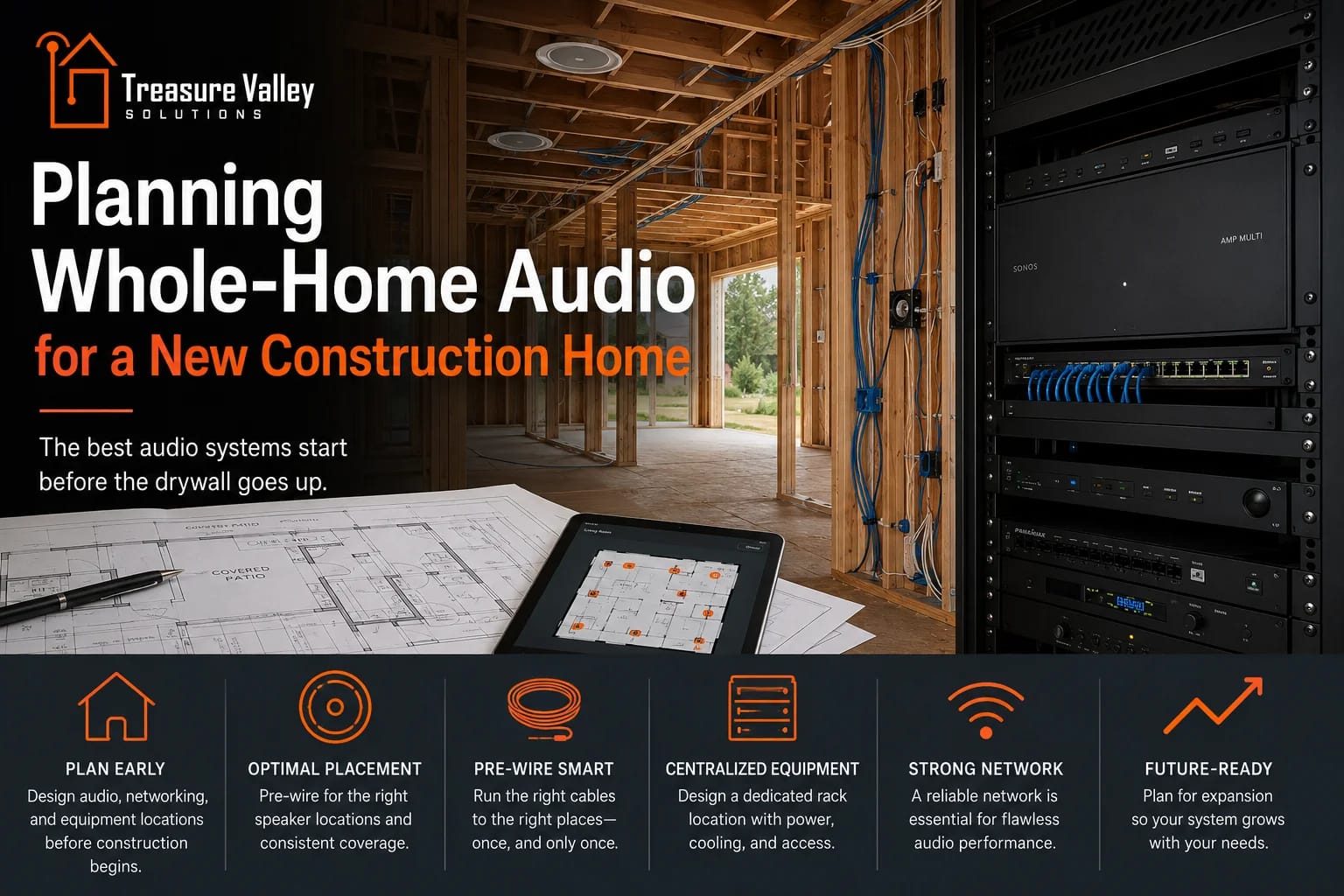

Planning whole-home audio during new construction gives us the opportunity to design the system correctly before the walls are closed. From speaker placement and prewiring to networking, equipment locations, outdoor audio, and future expansion, decisions made early can make a major difference in the finished system. See what we recommend planning now to create a home that's ready for great audio today and whatever comes next.
Building a new home gives you an opportunity you probably won't have again.
Before the drywall goes up, virtually every wall and ceiling is accessible.
We can run speaker wire exactly where it needs to go. We can plan ceiling speakers around lighting and other architectural elements. We can create dedicated pathways for televisions, networking, cameras, access points, and control systems. We can choose the right location for the equipment rack. And we can prepare for technology you may want years from now—even if you aren't ready to install it today.
Once the drywall goes up, all of those things are still possible.
They're just harder.
That's why we believe the best whole-home audio systems start long before anyone installs a speaker.
They start with a plan.
Start With How You Want to Live in the House
When we're planning audio for a new home, we don't start by counting speakers.
We start with the floor plan.
Then we talk about how you expect to use the different spaces.
Do you entertain frequently?
Will the great room and kitchen function as one large gathering space?
Do you want music on the covered patio?
What about around a future pool?
Would you listen to music in the primary bathroom every morning?
Do you want audio in the garage or shop?
Will any rooms use the same speakers for music and television?
Those conversations help us determine where audio actually adds value.
A typical project might include:
Kitchen
Great room
Dining room
Primary bedroom
Primary bathroom
Office
Bonus room
Covered patio
Pool or backyard
Garage or shop
That doesn't mean every one of those spaces automatically gets speakers.
It means we think through them before construction makes the decisions for us.
Think About Zones Before Thinking About Speakers
Once we know where audio makes sense, we decide how those spaces should operate.
This is where we start talking about audio zones.
A zone is an independently controlled area.
Maybe your kitchen and great room should always play together.
Maybe you'd rather have independent control over each.
Maybe the covered patio and pool should normally operate together but occasionally play different music.
There's no universal answer.
The right configuration depends on how you expect to use the house.
And that's important because the number of rooms, number of speakers, and number of audio zones don't necessarily match.
A large great room might contain six speakers but still be one zone.
A primary bedroom and bathroom might contain four speakers but make more sense as two independently controlled zones.
We're trying to find the right balance between flexibility and simplicity.
More zones aren't automatically better.
They should exist because they're useful.
Speaker Placement Should Be Part of the Ceiling Plan
This is one of the biggest advantages of planning early.
In-ceiling speakers aren't the only things going into your ceiling.
We may also be coordinating around:
Recessed lighting
Decorative lighting
HVAC registers
Smoke detectors
Sprinkler heads
Ceiling fans
Beams
Access points
Other technology
If everyone designs their part independently, the finished ceiling can look chaotic.
We'd much rather coordinate speaker locations while those decisions are still being made.
Good speaker placement needs to work acoustically and visually.
The speakers should provide appropriate coverage for the room, but they should also look intentional within the architecture.
When possible, we want spacing and alignment to make sense with the other ceiling elements rather than looking like the audio system was added as an afterthought.
Don't Automatically Put Two Speakers in Every Room
A pair of speakers is a perfectly good solution for many spaces.
But "two speakers per room" isn't a design philosophy.
Room size matters.
Room shape matters.
Ceiling height matters.
How people move through the room matters.
A small office may be perfectly served by two speakers.
A large open-concept kitchen and great room may sound much better with four or six.
And the reason isn't necessarily volume.
It's coverage.
With more properly positioned speakers, we can distribute the audio more evenly throughout a large area.
Instead of turning two speakers up enough to reach the far side of the room, we can have several speakers operating at more comfortable levels.
The result should be audio that feels consistent as you move through the space.
Vaulted Ceilings Deserve Extra Attention
Custom homes often have architectural features that make speaker placement more complicated.
Vaulted ceilings are a good example.
A speaker installed 16 feet above the floor behaves differently than one installed in a standard eight- or nine-foot ceiling.
The angle of the ceiling can also affect where the speaker is actually directing its sound.
That doesn't mean we can't create great audio in those spaces.
It means we need to think about the speaker type, placement, coverage pattern, and room geometry instead of simply marking symmetrical circles on a floor plan.
These are much easier conversations to have before framing and electrical work are complete.
Outdoor Audio Should Be Planned at the Same Time
Outdoor audio is one of the things we'd strongly recommend discussing during construction—even if you aren't planning to finish the entire outdoor system immediately.
Why?
Because getting wire outside later can be significantly more difficult.
If you know there's going to be a covered patio, outdoor kitchen, pool, firepit, sport court, detached shop, or other outdoor living area, we can think about those spaces while cable pathways are still accessible.
Sometimes the right answer is installing speakers during construction.
Sometimes the smarter move is simply installing the infrastructure so we're ready later.
Either way, we're making that decision intentionally.
More Outdoor Speakers Can Actually Mean Less Noise
This sounds counterintuitive, but it's an important concept.
If we're trying to cover a large backyard with two speakers mounted on the house, we have to turn those speakers up considerably to reach people farther away.
That means it's extremely loud near the house.
And a lot of that sound may travel beyond your property.
A distributed outdoor audio design takes a different approach.
We can place more speakers closer to the areas where people will actually be.
Each speaker can operate at a lower level.
The overall coverage becomes more consistent, and we're not relying on a pair of speakers to throw sound across the entire property.
That's better for you.
And usually better for your neighbors.
Prewire Is Relatively Inexpensive. Retrofitting Usually Isn't.
This is probably one of the most important things to understand about new construction technology.
There are plenty of decisions you can postpone.
You don't necessarily need to buy every speaker during construction.
You don't necessarily need every television immediately.
You may not be building the pool for another few years.
But wire is different.
While the walls are open, running additional low-voltage cable can be relatively straightforward.
After drywall, paint, cabinetry, stonework, landscaping, and other finishes are complete, getting that same cable from point A to point B may become much more difficult.
That's why we like to distinguish between:
What you need installed now
and
What it makes sense to prepare for now.
Those aren't always the same thing.
Future Speaker Locations Are Worth Considering
Maybe you aren't sure whether you'll want speakers in the garage.
We can still discuss whether prewiring the garage makes sense.
Maybe the pool won't be built for three years.
We can potentially establish a pathway or run appropriate infrastructure while the house is under construction.
Maybe you don't want audio in a particular room today but could imagine converting it into a game room later.
Again, we can plan accordingly.
We're not trying to fill the house with unused wiring just for the sake of it.
We're trying to identify locations where a relatively small decision today could prevent a much larger project later.
Plan Your Television Locations Too
Whole-home audio doesn't exist separately from the rest of the entertainment system.
If we're reviewing the floor plans, we're also thinking about where televisions will go.
That may affect:
Network wiring
HDMI or video pathways
Power locations
Speaker wiring
Equipment locations
Control
Furniture placement
Mounting height
And in some rooms, the audio system may interact directly with the television.
The standard Sonos Amp, for example, includes HDMI ARC and can be a very useful solution when we're powering passive speakers for TV audio.
The new Sonos Amp Multi serves a different role and is designed primarily around larger multi-zone distributed-audio systems.
Knowing which rooms need TV integration helps us determine which architecture makes sense.
Centralized vs. Local Equipment
Another important decision is where the amplifiers and other electronics will live.
For larger homes, we often prefer to centralize as much of the infrastructure as practical.
Instead of putting amplifiers in cabinets throughout the house, speaker wiring can return to a central equipment location.
That gives us several advantages.
The electronics aren't occupying cabinetry in living spaces.
The wiring is organized.
Network connections are centralized.
The equipment is easier to access.
And future changes become much easier.
Products like the new Sonos Amp Multi make this approach particularly interesting.
Amp Multi Changes the Math for Larger Sonos Systems
Traditionally, building a large Sonos system with passive architectural speakers could require quite a few individual Sonos Amps.
Amp Multi gives us another option.
It provides eight amplified outputs at 125 watts per channel, and those outputs can be assigned across up to four independent Sonos zones.
So instead of automatically dedicating one two-channel amplifier to each area, we can configure the outputs around what the spaces actually need.
A large room can use more outputs.
A smaller area can use fewer.
And when we use compatible Sonos Architectural speakers with Optimize Sonos Speakers enabled, Amp Multi can safely support loads down to 2.67 ohms, allowing up to three compatible speakers per output. That gives a single Amp Multi the ability to power as many as 24 Sonos Architectural speakers in an appropriate configuration.
For a new construction project with a significant amount of architectural audio, that gives us a lot of flexibility.
Plan the Equipment Room Early
If we're centralizing the technology, we need somewhere to put it.
This is another decision we'd rather make from the plans than after the house is nearly finished.
The equipment location needs to account for more than simply whether a rack physically fits.
We think about:
Rack dimensions
Access
Electrical requirements
Ventilation
Cooling
Cable pathways
Internet service
Network equipment
Future expansion
A tiny closet with no ventilation may technically fit an equipment rack.
That doesn't make it a good equipment room.
We'd rather identify an appropriate location while there's still an opportunity to make adjustments.
Why Cooling Matters
A technology rack may contain amplifiers, network switches, control processors, surveillance equipment, power management, and other electronics.
All of those devices generate some amount of heat.
Put enough equipment into a small enclosed room and thermal management becomes important.
The new Sonos Amp Multi is interesting in this respect because Sonos designed it specifically around efficient rack installations.
It uses GaN technology, Class D amplification, and post-filter feedback to reduce energy loss and heat generation. The amplifier itself is completely fanless and convection cooled.
Sonos also offers a dedicated 2U rack mount designed to maintain airflow above and below the unit without requiring separate vent panels.
Those features help.
But they don't eliminate the need to think about the environment where the entire rack will live.
Don't Treat the Network as an Afterthought
A modern home depends heavily on its network.
Whole-home audio does too.
So do televisions.
Streaming devices.
Smart-home control.
Surveillance cameras.
Doorbells.
Lighting systems.
Mobile devices.
And whatever connected products arrive next.
That's why the network should be part of the technology design from the beginning.
During construction, we can plan:
Ethernet locations
Wireless access point locations
Network switch capacity
Equipment rack connections
Outdoor network coverage
Camera connections
Television connections
Control-system connections
Amp Multi itself supports both Ethernet and Wi-Fi 6.
For equipment installed in a central rack, wired Ethernet is often an obvious choice because we're already right next to the network infrastructure.
More broadly, though, we want the entire home to have a network designed for what will actually be connected to it.
Wi-Fi Access Points Need Planning Too
Good Wi-Fi isn't about putting one extremely powerful router in the middle of a large house.
Larger homes typically benefit from multiple properly located wireless access points.
Those access points need connections.
And their locations matter.
If we wait until the home is finished to figure out Wi-Fi coverage, our options may be limited by where network cabling happens to exist.
During construction, we can plan those locations based on the floor plan and expected coverage requirements.
We can also consider outdoor coverage for patios, pools, shops, and other areas where you'll expect your phone, Sonos system, or other devices to work.
Again, the cost of thinking about it early is small.
The cost of solving it badly later can be much higher.
Think About the Entire Technology System Together
One of the biggest mistakes we see in new construction is treating every technology category as an independent decision.
Audio gets planned at one point.
Wi-Fi comes later.
Then someone thinks about cameras.
Then TVs.
Then lighting control.
Then the equipment rack.
But these systems share infrastructure.
They share the network.
They may share control.
They may share equipment locations.
And they all compete for pathways through the house.
We'd rather look at the whole picture.
That might include:
Whole-home audio
Networking and Wi-Fi
Televisions and entertainment
Home automation
Lighting control
Security
Surveillance cameras
Access control
Motorized shades
Outdoor technology
Not every home needs all of those systems.
But we want to know which ones are part of the plan before we're pulling wire.
Don't Forget Control
A sophisticated system isn't particularly impressive if nobody knows how to use it.
Sonos does a great job of making audio straightforward through the Sonos app.
Amp Multi can provide up to four independent Sonos streams from a single unit, and it also supports Apple AirPlay 2 and Spotify Connect.
For larger smart-home projects, Amp Multi can also integrate with platforms including Control4, Crestron, URC, RTI, and Nice.
That gives us options.
Maybe the Sonos app is all you need.
Maybe you want audio incorporated into a broader smart-home interface along with lighting, shades, climate, televisions, and other systems.
The important thing is that the control experience matches the complexity of the project.
We want the technology behind the scenes to be sophisticated without making the experience of using it sophisticated.
New Construction Is the Time to Think About Expansion
Nobody can predict exactly what home technology will look like ten years from now.
We don't try.
Instead, we try to avoid making decisions today that unnecessarily limit tomorrow.
That can mean:
Leaving rack capacity
Providing spare network capacity
Installing conduit where appropriate
Planning cable pathways
Prewiring likely future locations
Leaving room for additional amplification
Thinking about future outdoor spaces
Amp Multi itself follows that same philosophy.
A Sonos system can support up to 32 audio zones, and multiple Amp Multi units can be combined as the system grows.
You may never need anything close to that.
But it's nice to know that adding another audio area doesn't require throwing away the system we designed originally.
When Should We Get Involved?
Earlier than most people think.
Ideally, we'd like to review the project while we still have plans and open framing to work with.
That gives us an opportunity to coordinate with the builder, electrician, designer, and other trades before decisions become difficult or expensive to change.
We can identify:
Speaker locations
Television locations
Network drops
Wi-Fi access points
Camera locations
Equipment rack location
Cable pathways
Outdoor technology
Future prewire
Then we can get the appropriate infrastructure in place while the walls are open.
We don't necessarily need every final piece of equipment selected at that point.
But we do want the infrastructure to support the finished design.
What If You're Not Sure What Technology You Want Yet?
That's completely normal.
You don't need to know whether you want a particular amplifier model five years from now.
You don't need to know what television you'll eventually buy.
You don't need to commit to every possible smart-home feature.
What we need to understand is what you may want the home to be capable of.
There's a big difference between installing every technology option today and preparing the home so those options remain available.
Sometimes the smartest thing we install during construction is simply the right wire or conduit.
You may not use it immediately.
But if you need it later, you'll be glad it's there.
The Best Technology Is the Technology You Don't Have to Think About
When a new-construction technology system is designed well, most of the complexity disappears after move-in.
You see clean architectural speakers.
You have strong Wi-Fi where you need it.
You turn on the TV and it works.
You open Sonos and play music throughout the house.
Your cameras are where they should be.
The equipment is organized somewhere out of sight.
And when you decide to add something later, we already have a path forward.
What you don't see are the hundreds or thousands of feet of wire, network infrastructure, amplifier assignments, rack layout, cable management, DSP settings, and planning that make that experience possible.
That's our job.
Building a New Home? Plan the Technology Before the Drywall.
The best time to fix a technology problem is before it becomes one.
During construction, we have an opportunity to think through the entire system:
Where should the speakers go?
How should the audio zones work?
Where should the televisions be?
Where will the equipment live?
How will Wi-Fi cover the house and outdoor spaces?
What should we prewire now for something you may want later?
How should all of these systems work together?
Products like Sonos Amp Multi give us better tools than ever for building powerful, scalable whole-home audio systems.
But great equipment doesn't replace good planning.
At Treasure Valley Solutions, we want to be involved early enough that we're not trying to work around decisions that have already been made.
We can coordinate the audio, networking, wiring, equipment infrastructure, and smart-home technology as part of the home—not as something added after it.
Because once the walls are closed, you'll see very little of what we installed.
You'll just experience the difference every day.
Need Expert Help?
Ready to implement these solutions in your own home or business?
Our Services

Home theater design and installation planned around your room, viewing goals, and equipment scope.
Expert TV Mounting Treasure Valley Homeowners & Businesses Trust

Explore whole-home audio, commercial sound, Sonos setup, and surround sound installation in the Treasure Valley.

Complete home automation and control.
Serving the Treasure Valley
Local installation in your city