 (208) 991-3502
 Meridian, ID



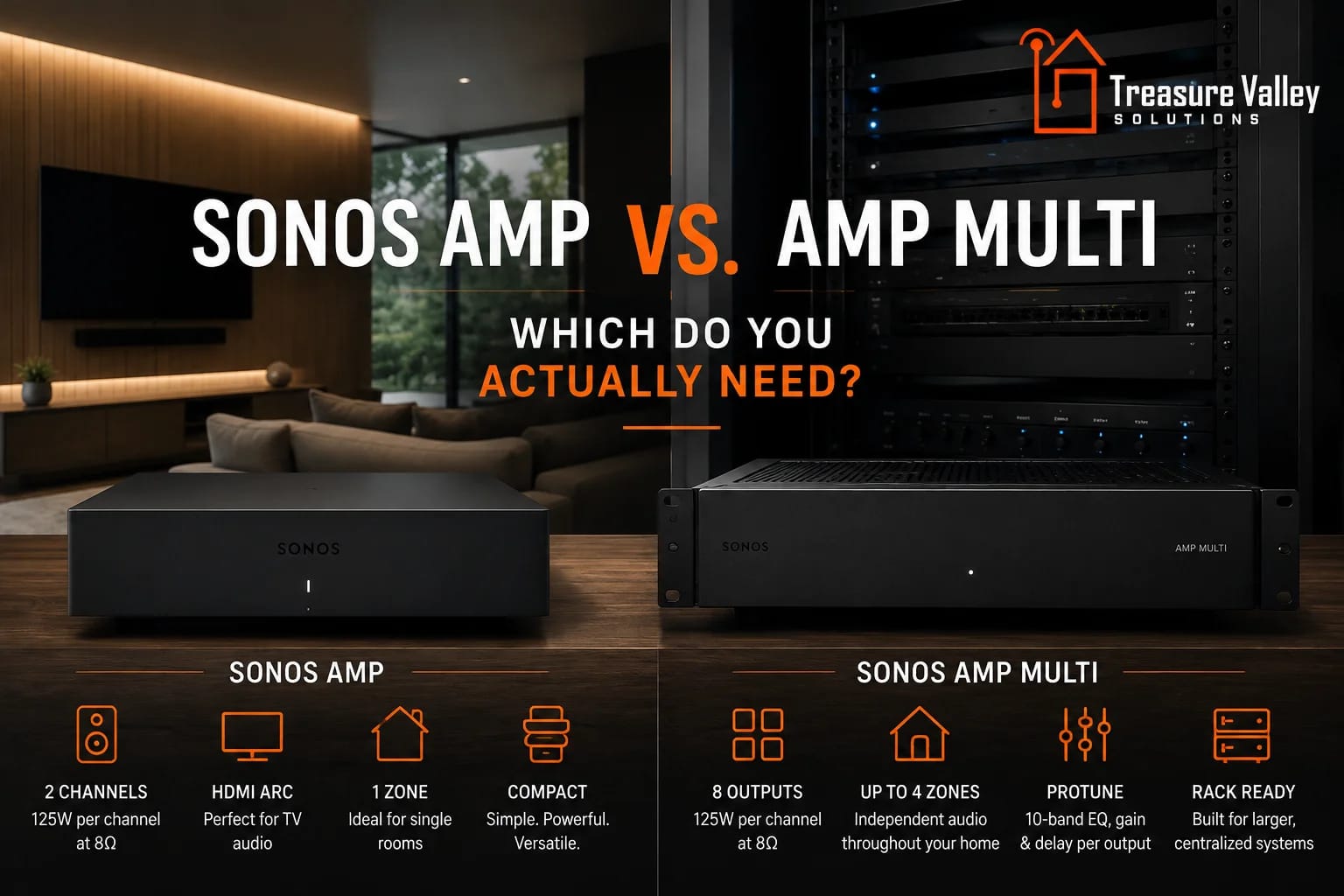

Sonos Amp Multi gives us powerful new options for larger whole-home audio systems, but that doesn't mean the standard Sonos Amp is going away. Each amplifier has strengths that make it better suited to different applications, from a single room or TV setup to a centralized multi-zone audio system. We break down the differences and explain when we'd choose Sonos Amp, Amp Multi, or a combination of both.
With the introduction of the new Sonos Amp Multi, there's an obvious question for anyone planning a Sonos system:
Do I need the new Amp Multi, or is the regular Sonos Amp still the better choice?
The answer isn't simply that Amp Multi is newer, bigger, and therefore better.
We expect to use both.
The standard Sonos Amp remains an excellent solution for certain rooms and applications. Amp Multi gives us an entirely different set of tools for larger, centralized whole-home audio systems.
The key is understanding what each product was designed to do—and using the right one in the right place.
The Biggest Difference: One Zone vs. Multiple Zones
The easiest way to understand the difference is to look at how each amplifier handles audio zones.
The standard Sonos Amp is a two-channel amplifier delivering 125 watts per channel at 8 ohms. It can operate in stereo or dual mono and is designed primarily around a single Sonos room or zone.
The new Sonos Amp Multi takes a very different approach.
It provides:
8 amplified outputs
125 watts per channel at 8 ohms, with all channels driven
Up to 4 independent Sonos zones
Independent mono or stereo configuration for each output
Sonos specifically designed those outputs so they can be assigned to different zones as needed.
That's much more than simply putting four Sonos Amps into one box.
It changes how we can design the entire audio system.
A Simple Example
Let's say we're designing audio for four areas:
Kitchen
Dining Room
Great Room
Covered Patio
If each of those areas needs independent control, the traditional approach might involve multiple Sonos Amps.
With Amp Multi, we can potentially handle all four zones from one amplifier.
But here's the more interesting part: those zones don't all have to use the amplifier outputs the same way.
Maybe the dining room is small and only needs a pair of speakers.
The great room may have a vaulted ceiling and a much larger footprint, so we want additional speakers for better coverage.
The covered patio may also need multiple speakers because we're trying to distribute sound evenly across a large outdoor space.
Amp Multi lets us assign its eight outputs according to the needs of those spaces rather than forcing every room into exactly the same amplifier configuration. Sonos' documentation specifically allows any combination of the eight outputs to be assigned across up to four zones.
That's one of the biggest reasons we're excited about it.
So Is Amp Multi Four Sonos Amps in One Box?
Not really.
It might be tempting to think of it that way because Amp Multi has eight amplified outputs compared with two on a standard Amp.
But Amp Multi adds capabilities that go well beyond consolidating hardware.
For example, Amp Multi includes ProTune, which gives us a 10-band parametric EQ along with gain and delay adjustment on each output.
That gives us considerably more control when we're commissioning the finished system.
We can account for speaker placement, differences in room acoustics, speaker distance, and other conditions that affect how a system actually sounds once it's installed.
Amp Multi also uses Class D amplification with GaN and post-filter feedback (PFFB) technology and is designed as an entirely fanless amplifier.
So while consolidating several zones into one chassis is certainly one advantage, Amp Multi is really a different class of Sonos product.
When We'd Choose a Regular Sonos Amp
Here's where the comparison gets more interesting.
There are plenty of situations where we would still specify a regular Sonos Amp.
A Single Room or Audio Zone
If we're simply powering a pair of speakers in one room, there may be no reason to use Amp Multi.
Maybe you want two in-ceiling speakers in an office.
Or a pair of outdoor speakers on a small patio.
Or you're adding one audio zone to an existing house.
A standard Amp gives us 125 watts per channel, Sonos streaming, AirPlay 2, RCA line-in, a subwoofer output, Ethernet, and everything we need to create a very capable standalone zone.
Using Amp Multi in that situation could be unnecessary unless we're planning for additional zones.
A TV Room
This is an especially important difference between the two products.
The standard Sonos Amp includes HDMI ARC, allowing us to connect it directly to a compatible television and use passive speakers for TV audio. It supports stereo PCM, Dolby Digital, and DTS Digital Surround formats.
Amp Multi does not list an HDMI ARC connection among its inputs.
So if we're designing a room where the amplifier needs to connect directly to a television, the standard Sonos Amp may actually be the better product.
That's a perfect example of why "newer" doesn't automatically mean "better."
It depends on what we're trying to accomplish.
When We'd Choose Sonos Amp Multi
Amp Multi starts to make considerably more sense as the number of rooms and speakers increases.
Whole-Home Audio
If we're designing audio throughout a new home or doing a substantial remodel, Amp Multi gives us a much cleaner way to centralize the system.
Instead of installing numerous individual amplifiers, we can potentially consolidate several zones into each Amp Multi.
That means fewer individual components, cleaner wiring, and a more organized equipment rack.
Larger Rooms
Amp Multi also gives us more flexibility when a room needs more than a basic pair of speakers.
That's important because the number of speakers we recommend isn't determined simply by how loud you want the room.
Often, we're trying to achieve better coverage.
A large kitchen and great room might sound much better with several speakers playing at moderate levels than with two speakers trying to fill the entire space.
The same concept becomes even more important outdoors.
With Amp Multi, we have more flexibility to allocate amplifier outputs based on those requirements.
Systems With Lots of Architectural Speakers
Amp Multi becomes particularly powerful when paired with Sonos Architectural speakers.
With Optimize Sonos Speakers enabled, Amp Multi can detect compatible Sonos Architectural speakers and automatically apply custom EQ profiles, limiter settings, and DSP tuning.
It also allows the amplifier to safely drive loads down to 2.67 ohms.
That means we can connect as many as three Sonos Architectural speakers per output, giving one Amp Multi the ability to power up to 24 speakers in the right configuration.
That's a significant amount of distributed audio from a single amplifier.
What About Rack Space?
This is something we think about on almost every larger project.
The equipment rack isn't the glamorous part of a smart home, but good rack design makes an enormous difference in reliability and serviceability.
Every additional component requires:
Rack space
Power
Network connectivity
Speaker wiring
Cable management
Heat management
If we can accomplish the same job with fewer pieces of equipment, that's generally a good thing.
Amp Multi is specifically designed around this type of installation.
The unit itself is 1.5U high, while Sonos offers a dedicated 2U rack mount that creates airflow above and below the amplifier without requiring additional vent panels between units.
Combined with its fanless convection-cooled design, Amp Multi gives us a much cleaner way to build larger Sonos systems into a centralized equipment rack.
The Difference You Probably Won't Notice
Ironically, one of the best things about Amp Multi is that you probably won't notice most of this once we're finished.
You don't need to think about which amplifier channel powers the kitchen.
You don't need to know how we've grouped outputs.
You don't need to adjust a parametric EQ.
And you definitely shouldn't need to visit the equipment rack every time you want to listen to music.
All of that happens behind the scenes.
From your perspective, it's still Sonos.
Open the Sonos app, choose what you want to hear, select where you want to hear it, and press play.
Amp Multi supports up to four independent streams from one unit, and those zones can also be grouped when you want music playing across multiple areas. The system also supports Apple AirPlay 2 and Spotify Direct Control.
The technology behind the system becomes more capable without making the day-to-day experience more complicated.
That's exactly what we want.
Can We Use Sonos Amp and Amp Multi in the Same House?
Absolutely.
In fact, we expect that to make sense in plenty of systems.
Imagine a house where most of the architectural audio is centralized:
Kitchen
Dining room
Great room
Patio
Primary bathroom
Office
Pool area
Those areas may be excellent candidates for one or more Amp Multi units.
But maybe there's also a bonus room where we want passive speakers connected directly to the television.
A regular Sonos Amp could make more sense there because of its HDMI ARC connection.
There's no reason we have to choose one amplifier for the entire house.
We can choose the right Sonos product for each application while keeping everything within the same Sonos ecosystem.
Sonos Amp vs. Amp Multi at a Glance
Sonos Amp | Sonos Amp Multi | |
|---|---|---|
Amplified outputs | 2 | 8 |
Power | 125W/channel @ 8Ω | 125W/channel @ 8Ω, all channels driven |
Independent zones | 1 | Up to 4 |
Output configuration | Stereo or dual mono | Each output configurable mono or stereo |
HDMI ARC | Yes | No HDMI ARC listed |
RCA line-in | Yes | 2 RCA inputs |
Subwoofer output | Yes | Yes |
AirPlay 2 | Yes | Yes |
Ethernet | Yes | Yes |
WiFi | Yes | WiFi 6 |
ProTune | No | Yes |
10-band parametric EQ per output | No | Yes |
GaN/PFFB amplification | No | Yes |
Purpose-built 2U rack mount | No | Yes |
Best fit | Individual rooms, TV applications, smaller systems | Multi-zone and larger whole-home systems |
The biggest thing we wouldn't recommend doing is choosing between them based on that table alone.
The right answer depends on the entire system.
Which One Do You Actually Need?
For a single pair of speakers or a room where TV audio is part of the design, there's a good chance the regular Sonos Amp is exactly what we need.
For a larger whole-home system with multiple zones, centralized equipment, and numerous architectural speakers, Amp Multi gives us considerably more flexibility.
And for many homes, the best system may use both.
That's why our starting point isn't:
"Which amplifier do you want?"
It's:
"Where do you want audio, and how do you want to use it?"
From there, we can determine how many zones make sense, how many speakers each space needs, where the equipment should live, whether TV audio needs to be incorporated, what should be wired during construction, and how much room we should leave for future expansion.
Then we select the equipment that best accomplishes those goals.
The arrival of Sonos Amp Multi doesn't change that approach.
It simply gives us a much more capable tool to work with.
Planning a Sonos System?
If you're building a new home, remodeling, adding outdoor audio, or looking to expand an existing Sonos system, the best time to think about the amplifier is after we've looked at how you actually want to use the spaces.
At Treasure Valley Solutions, we design the speakers, zones, wiring, networking, amplification, and control around the home—not the other way around.
Whether that means a Sonos Amp, Amp Multi, or a combination of the two, the goal is the same:
Great audio everywhere you want it, with technology that's simple to use once we're done.
Need Expert Help?
Ready to implement these solutions in your own home or business?
Our Services

Home theater design and installation planned around your room, viewing goals, and equipment scope.

Expert TV Mounting Treasure Valley Homeowners & Businesses Trust

Explore whole-home audio, commercial sound, Sonos setup, and surround sound installation in the Treasure Valley.

Complete home automation and control.
Serving the Treasure Valley
Local installation in your city