 (208) 991-3502
 Meridian, ID




Surround sound system installation cost is what you pay a professional to place the speakers, run and hide the wiring, connect the receiver, and tune everything to your room. It does not include the e...
Surround sound system installation cost is what you pay a professional to place the speakers, run and hide the wiring, connect the receiver, and tune everything to your room. It does not include the equipment. A standard 5.1 installation usually costs $300 to $1,200 in labor, a 7.1 system $1,000 to $2,500, and a Dolby Atmos room $2,500 to $5,000 or more.
This guide breaks that number into parts you can control. You will see what each system type costs to install, what moves a quote up or down, and how to build your own estimate with a worked example. You will also see how DIY compares with hiring a pro, and where the real savings are.
Treasure Valley Solutions designs, installs, and programs surround sound for homes across the Treasure Valley. The ranges below are national figures from published pricing, not a quote. Your room, your walls, and your gear decide the final price, and a short walkthrough settles it faster than any average.
Why installation cost deserves its own budget line
Most buyers price the speakers and receiver, then find that labor is a second bill that can rival the first. Plan for installation separately from the start and your budget holds.
Equipment and labor are two separate bills
Equipment is what you carry out of the store. Installation is the labor, wiring, and calibration that turns a pile of speakers into a system that sounds like a theater. The table shows how both climb as the system grows.
| System type | Speakers | Equipment cost | Typical installation cost | Fits best |
|---|---|---|---|---|
| 2.1 soundbar and subwoofer | 2 + sub | $200–$800 | $150–$400 | Bedrooms, small living rooms |
| 5.1 surround | 5 + sub | $500–$1,500 | $300–$1,200 | Living rooms, family rooms |
| 7.1 surround | 7 + sub | $1,000–$3,000 | $1,000–$2,500 | Larger rooms, frequent movie nights |
| Dolby Atmos (7.1.4) | 11 + sub | $2,500–$8,000+ | $2,500–$5,000+ | Dedicated theater rooms |
| In-wall or in-ceiling system | Varies | Varies | $1,200–$3,000 | Clean look, no visible wire |
These installation ranges assume reasonable access to walls and power. Ceiling speakers, long cable runs, and electrical upgrades push a job to the top of its range or past it.
Why published prices disagree
One national dataset built on about 1,500 verified projects puts the average near $795, with most jobs between $241 and $1,351. Installer guides for full rooms often quote $500 to $3,500. Both can be accurate. Scope explains the gap: simple wireless jobs pull averages down, and wired in-wall rooms pull them up.
So ignore any single average and find your scope. A quote for five speakers on stands and a quote for eleven speakers with hidden wiring are different products that happen to share a name.
An average price describes other people's rooms, and only your scope tells you your own price.
Is surround sound worth the installation cost?
For a medium or large room where you watch movies, sports, or streaming dramas, yes. True surround sound makes dialogue clearer and puts effects around you instead of in front of you. In a bedroom or a small den, a soundbar with a subwoofer and a $150 to $400 setup is the smarter spend.
The install itself matters as much as the gear. A mid-priced 5.1 system that is placed and calibrated well will beat an expensive one that is dropped in with default settings. That is the main reason paying for labor is worth it.
What drives the price of a surround sound installation
Five things move a quote: speaker count, how you hide the wiring, how much prep the walls and power need, room size, and labor rates. Each one is something you can decide or at least plan for.
Speaker count and type
A 5.1 system uses six pieces, 7.1 uses eight, and a 7.1.4 Atmos layout uses twelve. Every extra speaker adds a cable run, a mounting job, and calibration time. Mounting alone costs $50 to $150 per speaker, and in-wall or in-ceiling models sit at the top of that range because someone has to cut, mount, and hide the wire.
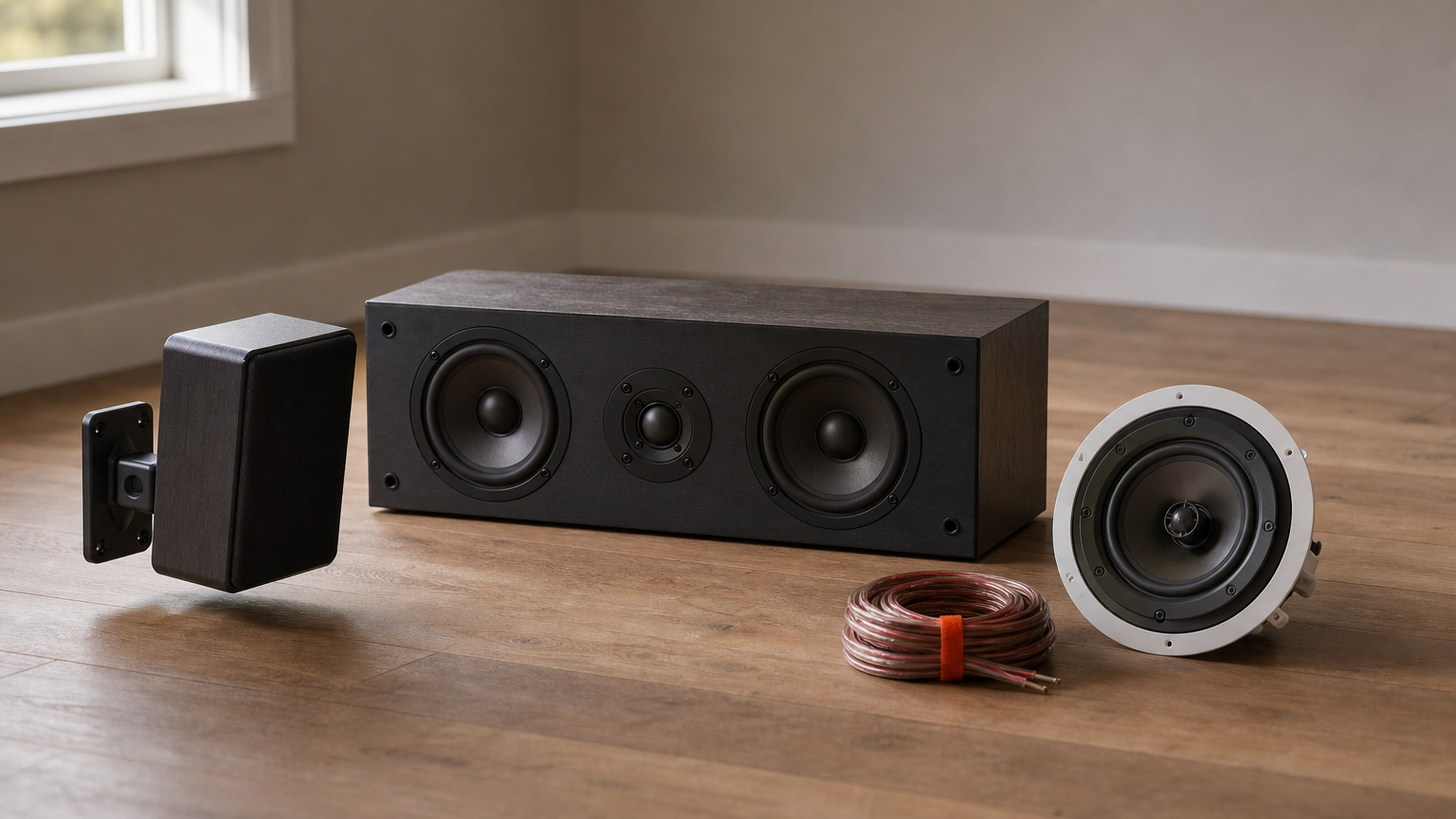
Wireless systems are a common question. They cut wire runs, but rear speakers still need power, and the equipment costs more. Published wireless installation ranges run from about $250 to $4,000, so wireless saves labor but not necessarily money.
The line items on a typical quote
A good quote lists each task separately. These are the ranges that show up most often for common jobs.
| Task | Typical cost |
|---|---|
| Receiver setup and connections | $100–$300 |
| Speaker mounting | $50–$150 per speaker |
| Wire concealment | $100–$500 |
| System calibration | $150–$400 |
| Wall or ceiling cutting and patching | $100–$500 |
| Outlets or a dedicated circuit | $250–$1,000 |
| Low-voltage prewire (new construction) | $200–$1,000 |
| Smart home or remote programming | $150–$600 |
| Permits, when required | $50–$250 |
Prewiring is the cheapest wiring you will ever buy. If you are building or opening walls in a remodel anywhere in the Treasure Valley, run speaker cable before the drywall goes up. Fishing wire through a finished wall costs far more in time and patching.
Room size and labor rates
Bigger rooms need more speakers, more powerful amplification, and longer cable runs. Open floor plans and vaulted ceilings add acoustic complexity. Small rooms up to about 200 square feet are the cheapest to outfit.
Hourly labor in published figures runs from $50 to $150 depending on region and the trade involved. Standard jobs often take two to three hours, while hidden wiring takes much longer. Local rates differ from national ones, which is why a quote for your own address beats any chart.
Your quote climbs with speaker count and hidden wiring, not with the brand on the box.
How to estimate your own installation cost
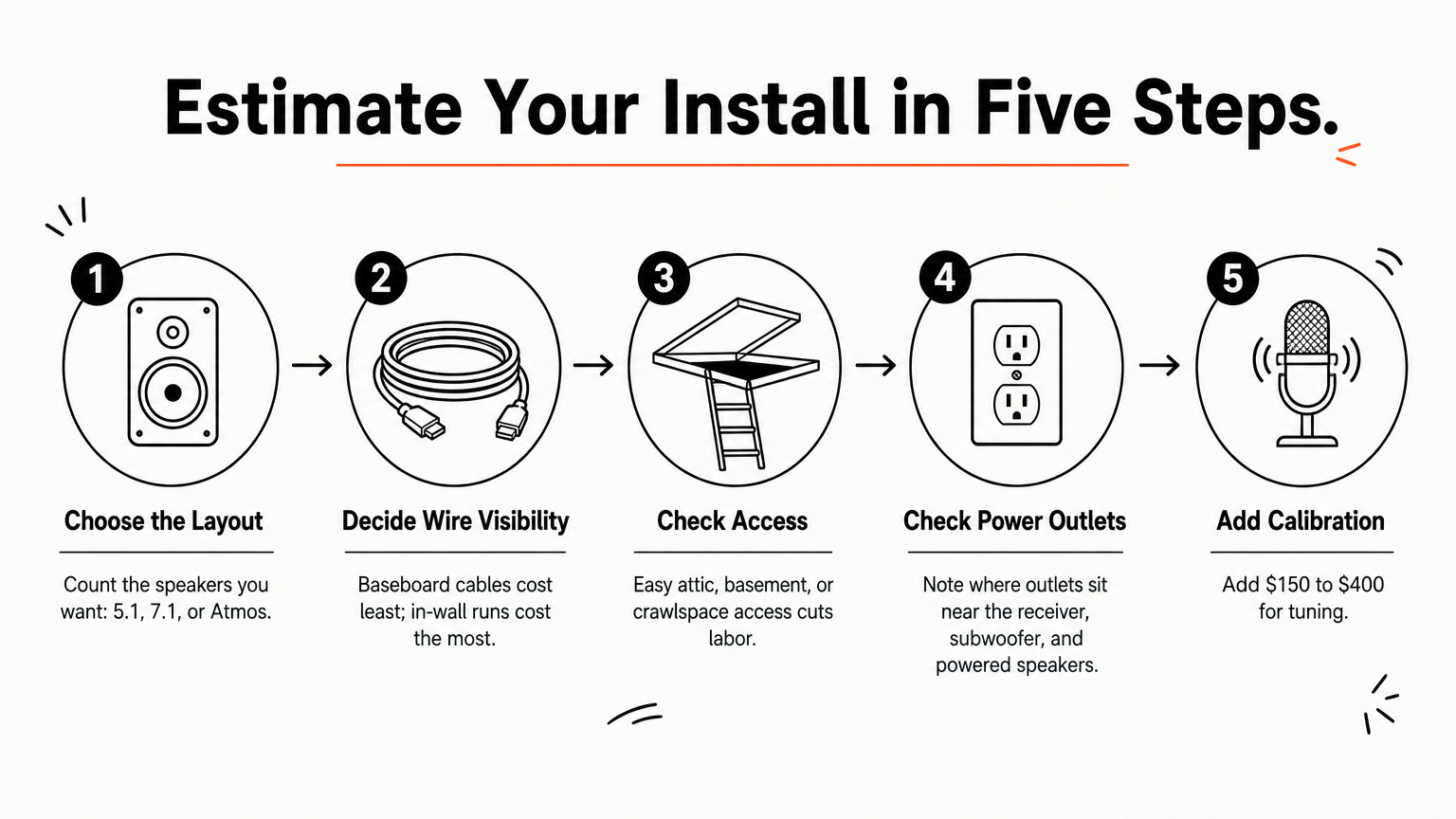
You can build a realistic estimate in five steps and then check it against a written quote. The goal is to arrive at the walkthrough knowing which line items apply to you.
A five-step estimate
- Choose the layout. Count the speakers you want, such as 5.1, 7.1, or Atmos.
- Decide how visible the wiring can be. Cables along baseboards cost the least, and in-wall runs cost the most.
- Check access. Look at the attic, basement, or crawlspace above or below the room, because easy access cuts labor.
- Check power. Note where outlets sit relative to the receiver, subwoofer, and any powered rear speakers.
- Add calibration. Include $150 to $400 for tuning, since skipping it wastes the equipment.
Worked example: a 5.1 living room
Say you have a family room of about 300 square feet and a mid-range 5.1 package at $1,000. Speakers on stands up front, two rear speakers wall-mounted, wires hidden along the wall. The labor might break down like this:
| Line item | Estimate |
|---|---|
| Receiver setup and connections | $200 |
| Wire concealment | $300 |
| Two rear speaker mounts at $100 each | $200 |
| Calibration | $250 |
| Installation total | $950 |
Add the $1,000 of equipment and the finished system costs about $1,950. If you decide you want the rear speakers in the wall instead, add roughly $500 to $2,000 for in-wall wiring, depending on access. Services such as our Surround Sound Installation are built for exactly this kind of existing living room, family room, or media room.
What to ask for in a quote
Get the number in writing and make sure it lists:
- The number and type of speakers being installed
- How wires will be concealed, and whether wall patching is included
- Whether calibration is included
- Any electrical work or permits
- What the warranty covers
A quote that lists labor line by line is a quote you can compare, question, and trust.
DIY versus professional installation
DIY saves you the labor, usually a few hundred dollars, and it works well for simple rooms. A professional pays off once you add in-wall wiring, ceiling speakers, 7.1, or Atmos.
What DIY really costs
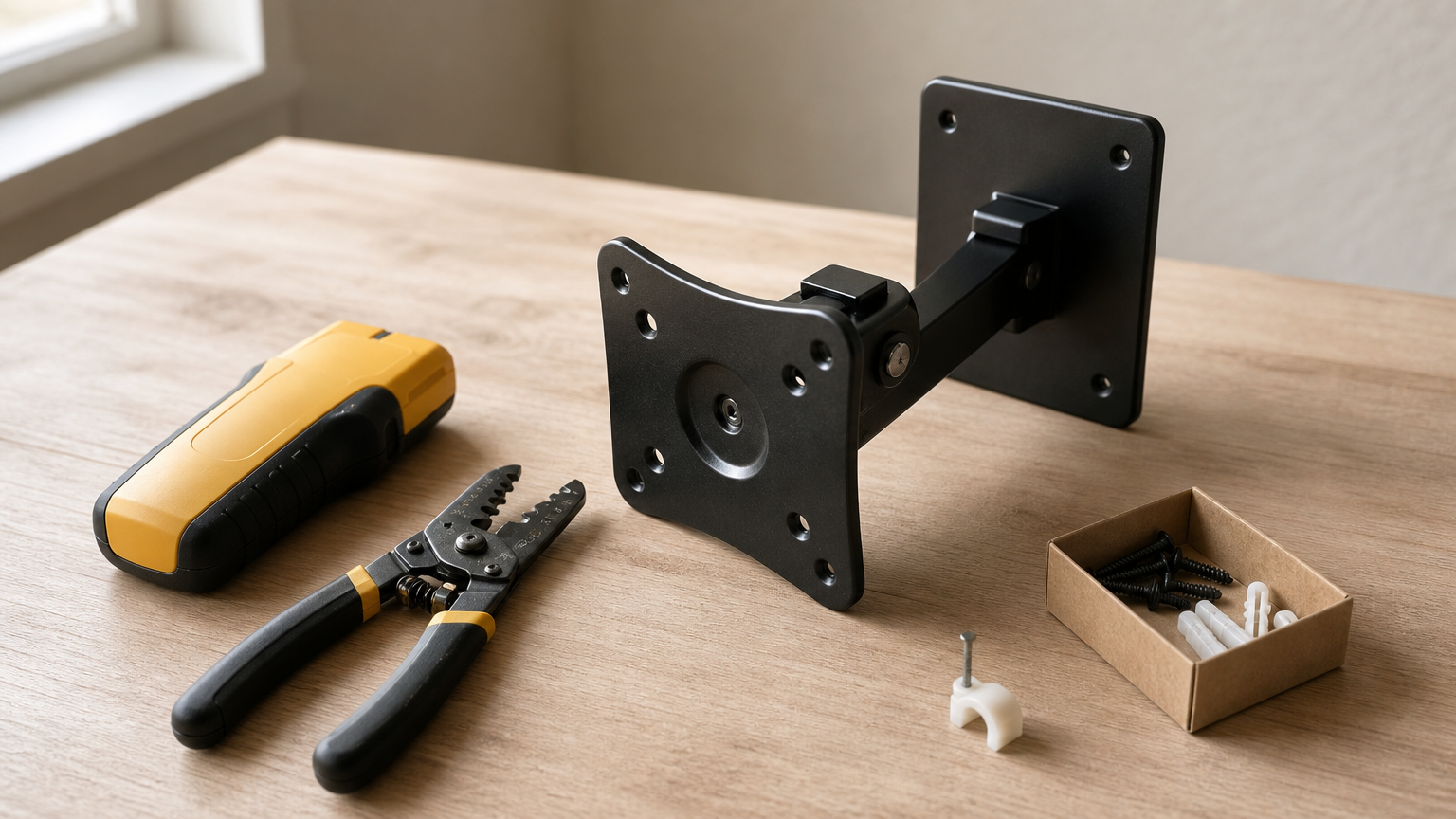
The savings are real but smaller than they look. DIYers typically spend $50 to $300 on tools such as wire strippers, a stud finder, and mounts. That is on top of the equipment. The time cost is also real, because running wire neatly through a room often takes a full weekend.
| DIY | Professional | |
|---|---|---|
| Labor cost | $0, plus $50–$300 in tools | $300–$1,200 for a typical 5.1 |
| Time | A weekend for most people | A few hours for a standard job |
| Risk | Drywall damage, wrong speaker placement | Low, and covered by a warranty |
| Calibration | Often skipped | Usually included or itemized |
| Best for | Soundbars, speakers on stands | In-wall, ceiling, 7.1, Atmos |
When hiring a pro makes sense
Hire a professional when the job touches your walls or ceilings. Cutting into drywall, fishing cable past fire blocking, and finding a spot for a ceiling speaker go wrong in expensive ways. Poor calibration is the other common failure, because most DIY systems never get tuned and sound only average.
Look for an installer who is licensed and insured and who stands behind the work. Ours is, with a one-year warranty on all work. You can also cut costs by splitting the job: clear the room, unbox the gear, measure, and mark speaker locations yourself, then let the pro handle wiring and tuning.
DIY is a fair choice for a soundbar or a simple 5.1, but any job that opens a wall is worth handing to a pro.
How to lower the cost without hurting the sound
The biggest savings come from planning the wiring early and sizing the system to your room. Cutting calibration or buying cheaper speakers is where money is wasted.
Plan the wiring first
Prewire during construction or a remodel. If walls are open, running speaker cable costs a fraction of what it does later. If they are not, choose hidden routes where access is easy, such as attics and unfinished basements, and use cord covers elsewhere to avoid demolition.
Choosing a layout with fewer cable runs also helps. Putting the receiver close to the front speakers and subwoofer shortens the longest runs, and every foot of wire hidden inside a wall adds labor.
Size the system and time the purchase
Match the system to the room. A giant Atmos setup in a small den is overkill, while a solid 5.1 system covers most rooms and leaves room to add speakers later. Buying equipment during holiday sales and end-of-model clearances also lowers the equipment half of the bill.
Bundling helps with labor. Combining surround sound with TV mounting or whole-home audio in a single visit usually costs less than separate appointments. Ask whether a project can be scoped in phases, so you spread the cost across a year.
The cheapest surround sound system is the one scoped to your room and wired before the drywall closes.
Getting an accurate number
Surround sound installation costs $300 to $1,200 for a typical 5.1 system and climbs to $2,500 or more for Atmos or hidden in-wall wiring. Speaker count, wire routing, wall and power prep, and calibration decide where you land in that range. Build your estimate with the five steps above, and always get a line-item quote.
If you want a number for your own home, the fastest way is a walkthrough. Request a free on-site consultation and estimate and we will scope the speakers, the wiring, and the tuning for your room. We respond to all inquiries within one business day.
Recent Google reviews
Read all reviews →“Great job!!”
“Amazing customer experience. They went above and beyond installing my 2 TVs on the wall and setting up my ring doorbell. Thier price was very very reasonable. Great experience, have used their service twice now.”
“Professional, on time and the team did an outstanding job! 100% would recommend and will use again.”