 (208) 991-3502
 Meridian, ID





Your TV delivers stunning 4K visuals but the built-in speakers sound thin and lifeless. Movies lose their punch. Dialogue gets buried under background noise. You crank the volume and still miss half t...
Your TV delivers stunning 4K visuals but the built-in speakers sound thin and lifeless. Movies lose their punch. Dialogue gets buried under background noise. You crank the volume and still miss half the conversation. You know surround sound would fix this, but running speaker cables across your living room sounds like a nightmare you'd rather avoid.
Wireless surround sound systems solve both problems. You get theater-quality audio that wraps around your space without drilling holes or hiding wires under rugs. We've tested and researched 15 systems that deliver genuine surround sound to your TV through wireless connectivity. From premium custom installations to budget-friendly soundbar packages, this guide covers options for every room size and budget. You'll find detailed specs, real-world performance notes, and honest assessments of what each system does well and where it falls short.
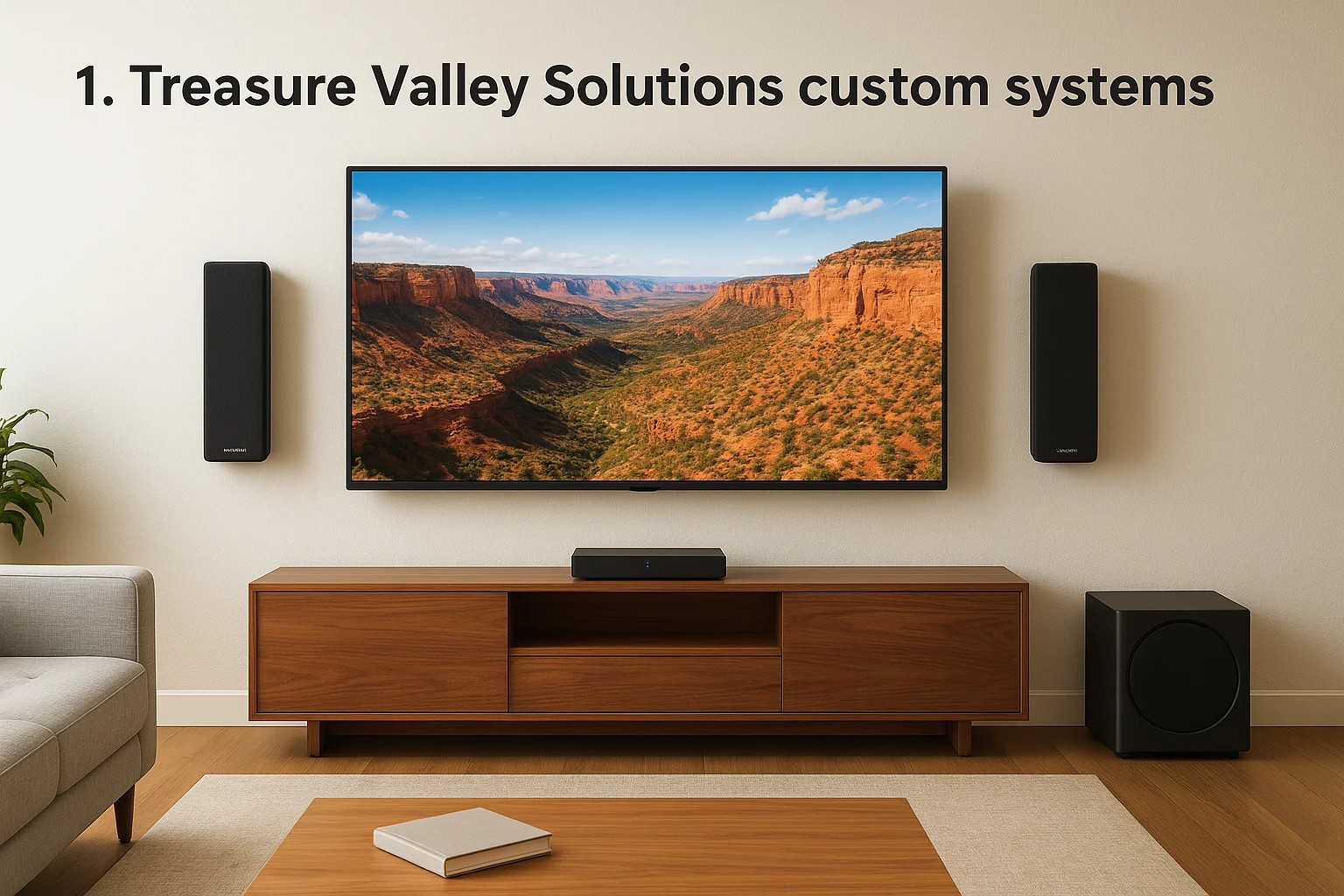
1. Treasure Valley Solutions custom systems
Treasure Valley Solutions builds fully customized wireless surround sound systems that adapt to your exact space, budget, and viewing habits. Their Meridian-based team designs each installation from scratch rather than forcing you into a one-size-fits-all package. You get professionally installed components that integrate with your TV, lighting, and smart home controls through a single interface.
Key wireless and audio specs
The wireless surround sound systems for TV that Treasure Valley Solutions installs use Wi-Fi-based transmission for reliable multi-channel audio without speaker cable runs. Your system connects through dedicated wireless modules that maintain consistent signal quality across all speakers. Audio formats include Dolby Atmos, DTS:X, and standard surround depending on which components you select. The team matches amplification power to your room dimensions, typically ranging from 100 watts to 500+ watts per channel for larger spaces.
Best use cases and room sizes
Custom installations work best when your room presents unique challenges that off-the-shelf systems can't address. You benefit most if you need speakers hidden in walls or ceilings, awkward room layouts, or integration with existing smart home gear. Treasure Valley Solutions handles everything from compact 12x14 media rooms to expansive open-concept great rooms exceeding 25 feet in any direction.

Smart TV and streaming features
Your custom system integrates with any smart TV brand through HDMI connections and supports streaming from all major platforms. Treasure Valley Solutions programs universal remote controls or tablet interfaces that manage your TV, surround sound, streaming devices, and lighting from one screen. Voice control through Alexa or Google Assistant becomes possible when you want hands-free operation.
Custom integration means your surround system works exactly how you want it to, not how a manufacturer decided it should work.
Strengths, limitations, and trade offs
Professional installation delivers clean results with hidden wiring and optimized speaker placement that DIY setups rarely achieve. You get ongoing local support when questions arise or you want to add features. The limitation is time investment during the design and installation process. Trade-offs include higher upfront costs compared to buying a soundbar package online, though you avoid the frustration of systems that don't quite fit your needs.
Price range and value notes
Custom wireless surround installations from Treasure Valley Solutions typically start around $3,000 to $5,000 for basic setups and scale to $15,000+ for premium components and complex rooms. You pay for design expertise, professional installation, and programming in addition to equipment. The value comes from getting exactly what you need without wasted features, backed by local service you can actually reach when needed.
2. Samsung HW-Q990F soundbar system
The Samsung HW-Q990F delivers 11.1.4 channels of wireless surround sound through a speaker-packed soundbar, wireless subwoofer, and rear satellite units. This flagship system creates three-dimensional audio that places effects above, beside, and behind you without running a single speaker cable. Samsung redesigned the subwoofer from previous models to use dual 8-inch drivers in a sealed enclosure that eliminates port noise while delivering tighter bass response.
Key wireless and audio specs
You get 15 drivers in the main soundbar that include side-firing, corner-firing, and up-firing speakers for expansive soundstage coverage. The system handles Dolby Atmos and DTS:X formats with dedicated height channels that bounce audio off your ceiling. Wireless transmission operates on dedicated frequency bands to prevent interference with your Wi-Fi network. Total power output reaches levels that fill rooms up to 400 square feet without distortion at high volumes.
Best use cases and room sizes
This Samsung system works best in living rooms between 250 and 400 square feet where you want cinema-quality audio without professional installation. You benefit most if you own a Samsung QLED TV that unlocks advanced features. The 48.5-inch soundbar fits under TVs 55 inches and larger without overhanging narrower stands.
Smart TV and streaming features
The HW-Q990F connects through HDMI 2.1 with eARC to handle high-resolution audio from your TV's built-in apps. You can stream music via Wi-Fi, Bluetooth 5.3, AirPlay 2, Chromecast, and Spotify Connect when you're not watching content. SpaceFit Sound Pro calibrates the system in under one minute using your TV's microphone. Samsung TV owners unlock Q-Symphony technology that adds the TV's built-in speakers as bonus channels and enables wireless Dolby Atmos transmission without HDMI cables.
Q-Symphony synchronizes your Samsung TV's speakers with the soundbar to strengthen the center channel and expand the overall soundscape beyond what the bar alone can deliver.
Strengths, limitations, and trade offs
Samsung engineered this system for crystal-clear dialogue that cuts through complex soundtracks without forcing you to adjust volume constantly. The sealed subwoofer design reduces cabinet resonance that bothers neighbors in apartments or condos. Limitations include only two HDMI inputs that require an external switch for multiple gaming consoles. Non-Samsung TV owners miss out on Q-Symphony and wireless Atmos features.
Price range and value notes
The complete HW-Q990F system retails around $1,700 to $1,900 depending on sales and bundles. You pay premium pricing for flagship performance and Samsung TV integration that cheaper systems can't match. The value proposition strengthens if you already own a compatible Samsung television.
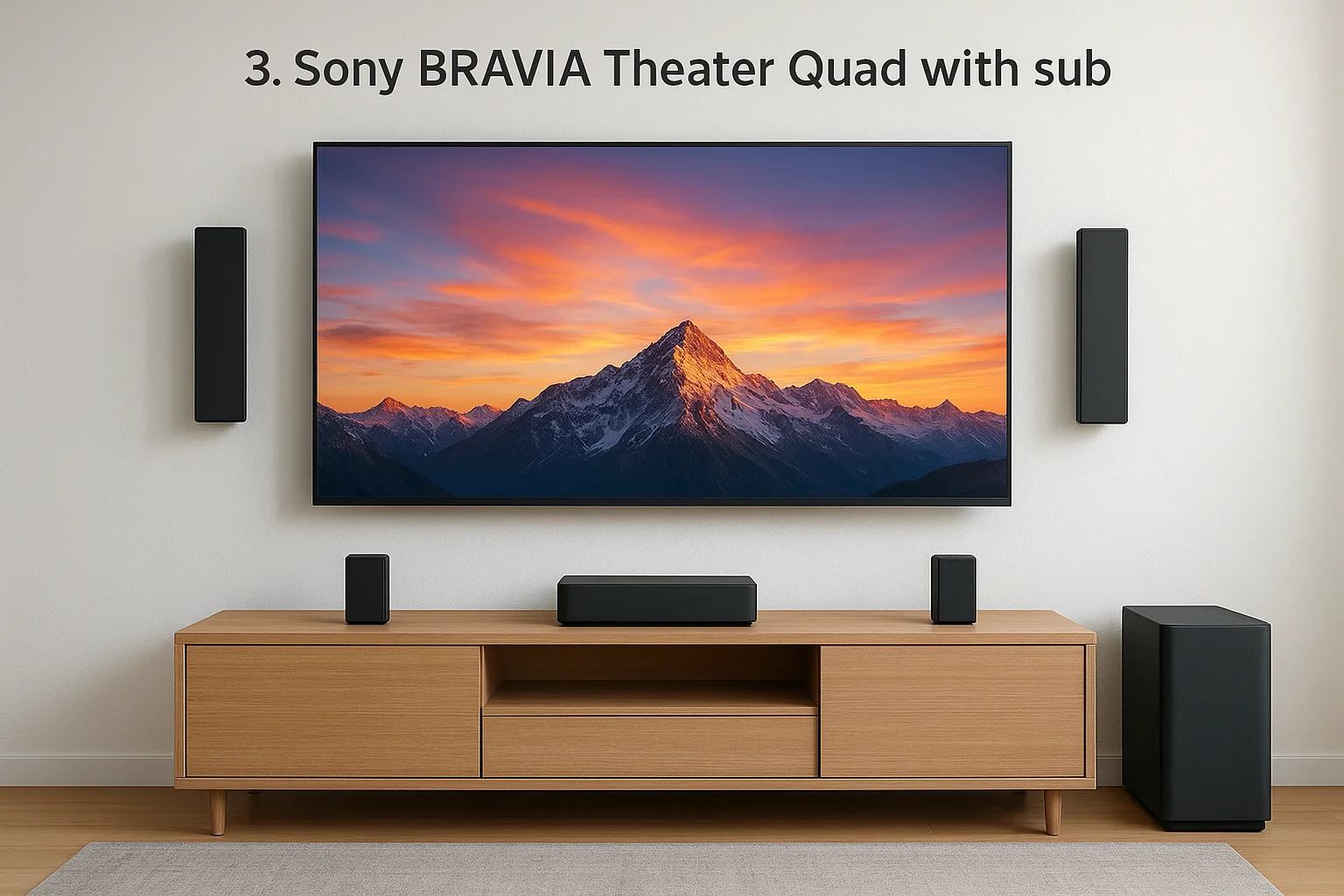
3. Sony BRAVIA Theater Quad with sub
The Sony BRAVIA Theater Quad takes a radically different approach to wireless surround sound systems for TV by using four discrete panel-like speakers instead of a traditional soundbar. Each speaker contains upfiring and beamforming technology that creates Dolby Atmos effects from multiple positions around your room. You can wall-mount these slim arrays or place them freestanding, and Sony's software compensates for either placement choice. A compact control box handles all connections to your TV and stays hidden beneath your entertainment center.
Key wireless and audio specs
This system delivers 7.1.2-channel sound through 16 total speaker drivers spread across the four main speakers. Each unit contains multiple drivers working together to create 360 Spatial Sound Mapping that adapts to your room's shape and dimensions. The SA-SW5 wireless subwoofer adds 300 watts of power through a 7-inch driver that handles low frequencies down to 32Hz. Wireless transmission happens through dedicated Sony protocols that maintain audio quality without compression. You connect the control box to your TV via HDMI 2.1 with eARC for lossless audio transmission.
Best use cases and room sizes
Sony designed this system for flexible placement in modern living spaces where traditional soundbar setups don't work well. You benefit most when your room layout requires speakers in non-standard positions or when you want discreet speakers that blend with contemporary decor. The system handles medium to large rooms up to 350 square feet effectively. Compact speaker dimensions mean you can fit them into tighter spaces that larger soundbars can't accommodate.
Smart TV and streaming features
Your Quad system supports 8K video passthrough at 60Hz and 4K at 120Hz for next-generation gaming consoles and high-resolution content. Built-in Chromecast, AirPlay 2, and Spotify Connect let you stream music wirelessly from any device. Sony BRAVIA TV owners unlock Acoustic Center Sync that uses the TV's built-in speakers alongside the Quad system for enhanced dialogue clarity. The system also supports Sony 360 Reality Audio for compatible music streaming services.
Acoustic Center Sync anchors dialogue directly to the screen by incorporating your Sony TV's speakers into the overall soundstage for more precise vocal placement.
Strengths, limitations, and trade offs
Sony's panel-like speaker design offers installation versatility that traditional soundbars can't match. The system delivers precise sound architecture through advanced beamforming rather than brute force. Limitations include the unusual form factor that requires planning for four separate speaker placements plus subwoofer positioning. Trade-offs involve higher complexity compared to single-bar solutions, though you gain superior spatial accuracy in return.
Price range and value notes
The complete BRAVIA Theater Quad system with SA-SW5 subwoofer costs approximately $3,200 to $3,500 depending on retailer and promotions. You pay premium pricing for Sony's innovative speaker design and spatial processing technology that differs from conventional wireless surround sound systems for TV. The value proposition centers on flexible placement options and precision audio rather than maximum power output.
4. Sonos Arc Ultra with Sub and Era surrounds
The Sonos Arc Ultra represents one of the most refined wireless surround sound systems for TV available in 2026, combining sleek design with powerful spatial audio capabilities. This system uses 14 built-in speakers including dedicated center channel drivers and precisely angled side, front, and up-firing tweeters to create immersive Dolby Atmos sound. You can expand the Arc Ultra with one or two Sonos Sub subwoofers and pair of Era 100 or Era 300 rear speakers to build a complete wireless surround setup.
Key wireless and audio specs
Your Arc Ultra soundbar connects through HDMI eARC for lossless audio transmission and communicates with other Sonos components via Wi-Fi rather than proprietary wireless protocols. The system supports Dolby Atmos with dynamic object-based audio that places sounds precisely in three-dimensional space. Each Sub features dual force-canceling drivers that deliver deep bass without cabinet vibration. Era 300 surrounds contain six multidirectional drivers specifically engineered for spatial audio formats. Total system configuration reaches 7.1.4 channels when you pair the Arc Ultra with Sub and Era 300 speakers.
Best use cases and room sizes
Sonos excels in homes where multiroom audio expansion matters as much as TV sound quality. You benefit most if you want to stream music throughout your house while maintaining theater-quality performance in your main viewing space. The Arc Ultra fits TVs 55 inches and larger and handles rooms up to 350 square feet effectively. Smaller rooms work better with Era 100 surrounds, while larger spaces justify the Era 300 upgrade.
Smart TV and streaming features
Built-in Amazon Alexa and Sonos Voice let you control playback hands-free without reaching for a remote. You stream content through AirPlay 2, Spotify Connect, and all major music services directly from the Sonos app. The system lacks Bluetooth but the extensive streaming integration compensates for this omission.
The Sonos ecosystem treats your TV surround system as part of a whole-home audio network rather than an isolated home theater component.
Strengths, limitations, and trade offs
Sonos delivers exceptional build quality and intuitive app control that makes daily use effortless. The modular approach lets you start with just the soundbar and add components gradually. Limitations include single HDMI connection and app-only volume control without physical remotes. Trade-offs involve higher per-component costs compared to bundled systems.
Price range and value notes
The complete Arc Ultra system with Sub and Era 300 surrounds costs approximately $2,500 total when purchased separately. Individual components range from $449 for Era 100 speakers to $1,099 for the Arc Ultra itself. You pay premium pricing for Sonos ecosystem integration and long-term software support that extends system lifespan beyond typical soundbar replacements.
5. JBL Bar 1300X Atmos system
The JBL Bar 1300X stands out among wireless surround sound systems for TV through its detachable battery-powered rear speakers that recharge directly on the soundbar. You get 11.1.4-channel surround sound without plugging rear speakers into wall outlets, solving the biggest hassle most wireless systems still face. The soundbar itself contains 11 drivers while a 12-inch wireless subwoofer handles deep bass frequencies.
Key wireless and audio specs
Your system delivers 1,170 watts of total power across all channels with frequency response spanning 33Hz to 20kHz. The Bar 1300X handles Dolby Atmos and DTS:X formats through four dedicated up-firing speakers mounted in the soundbar. Wireless connectivity includes Wi-Fi, Bluetooth 5.0, AirPlay 2, and Chromecast for flexible streaming options. Connection to your TV happens through HDMI 2.0 with eARC for high-resolution audio transmission.
Best use cases and room sizes
This JBL system works best in living rooms between 200 and 350 square feet where you want true wireless rear speakers without power cables. You benefit most when flexibility matters because you can detach the rear speakers for movie nights and reconnect them to recharge when watching regular TV programming. The battery-powered surrounds run for approximately 10 hours before needing a three-hour recharge cycle.
Smart TV and streaming features
Built-in streaming protocols support all major music services directly through the soundbar without routing audio through your TV. Your system passes through 4K video signals to maintain picture quality. Voice control works through compatible devices though the soundbar lacks built-in voice assistants.
Battery-powered rear speakers eliminate the last cable run in wireless surround setups, giving you genuine placement freedom.
Strengths, limitations, and trade offs
JBL solved the power outlet problem that plagues most wireless surround systems. Setup takes roughly five minutes with automatic speaker pairing. Limitations include HDMI 2.0 rather than 2.1 which restricts some gaming features. You trade cutting-edge connectivity for superior wireless implementation.
Price range and value notes
The complete Bar 1300X system costs approximately $1,700 for soundbar, subwoofer, and battery-powered rear speakers. You pay premium pricing for true wireless rear channels that other systems can't match. Value centers on convenience rather than raw power specifications.
6. JBL Bar 700 MK2 wireless system
The JBL Bar 700 MK2 delivers 7.1-channel surround sound through a refined package that improves upon its predecessor with enhanced wireless features. This system combines a speaker-packed soundbar, 10-inch wireless subwoofer, and detachable battery-powered rear speakers that recharge directly on the main bar. You get authentic surround effects without running power cables to your rear speakers.
Key wireless and audio specs
Your Bar 700 MK2 contains seven built-in speakers powered by an integrated amplifier that handles Dolby Atmos content. The down-firing subwoofer adds impact to explosions and musical bass lines without overwhelming dialogue frequencies. Wireless rear speakers communicate through dedicated transmission protocols that prevent audio lag. These surrounds operate for 10 hours on battery power and fully recharge in three hours when docked to the soundbar.
Best use cases and room sizes
This JBL system works best in rooms between 180 and 300 square feet where you want flexibility. You benefit most when you need wireless surround sound systems for TV that adapt to different viewing situations. Attach the rear speakers for wide stereo soundstage during casual viewing, then detach them for genuine wraparound effects during movie nights.
Smart TV and streaming features
Built-in Apple AirPlay 2, Bluetooth, and Google Cast let you stream music from any compatible device. Your system connects to TVs through HDMI with eARC for high-quality audio transmission. Voice control integration works through external assistants rather than built-in microphones.
Rechargeable rear speakers that dock to the soundbar eliminate both speaker cables and separate power adapters from your setup.
Strengths, limitations, and trade offs
JBL engineered practical wireless implementation that solves real-world cable management problems. Setup requires minimal effort with automatic speaker pairing. Your system may lack flagship power levels but delivers balanced performance suitable for most content types.
Price range and value notes
The Bar 700 MK2 costs approximately $700 to $900 depending on sales timing. You pay mid-tier pricing for genuine wireless convenience in a complete package that includes everything needed for surround sound.
7. Polk MagniFi MAX AX SR system
The Polk MagniFi MAX AX SR delivers 5.1.2-channel wireless surround sound through an 11-driver soundbar, 10-inch wireless subwoofer, and pair of dedicated rear speakers. This system supports Dolby Atmos and DTS:X formats with up-firing drivers that create overhead audio effects. Polk designed this package for buyers who want flagship features without flagship pricing.
Key wireless and audio specs
Your MagniFi MAX AX SR processes immersive audio formats through dedicated height channels built into the soundbar. Wireless connectivity includes Wi-Fi, Bluetooth, Chromecast, AirPlay 2, and Spotify Connect for comprehensive streaming options. The rear speakers connect wirelessly to the main bar and require AC power outlets for operation. Frequency response covers the range needed for movie soundtracks and music playback.
Best use cases and room sizes
This Polk system works best in living rooms between 200 and 350 square feet where you want true Atmos performance at reasonable cost. You benefit most when clear dialogue matters because VoiceAdjust technology lets you boost vocal frequencies independently of other sounds. Dual 3-inch drivers in each rear speaker provide sufficient output for wraparound effects.
Smart TV and streaming features
Built-in streaming protocols eliminate the need to route audio through your TV for music playback. Your system connects through HDMI eARC for lossless audio transmission from compatible televisions. Voice control works through external assistants rather than built-in microphones in the soundbar itself.
VoiceAdjust gives you independent control over dialogue levels so conversations stay intelligible during action-heavy scenes.
Strengths, limitations, and trade offs
Polk engineered balanced performance across all frequency ranges rather than emphasizing bass at the expense of clarity. The system handles both movies and music effectively. Your rear speakers need power outlets which limits placement options compared to battery-powered alternatives.
Price range and value notes
The complete MagniFi MAX AX SR costs approximately $900 for all components. You pay mid-range pricing for Atmos capability and comprehensive streaming that budget wireless surround sound systems for TV typically omit.
8. Nakamichi Dragon surround system
The Nakamichi Dragon represents the most powerful option among wireless surround sound systems for TV with an intimidating 11.4.6-channel configuration that uses 31 total speaker drivers. This flagship system includes a massive 58-inch soundbar, quad 12-inch wireless subwoofers delivering 750+ watts each, and Omni-Motion Reference Surround speakers that fire sound sideways and upward. You get raw acoustic power that transforms movie watching into a visceral experience.
Key wireless and audio specs
Your Dragon system pumps out 5,000 watts of total power with maximum output reaching 131dB, far exceeding what most residential systems deliver. The soundbar contains three Air Motion Transformer tweeters known among audiophiles for hyper-accurate frequency response across the 19Hz to 22kHz range. Six angled up-firing speakers split between 10-degree and 20-degree angles ensure Adaptive Height Dispersion Processing renders overhead Dolby Atmos effects precisely. Wireless transmission connects all four aluminum-driver subwoofers and surround speakers without signal degradation.
Best use cases and room sizes
This Nakamichi system demands large dedicated home theaters exceeding 400 square feet where maximum impact matters more than subtlety. You benefit most when your goal involves recreating commercial cinema experiences at home. The quad subwoofer configuration works best with ample floor space for strategic placement that eliminates dead spots in bass response.
Smart TV and streaming features
Three HDMI 2.1 inputs plus dedicated eARC output handle multiple 4K sources simultaneously with support for Dolby Vision and HDR10 video formats. Your system streams music through Bluetooth 5.0 with aptX HD codec support that maintains audio quality during wireless transmission. Optical and coaxial digital inputs provide backup connectivity options.
The Dragon's quad subwoofer array eliminates the single-point bass problem that causes uneven low-frequency response across large viewing spaces.
Strengths, limitations, and trade offs
Nakamichi engineered uncompromising power delivery that handles reference-level volumes without distortion or compression. The system creates truly immersive sound fields in appropriately sized rooms. Your setup requires significant physical space and multiple AC outlets for four subwoofers plus other components. Trade-offs include substantial upfront investment and installation complexity.
Price range and value notes
The complete Dragon system costs approximately $6,500 for all components. You pay flagship pricing for extreme power output and build quality that mass-market systems cannot approach. Value centers on maximizing impact rather than minimizing cost.
9. Nakamichi Shockwafe Ultra 9.2.4
The Nakamichi Shockwafe Ultra 9.2.4 eARC SSE Max brings scaled-down Dragon technology to wireless surround sound systems for TV at a more accessible price point. This system delivers 9.2.4-channel audio through a soundbar, dual wireless subwoofers, and four modular surround speakers that create 360-degree immersion. Nakamichi redesigned the hardware based on customer feedback with upgraded drivers, new amplifiers, and second-generation surround speakers featuring silk dome tweeters.
Key wireless and audio specs
Your Shockwafe system processes Dolby Atmos and DTS:X formats through dedicated height channels in the soundbar. Three Spatial Surround Elevation processing engines work together to create realistic soundstage width, balance the mix across all speakers, and generate convincing overhead effects. The soundbar contains extended-range twin-cone drivers while each surround speaker uses a two-way design with silk dome tweeters. Wireless subwoofers connect through dedicated bands separate from your home Wi-Fi network. Connectivity includes HDMI 2.1 inputs with eARC, Bluetooth 5.0 with aptX HD, and support for 4K HDR with Dolby Vision passthrough.
Best use cases and room sizes
This Nakamichi system works best in medium to large rooms between 250 and 450 square feet where you want commanding sound without Dragon-level investment. You benefit most when bass impact matters because dual subwoofers eliminate the weak spots that single-sub configurations create. The four surround speakers need strategic placement and multiple power outlets to deliver optimal results.
Smart TV and streaming features
Built-in Bluetooth with aptX HD codec maintains audio quality when streaming music wirelessly from compatible devices. Your system connects through HDMI 2.1 for variable refresh rate and auto low latency mode that benefit next-generation gaming consoles. Support for 4K at 120Hz ensures smooth gameplay on compatible displays.
Dual wireless subwoofers distribute bass energy more evenly across your viewing space compared to single-sub systems that create hot spots and dead zones.
Strengths, limitations, and trade offs
Nakamichi packed flagship features into a smaller footprint with pricing that competes against mid-tier soundbar systems. The SSE Max processing creates impressive spatial effects during properly mixed content. Your installation requires multiple power outlets for four surround speakers plus two subwoofers. Finding optimal placement takes experimentation to maximize the system's capabilities.
Price range and value notes
The Shockwafe Ultra 9.2.4 eARC SSE Max costs approximately $1,900 for the complete system. You pay upper mid-range pricing for dual subwoofers and advanced processing that budget systems omit entirely.
10. Bluesound Pulse Soundbar Plus system
The Bluesound Pulse Soundbar Plus targets audiophile listeners who demand high-resolution audio quality from their wireless surround sound systems for TV. This system processes 24-bit/192kHz audio streams including MQA decoding and works as a Roon Ready endpoint if you run a compatible music server. You build your surround setup by pairing the SOUNDBAR+ with a PULSE SUB+ subwoofer and two PULSE FLEX 2i or PULSE M satellite speakers.
Key wireless and audio specs
Your Bluesound system delivers 7.1-channel audio through 11 speaker drivers with the soundbar producing 120 watts and each Flex speaker outputting 25 watts. Frequency response spans 22Hz to 20kHz across all components working together. The soundbar contains eight forward-facing drivers in a configuration that includes 1-inch tweeters, 2-inch mid-range drivers, 4-inch woofers, and 4-inch passive radiators. Wireless connectivity uses dual-band Wi-Fi 802.11ac for surround speakers and subwoofer communication. You connect to your TV through HDMI 2.1 with eARC while Bluetooth aptX HD maintains quality during wireless music streaming.
Best use cases and room sizes
This Bluesound system works best for music listeners who also watch movies rather than dedicated home theater enthusiasts. You benefit most when you own high-resolution audio files or subscribe to services offering lossless streaming. The system handles rooms between 200 and 350 square feet effectively with balanced tonal character across all frequency ranges.
Smart TV and streaming features
Built-in AirPlay 2 connectivity lets iOS devices stream lossless audio directly over Wi-Fi. Your system supports Spotify Connect and TIDAL Connect for native streaming that bypasses your phone. The BluOS app consolidates source control and provides equalization options.
The PULSE system prioritizes musical accuracy over maximum volume, delivering warm lows and precise treble without harshness.
Strengths, limitations, and trade offs
Bluesound engineered exceptional audio fidelity that reveals subtle details in well-recorded content. The system expands into multiroom audio by adding PULSE speakers in other zones. Your surround speakers need AC power outlets which restricts placement flexibility.
Price range and value notes
Pricing varies by configuration but typically ranges $1,800 to $2,500 for soundbar, subwoofer, and pair of surround speakers purchased separately. You pay premium pricing for high-resolution audio support that mass-market systems ignore.
11. Denon Home Sound Bar 550 system
The Denon Home Sound Bar 550 system offers budget-friendly multiroom expansion for wireless surround sound systems for TV through modular components you purchase gradually. This system combines a compact 26-inch soundbar with optional wireless subwoofer and 150 Wireless Speakers that create 5.1-channel surround audio. Denon wraps all components in matching cloth coverings that blend with contemporary living room aesthetics.
Key wireless and audio specs
Your Denon system delivers 5.1-channel audio through 11 total speaker drivers when you combine soundbar, subwoofer, and rear speakers. The compact bar handles Dolby Atmos and DTS:X formats though it lacks up-firing drivers for overhead effects. Wireless connectivity uses dual-band Wi-Fi and Bluetooth with support for 24-bit/192kHz high-resolution audio. Connection options include HDMI 2.1 with eARC, optical digital input, and analog minijack for various source types.
Best use cases and room sizes
This Denon setup works best when you want modular flexibility to start small and expand over time. You benefit most in rooms between 150 and 300 square feet where the soundbar's modest output suffices. The system lets you add 250 or 350 wireless speakers in other rooms for whole-home audio coverage.
Smart TV and streaming features
Built-in HEOS app consolidates streaming services including Spotify, Tidal, Deezer, and Amazon Music into one interface. Your system supports AirPlay 2, Alexa, and Google Assistant for voice control and wireless streaming. Each 150 Wireless Speaker includes independent volume controls and Bluetooth pairing plus USB and minijack inputs.
The HEOS ecosystem lets you build from a single soundbar to a complete multiroom audio system at your own pace.
Strengths, limitations, and trade offs
Denon engineered clear, balanced sound that handles both movies and music effectively. The modular approach lets you spread purchases across months rather than buying everything upfront. Initial setup through HEOS can frustrate with firmware updates and pairing delays.
Price range and value notes
Complete system pricing totals approximately $1,500 for soundbar, subwoofer, and pair of 150 speakers. You pay mid-range pricing while saving several hundred dollars compared to Sonos or Bluesound multiroom alternatives.
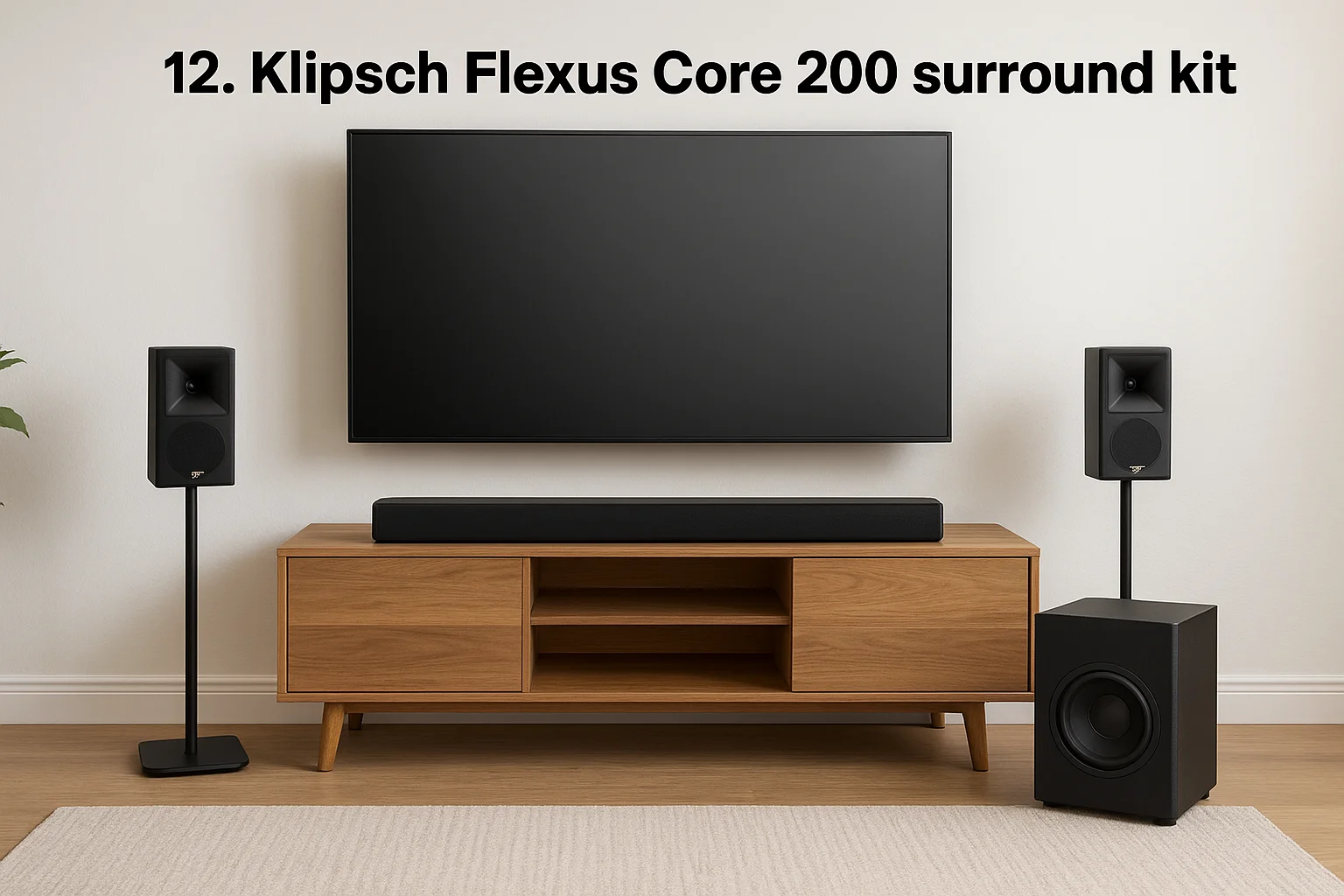
12. Klipsch Flexus Core 200 surround kit
The Klipsch Flexus Core 200 delivers authentic Klipsch horn-loaded sound in a wireless surround sound system for TV that costs significantly less than premium alternatives. This modular kit combines a sleek 2-channel soundbar with the Flexus Sub 100 subwoofer and pair of Flexus Surround 100 speakers to create convincing surround effects. Klipsch designed this system for buyers who want their signature dynamic sound without the complexity of professional installation.
Key wireless and audio specs
Your Flexus Core 200 soundbar contains dual horn-loaded tweeters that deliver the crisp high frequencies Klipsch is known for among audio enthusiasts. The system handles Dolby Atmos audio formats through virtual height processing rather than physical up-firing speakers. Wireless connectivity operates through dedicated radio frequencies that prevent interference with your home network. The Sub 100 adds low-frequency impact through a compact enclosure while Surround 100 speakers mount on stands or walls behind your seating position.
Best use cases and room sizes
This Klipsch system works best in rooms between 180 and 300 square feet where you want lively, detailed sound that brings movie soundtracks to life. You benefit most when dynamic range matters because horn-loaded drivers reproduce both quiet dialogue and explosive action without compression. The compact components fit spaces that larger systems overwhelm visually.
Smart TV and streaming features
Built-in Bluetooth connectivity lets you stream music wirelessly from compatible devices. Your system connects through HDMI for audio transmission from your TV's built-in apps and external sources.
Horn-loaded tweeters give Klipsch speakers their signature efficiency and dynamic punch that conventional dome tweeters cannot match.
Strengths, limitations, and trade offs
Klipsch engineered impressive dynamics and clarity at moderate price points. The modular design lets you start with the soundbar and add components gradually. Your system lacks built-in streaming beyond Bluetooth which limits wireless music options compared to Wi-Fi-equipped alternatives.
Price range and value notes
The complete Flexus kit costs approximately $800 to $1,000 for soundbar, subwoofer, and surround speakers. You pay mid-tier pricing for Klipsch audio heritage and horn-loaded performance that budget systems cannot replicate.
13. Bose Smart Ultra Soundbar system
The Bose Smart Ultra Soundbar delivers premium wireless surround sound through the company's refined approach to audio engineering that prioritizes clarity over raw power. This system uses proprietary TrueSpace technology to create immersive soundscapes from a single elegant bar, with options to expand through wireless Bass Module 700 and Surround Speakers 700 for authentic multichannel audio. Bose designed this system for listeners who value balanced, articulate sound reproduction across all content types.
Key wireless and audio specs
Your Bose system processes Dolby Atmos and spatial audio formats through advanced digital signal processing that creates height effects without physical up-firing drivers. The soundbar connects wirelessly to optional surround components through proprietary Bose protocols that maintain audio synchronization. Built-in amplification powers the bar's driver array while connection to your TV happens through HDMI eARC for lossless audio transmission. Frequency response emphasizes midrange clarity that makes dialogue intelligible without artificial boosting.
Best use cases and room sizes
This Bose setup works best in rooms between 200 and 320 square feet where you prioritize voice clarity and balanced tonality. You benefit most when watching content with complex soundtracks where dialogue needs to stay clear despite background music and effects. The slim soundbar profile fits under most TV sizes without visual bulk.
Smart TV and streaming features
Built-in Wi-Fi and Bluetooth connectivity support wireless music streaming from all major services. Your system integrates with Amazon Alexa and Google Assistant for voice control without external devices. The Bose Music app consolidates source selection and EQ adjustments.
Bose's TrueSpace processing analyzes incoming audio and intelligently upmixes it to create spatial effects even from stereo source material.
Strengths, limitations, and trade offs
Bose engineered exceptional dialogue clarity that reduces the need to adjust volume during varied content. Setup simplicity means you connect and start using the system within minutes. Your investment prioritizes refinement over maximum output levels that some competing wireless surround sound systems for tv deliver.
Price range and value notes
The Smart Ultra Soundbar costs approximately $900 standalone with complete surround packages reaching $2,400 when adding bass module and rear speakers. You pay premium pricing for Bose audio quality and brand reliability backed by established customer support networks.
14. LG S95QR Dolby Atmos soundbar
The LG S95QR brings flagship-level immersion to wireless surround sound systems for tv through a comprehensive 9.1.5-channel configuration that uses up-firing drivers, side-firing speakers, and dedicated wireless rear satellites. This system includes a 15-speaker soundbar, 8-inch wireless subwoofer, and pair of rear speakers that each contain their own up-firing drivers for enhanced spatial effects. LG engineered this setup to compete directly against Samsung and Sony premium offerings while maintaining compatibility with LG OLED and QLED televisions.
Key wireless and audio specs
Your S95QR processes Dolby Atmos and DTS:X formats through 20 total speaker drivers distributed across all components. The main soundbar delivers 620 watts of power while wireless transmission operates through dedicated frequency bands that maintain audio quality without Wi-Fi interference. Up-firing drivers in both the soundbar and rear speakers create genuine overhead sound effects rather than simulated height processing. Connection to your TV happens through HDMI eARC for lossless audio transmission.
Best use cases and room sizes
This LG system works best in living rooms between 250 and 380 square feet where you want competitive flagship performance at slightly lower cost than premium alternatives. You benefit most when pairing with an LG television that unlocks synced processing features. The rear speakers require AC power outlets for operation.
Smart TV and streaming features
Built-in Bluetooth, Chromecast, and AirPlay 2 support wireless music streaming from compatible devices. Your system integrates with Google Assistant for voice control functionality. LG TV owners access additional calibration options through TV menus.
LG's rear speakers with integrated up-firing drivers extend the height dimension behind your seating position for more convincing Atmos immersion.
Strengths, limitations, and trade offs
LG engineered strong bass response from the included subwoofer that handles action sequences effectively. The system delivers balanced performance across movie and music content. Your rear speakers lack the battery operation that some competing models offer.
Price range and value notes
The complete S95QR system costs approximately $1,400 to $1,700 depending on retail promotions. You pay upper mid-tier pricing for genuine 9.1.5-channel configuration that budget systems cannot match.
15. Ultimea 5.1 budget surround system
The Ultimea 5.1 soundbar system delivers entry-level wireless surround sound for buyers who want authentic multichannel audio without spending four figures. This system combines a soundbar with adjustable surround speakers and wireless subwoofer that together output 320 watts of peak power. You get physical rear speakers that create genuine wraparound effects rather than virtual processing alone, making this one of the most affordable true wireless surround sound systems for TV available in 2026.
Key wireless and audio specs
Your Ultimea system delivers 5.1-channel audio through dedicated rear satellite speakers that connect wirelessly to the main soundbar. The subwoofer handles low frequencies separately to reduce strain on the soundbar drivers. App control lets you adjust individual speaker levels and EQ settings from your smartphone. Bluetooth connectivity supports wireless music streaming when you're not watching TV content.
Best use cases and room sizes
This budget system works best in compact to medium rooms between 120 and 240 square feet where basic surround effects suffice. You benefit most when upgrading from TV speakers or basic soundbars without stretching your budget to premium territory. The adjustable surround speakers let you fine-tune positioning based on your room layout.
Smart TV and streaming features
Built-in Bluetooth handles wireless music playback from compatible devices. Your system connects through HDMI or optical cable depending on your TV's available outputs. App control provides remote functionality beyond the included physical remote.
Budget pricing doesn't eliminate genuine surround sound when you choose systems with physical rear speakers instead of virtual processing alone.
Strengths, limitations, and trade offs
Ultimea engineered accessible entry into surround sound at pricing that competes with mid-tier soundbars. The system includes everything needed for 5.1-channel audio. Your investment prioritizes affordability over premium build quality or advanced features like Atmos processing.
Price range and value notes
The complete Ultimea 5.1 system costs approximately $200 to $280 depending on sales and retailer. You pay budget pricing for genuine multichannel audio that outperforms TV speakers dramatically while staying accessible to cost-conscious buyers.
Ready to upgrade your TV sound
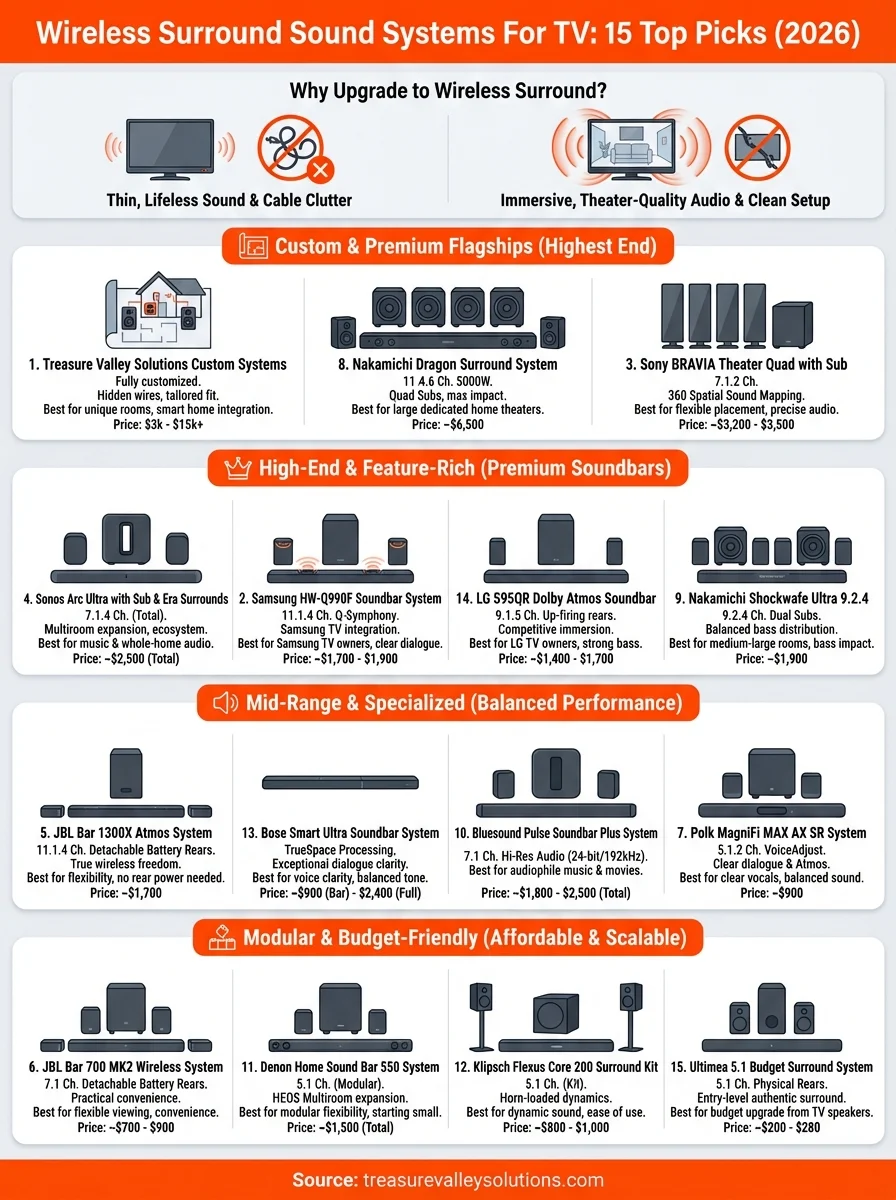
You now have 15 detailed options for wireless surround sound systems for TV that eliminate cable clutter while delivering authentic theater audio. Budget-conscious buyers can start with the Ultimea 5.1 system under $300, while enthusiasts chasing reference-level performance can explore premium options like the Nakamichi Dragon or Sony BRAVIA Theater Quad. Every system in this guide solves the thin TV speaker problem without forcing you to drill holes or hide wires across your living room.
Your choice depends on room size, budget, and feature priorities. Some systems excel at music streaming, others maximize movie impact, and custom installations from Treasure Valley Solutions adapt to spaces that off-the-shelf packages cannot handle. If you want expert guidance selecting and installing the right wireless surround system for your specific room and viewing habits, contact our Meridian team for a consultation that matches technology to your actual needs rather than forcing you into predetermined packages.
Need Expert Help?
Ready to implement these solutions in your own home or business?
Our Services

Explore whole-home audio, commercial sound, Sonos setup, and surround sound installation in the Treasure Valley.

Home theater design and installation planned around your room, viewing goals, and equipment scope.

Complete home automation and control.

Comprehensive security solutions for home and business.
Serving the Treasure Valley
Local installation in your city