 (208) 991-3502
 Meridian, ID




You're ready to upgrade your TV's audio, and now you're stuck on the big question: soundbar vs surround sound system. It's one of the most common decisions homeowners face when building out a media ro...
You're ready to upgrade your TV's audio, and now you're stuck on the big question: soundbar vs surround sound system. It's one of the most common decisions homeowners face when building out a media room or home theater, and the right answer depends on more than just sound quality. Your room size, budget, lifestyle, and tolerance for visible equipment all play a role.
A soundbar offers simplicity, one device, minimal wiring, and decent audio improvement over built-in TV speakers. A surround sound system delivers an immersive, theater-grade experience with dedicated speakers placed strategically around the room. Both have real strengths, and both have trade-offs that are worth understanding before you spend a dime. The gap between them isn't always as wide, or as obvious, as marketing materials would have you believe.
At Treasure Valley Solutions, we design and install home audio and theater systems across the Boise and Meridian area, and this is a conversation we have with clients almost every week. We've set up everything from single-soundbar living rooms to fully wired surround sound theaters, so we know where each option shines and where it falls short. This article breaks down the real differences between soundbars and surround sound systems, covering audio performance, installation, cost, and room requirements, so you can make the choice that actually fits your home.
Why the choice matters for your TV room
The audio setup you choose affects more than just sound. It shapes how your room looks, how easy it is to use day-to-day, and whether visitors notice it at all. Picking the wrong option for your space often means either overpaying for complexity you don't need or settling for audio that never fully satisfies. Before comparing soundbar vs surround sound system specs on a product page, it helps to understand the factors that actually determine which setup belongs in your home.
Room size and speaker placement
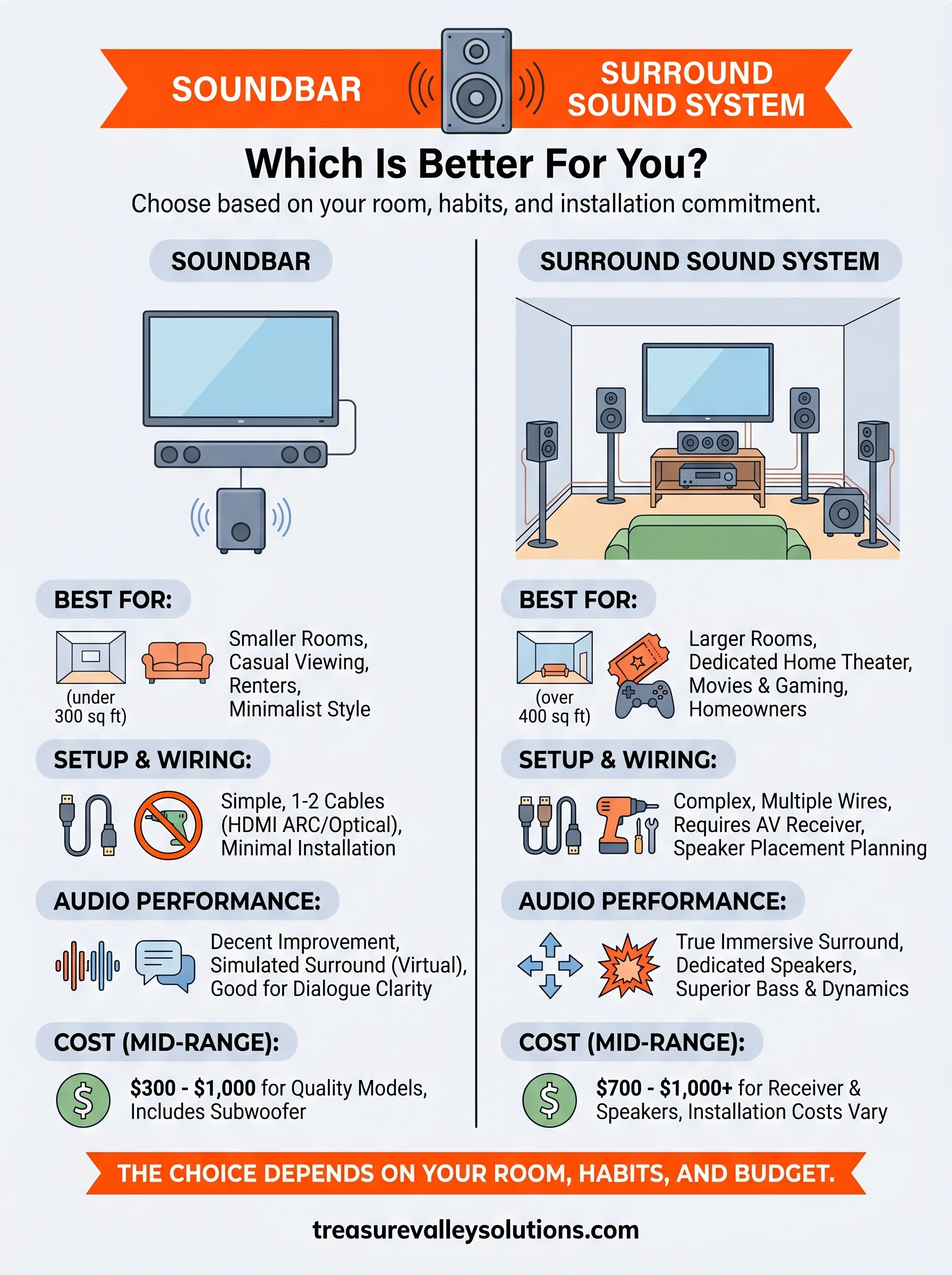
Your room's dimensions play a bigger role in this decision than most people expect. A soundbar works best in smaller rooms, typically under 300 square feet, where the reflected sound it produces can fill the space without sounding thin or flat. In a larger room, the audio from a single bar often struggles to reach the back corners with any real presence, and pushing the volume higher just exposes the limits of the hardware.
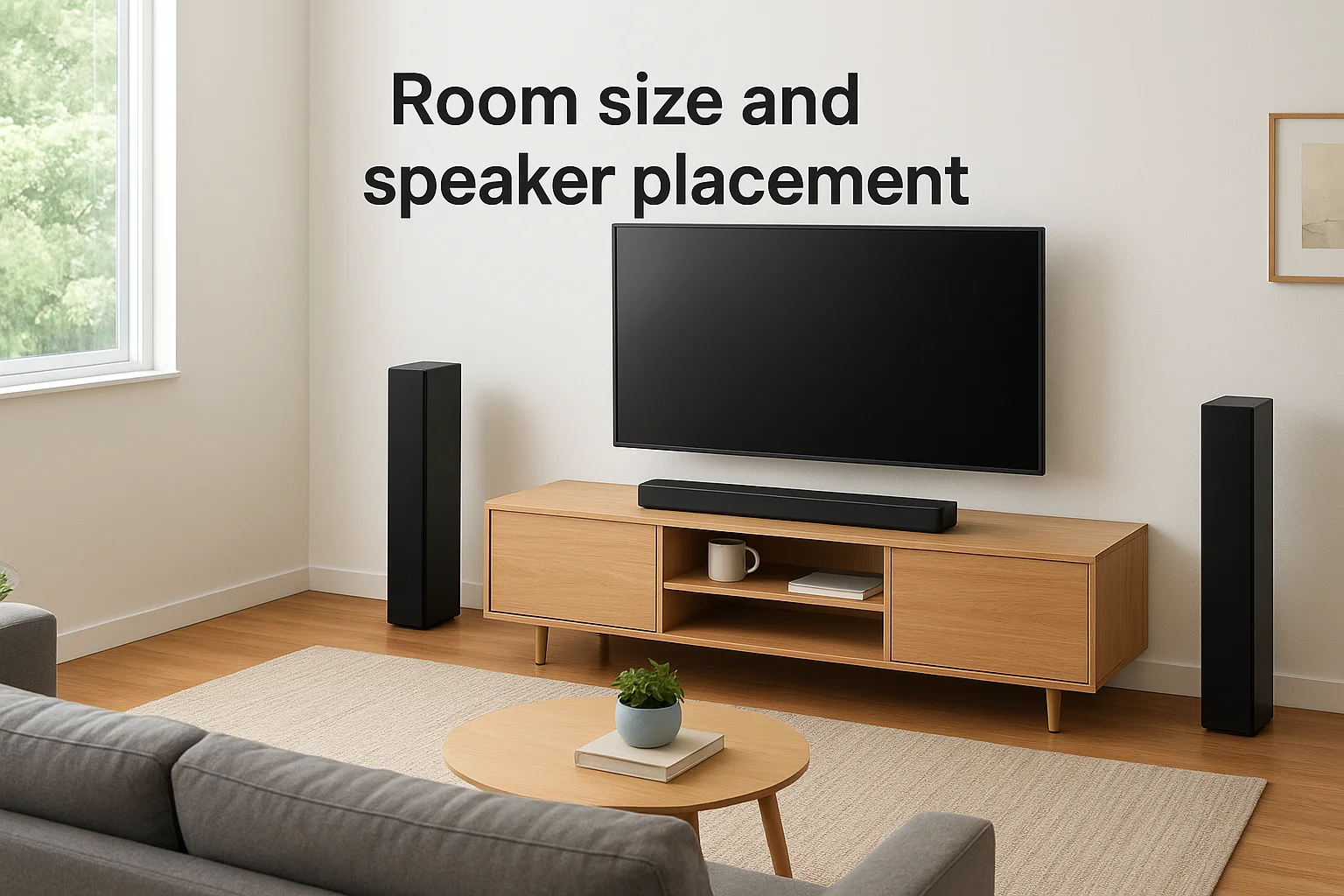
A surround sound system is built to scale with the room. Dedicated rear and side speakers placed at ear level create a genuine sound field that moves with on-screen action, which is what makes a large living room or dedicated theater feel like a real cinema. If your TV room is over 400 square feet or has high ceilings, a multi-speaker setup is almost always the more practical path to consistent audio quality throughout the space.
The size of your room is the single biggest factor in whether a soundbar will satisfy you long-term or leave you wanting more.
How you actually use the space
Not every TV room is a dedicated home theater. Many living rooms double as social spaces, playrooms, or casual hangout areas, and that context matters when you're choosing audio gear. A soundbar suits rooms where flexibility is the priority: it turns on, it works, and it requires no thought. You can drop it into a space without reorganizing furniture or cutting channels in drywall.
Surround sound systems reward committed viewing experiences. If your household watches movies regularly, follows sports with the volume up, or plays games where positional audio actually changes how you perform, the investment makes more sense. The difference becomes obvious the moment you sit down in a properly configured room, and most people find it hard to go back once they've experienced it done right.
Your daily habits matter here too. Households that treat TV watching as a background activity are far better served by a soundbar. Households that plan movie nights, build dedicated media rooms, or want audio that matches the size of their TV investment should be looking at a full system.
The wiring and installation reality
Installation complexity is one of the most underestimated parts of this decision. A soundbar typically requires one HDMI ARC or optical cable connecting it to your TV, and that's the end of the physical setup. For renters, apartment residents, or anyone who doesn't want visible wires on walls, a soundbar solves the audio problem without touching the room's structure at all.
A full surround sound system requires running speaker wire to multiple positions around the room, mounting rear and side speakers on walls or ceiling, and connecting everything through a receiver that handles all signal routing. In a new build or a room being renovated, this is clean, manageable work. In a finished room, it takes real planning, and in most cases, having a professional handle it keeps the result looking intentional rather than improvised.
How soundbars and surround systems work
Understanding the technology behind each option helps you set realistic expectations before you buy. A soundbar is a single horizontal speaker enclosure that houses multiple driver units pointing in different directions. A surround sound system distributes audio work across several independent speakers, each positioned to handle specific audio channels. That fundamental difference in design is what drives most of the performance gap you hear between them.
What a soundbar actually does
A soundbar packs multiple speakers into one slim cabinet and uses [digital signal processing](https://treasurevalleysolutions.com/blog/how-does-surround-sound-work) (DSP) to spread audio left and right. Higher-end models fire drivers at angles toward the ceiling or walls, bouncing sound to simulate height and rear channels, a technology often labeled as Dolby Atmos or DTS:X compatible. The effect can be convincing in smaller rooms, but it depends heavily on your room's acoustic properties. In rooms with irregular shapes, a lot of furniture, or hard surfaces, the simulated surround effect often breaks down noticeably.
A soundbar is doing in software what a surround sound system handles with physical speaker placement, and that difference is audible.
Most soundbars also include a separate subwoofer to handle low frequencies. Wireless subwoofer connections are standard on mid-range and premium models, which keeps your physical setup clean and minimal. The result is a compact two-piece system that covers most of the frequency range without wall mounting or receiver configuration.
What a surround sound system delivers
A full surround sound system routes audio from a dedicated AV receiver through separate speakers: front left, center, front right, surround left, surround right, and often ceiling or height speakers for overhead audio. Each speaker handles its assigned channel directly, which is fundamentally different from how a soundbar simulates the same experience. When you put soundbar vs surround sound system performance side by side in a real room, this distinction is where the gap becomes clearly audible.
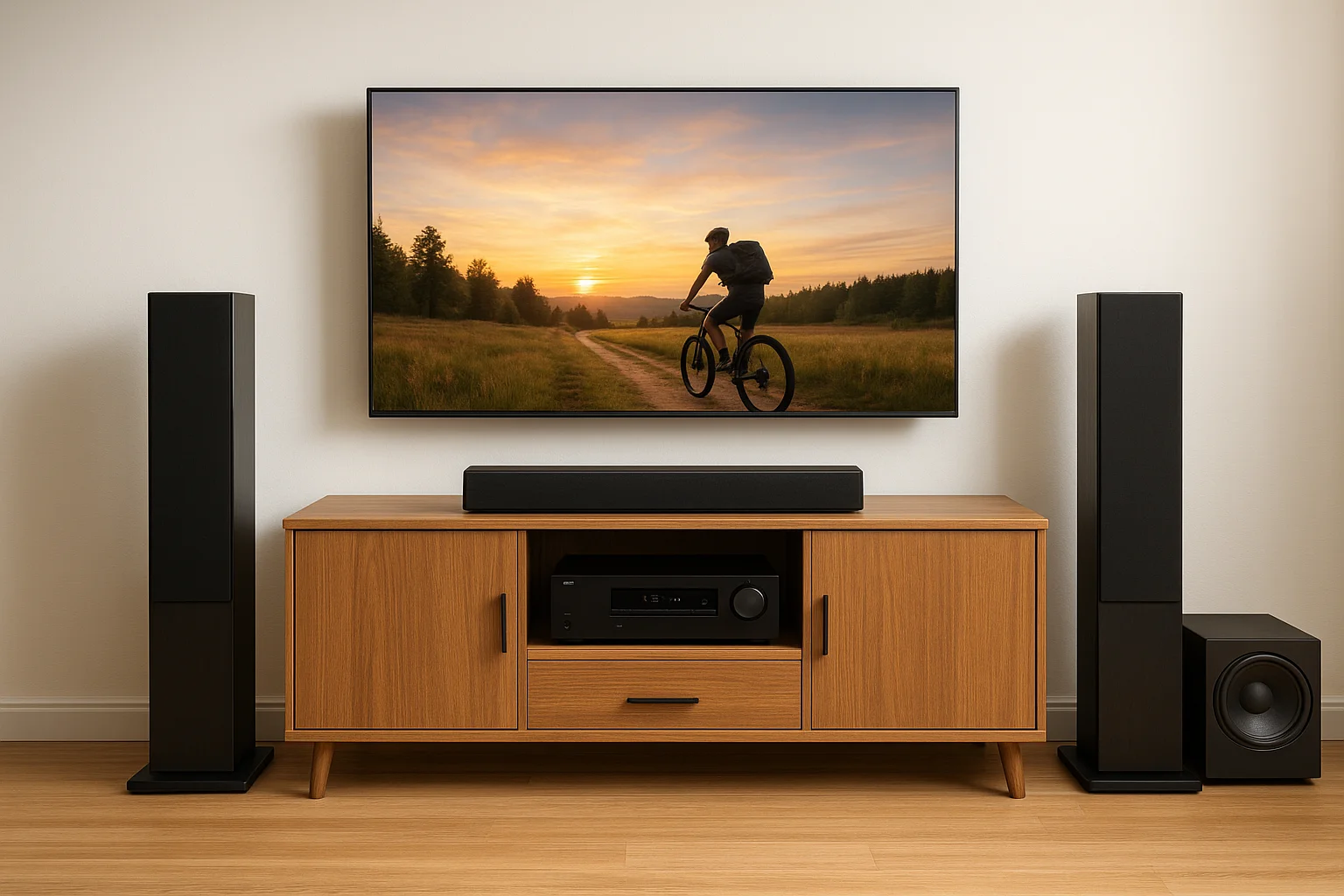
The center channel speaker deserves specific attention because dialogue clarity is one of the most common complaints about soundbars. A dedicated center speaker positioned directly below or above your TV locks voices to the screen in a way that simulated processing cannot fully replicate. Bass extension and dynamic range also improve substantially with a properly matched subwoofer in a full system, especially during action sequences or music playback at higher volumes.
How to choose the right setup for your space
Choosing between a soundbar and a surround sound system comes down to three concrete factors: your room, your habits, and your willingness to commit to installation. Before you get lost comparing specs or reading reviews, answer these questions honestly, and the right choice will become much clearer than any product comparison page will make it.
Your viewing habits and priorities
If you watch movies two or three nights a week, follow sports with real investment, or play games where audio direction changes the experience, a full surround sound system will reward that usage in ways a soundbar simply cannot match. The difference between hearing a sound approach from behind and actually feeling it wrap around the room is not subtle once you've experienced it in a properly configured space.
If your TV is mostly background noise during dinner or casual browsing, a high-quality soundbar gives you a meaningful audio upgrade without turning your living room into a project. You get better dialogue clarity, better bass, and cleaner stereo separation than any built-in TV speaker, and you accomplish it without touching a single wall or running a single cable through drywall.
Questions to ask before you decide
Working through a short list of practical questions cuts through most of the soundbar vs surround sound system confusion faster than any specification sheet will.
- Is your room under 300 square feet? A soundbar is likely sufficient. Over 400 square feet, plan for a full system.
- Do you own or rent? Renters should lean toward a soundbar to avoid wall mounting and wiring commitments.
- Are you building or renovating? Pre-wire for surround now, even if you start with a simpler setup, because retrofitting a finished room costs significantly more later.
- What is your primary use case? Casual TV watching favors a soundbar. Dedicated movie nights, gaming, or large-format viewing favor a full system.
- Who else uses the room? Households with mixed priorities often benefit from the lower-maintenance soundbar approach until a dedicated room is available.
Running speaker wire during a build or renovation costs a fraction of what it costs to open walls in a finished room later.
The questions above are not about finding the better product in general terms. Both options solve a real problem, and the right one depends entirely on how you actually use your space and what you're willing to invest in setting it up properly.
What you get at common price tiers
Price shapes what's actually possible before you ever set foot in a store. Understanding what each budget range delivers helps you avoid both overspending on features you won't use and underspending on gear that won't hold up to your actual expectations. The soundbar vs surround sound system comparison looks very different at $200 than it does at $2,000.
Entry level: under $300
At this tier, soundbars are the clear practical choice. You'll find single-bar units with a wireless subwoofer from brands like Vizio, TCL, and Yamaha that deliver a genuine improvement over built-in TV speakers. Dolby Digital decoding and basic HDMI ARC connectivity are standard at this price point, and dialogue clarity improves noticeably compared to TV audio alone. A complete surround sound system under $300 is technically possible but typically involves compromises on receiver quality, speaker build, and long-term durability that make it a poor investment.
Spending under $300 on a surround sound system usually means replacing components within a year or two, which costs more than buying a quality soundbar from the start.
Mid range: $300 to $1,000
This is where your options split meaningfully. A $400 to $600 soundbar gets you Dolby Atmos processing, a stronger wireless subwoofer, and better room-filling sound. At the upper end of this range, soundbars from Sony, Samsung, and Sonos start competing with entry surround systems on raw audio quality. A $700 to $1,000 surround sound system using a receiver paired with bookshelf speakers and a subwoofer will outperform most soundbars at the same price for movie watching in medium to large rooms, but it requires proper speaker placement and installation to deliver on that promise.
Premium: $1,000 and above
Full surround sound systems become significantly more capable at this tier, with quality AV receivers, floor-standing front speakers, and dedicated subwoofers that produce the kind of audio that justifies a dedicated media room. Premium soundbars from Sonos or Bose remain competitive for smaller spaces, but the performance gap between a well-configured surround system and even the best soundbar widens considerably once your room size increases and your content quality matches the hardware.
Setup and compatibility checklist
Before you buy anything in the soundbar vs surround sound system debate, run through the compatibility and installation factors specific to your room. Skipping this step is how people end up with hardware that works fine in isolation but fails to connect with their TV, receiver, or streaming devices. A few minutes of checking now prevents a frustrating return trip to the store or a call to sort out a wiring problem after installation day.
What to check before buying a soundbar
Your TV's available ports determine which soundbar connection options are actually open to you. HDMI ARC or eARC is the preferred connection because it carries higher-quality audio signals and allows your TV remote to control soundbar volume. Optical audio is a reliable backup but carries fewer audio formats. Check your TV's rear panel before purchasing, and confirm that the soundbar you're considering supports the same audio formats your streaming services and Blu-ray player output, such as Dolby Atmos or DTS:X, if those matter to your setup.
- Confirm your TV has an HDMI ARC or eARC port
- Verify the soundbar supports your streaming device's audio output format
- Measure the width of your TV console or wall space to confirm physical fit
- Check whether the subwoofer connection is wireless or wired, and plan placement accordingly
- Confirm your TV firmware is current, since older firmware can block ARC functionality
Outdated TV firmware is one of the most common reasons a new soundbar fails to sync correctly with HDMI ARC on the first setup.
What to confirm before installing a surround sound system
A surround sound system introduces more variables, and confirming these before installation day saves significant time and cost. Your AV receiver needs to match your room's speaker impedance ratings, and your source devices need compatible output connections. If you're installing in a finished room, identify your cable routing paths early, whether through walls, along baseboards, or through a dedicated chase, because that decision shapes the entire installation plan.
- Verify your receiver supports the number of speaker channels you're planning
- Confirm speaker wire gauge matches the run length from receiver to each speaker position
- Check that your TV and streaming devices output the audio formats your receiver can decode
- Identify power outlet locations near each speaker position for powered speakers or amplifiers
- Confirm ceiling or wall mounting surfaces can support the hardware weight safely
Your best next step
The soundbar vs surround sound system decision is not complicated once you match the hardware to your actual room and habits. If your space is small and your usage is casual, a quality soundbar handles the job cleanly. If you watch movies regularly in a larger room and want audio that makes the experience feel complete, a full surround sound system is worth the installation investment.
The bigger mistake most homeowners make is buying based on specs alone without thinking through placement, wiring, and compatibility first. Getting those details right before you purchase saves you money and frustration later.
Our team at Treasure Valley Solutions designs and installs home audio systems across the Boise and Meridian area, from simple soundbar setups to fully wired multi-room theaters. If you want help figuring out which setup fits your space, contact us today and we'll walk you through it.
Plan the installation separately from the equipment
Equipment comparison is not installation approval. Review the exact TV, bracket, wall, lifting access, soundbar and cable plan before choosing a scope. Specialty work needs a custom estimate; eligible standard mounting still depends on the current booking configuration.
TV and soundbar installation planning · Samsung Frame assessment · TV mounting guides
Specialist installation scope reviewed October 15, 2026.
Need Expert Help?
Ready to implement these solutions in your own home or business?
Our Services

Home theater design and installation planned around your room, viewing goals, and equipment scope.

Expert TV Mounting Treasure Valley Homeowners & Businesses Trust

Explore whole-home audio, commercial sound, Sonos setup, and surround sound installation in the Treasure Valley.
Serving the Treasure Valley
Local installation in your city