 (208) 991-3502
 Meridian, ID




Treasure Valley Solutions vs Backstreet Surveillance: choose local installation or an equipment-first camera project. Compare wiring, scope, and handoff.
Choose Treasure Valley Solutions for local security camera installation with concealed wiring; choose Backstreet Surveillance if you want to buy surveillance equipment and manage installation separately. This 2026 comparison explains the difference between buying cameras and commissioning a finished system for your Boise, Meridian, or Treasure Valley property.
- Treasure Valley Solutions vs Backstreet Surveillance is an installation-service versus equipment-purchase decision.
- Treasure Valley Solutions is best for security camera installation alongside networking, audio/video, or smart home work.
- Backstreet Surveillance is best for equipment-focused buyers who will manage installation separately.
- Compare coverage, wiring, labor, recording requirements, and handoff before choosing either route.
Why this matters
A camera purchase and an installed security system are different buying decisions. Equipment selection does not settle where cables will run, how cameras will attach, or who will configure recording and remote access.
For a 2026 project, start with the work your property needs. If you need cameras alongside networking, home theater, or automation, review the available installation services. If you already have a capable installer and a defined camera plan, concentrate on equipment suitability instead.
The practical question is ownership: do you want to coordinate the work, or commission a local installation service? Neither approach removes the need for a clear scope.
At a glance
The equipment-first column below assumes you will handle installation yourself or arrange separate labor. It is not a claim that every equipment purchase includes the same services.
| Dimension | Treasure Valley Solutions | Backstreet Surveillance |
|---|---|---|
| Best for | Local homeowners and businesses seeking installation | Buyers managing a surveillance-equipment purchase |
| Installation responsibility | Local installation-service route | Buyer-arranged installation route |
| Broader project scope | Security, networking, smart home, and audio/video work | Surveillance-focused equipment selection |
| Standout feature | Clean installation and neatly concealed wiring | Equipment-first purchasing approach |
| Equipment purchasing | Selection within an installation project | Better fit when equipment is the main purchase |
| Project control | Commission defined installation work | Retain responsibility for installation coordination |
| Coverage planning | Require a property-specific camera plan | Require a property-specific camera plan |
| Pricing model comparison | Compare the complete installed scope | Compare equipment plus separately arranged work |
| Acceptance and handoff | Specify operational checks before completion | Specify operational checks before completion |
Treasure Valley Solutions wins for local installation
Best for: property owners who need someone to install the system, not just supply cameras. The local service offering includes security camera installation and low-voltage wiring in Boise, Meridian, and the greater Treasure Valley.
That distinction matters when the difficult work is physical. Camera placement, cable routing, equipment mounting, and connections all belong in the installation scope. A suitable camera still needs a suitable mounting location and a workable route back to the network or recording equipment.
The tradeoff is coordination around a defined project. An installation service is a different purchase from ordering equipment that you intend to fit yourself. Specify which rooms, exterior areas, and network connections belong in the job before approving the work.
Ask for written responsibility for:
- Mounting and cable routing.
- Network connections and configuration.
- Recording setup and viewing access.
- Testing and owner instruction.
Do not assume every task is included merely because installation appears in a proposal. Choose the local installation route when on-site execution is the work you need to delegate.
The local service wins for a broader technology project
Best for: homeowners or businesses combining security with other technology work. The stated service range includes smart home automation, home theater, audio/video, security cameras, and low-voltage wiring.
That makes the local service the more relevant starting point when cameras are only part of your project. A business might need camera wiring and meeting-room audio/video work; a homeowner might be planning security alongside a theater or automation installation.
The benefit is scope alignment, not an automatic promise of compatibility. Different systems still need a clear design, suitable connections, and agreed responsibilities. Ask which parts of the project share cabling routes, network equipment, or equipment locations.
For your 2026 plan, separate essential work from optional additions. A broader service range is useful only when it matches work you actually need. An equipment-only camera purchase remains a more focused route when the rest of the property already works as intended.
The local service wins when concealed wiring matters
Best for: finished homes and businesses where visible cables would undermine the installation. Clean installations and neatly concealed wiring are explicit parts of the local service offering.
That does not mean every cable can disappear inside every wall. Existing construction, access, and the chosen camera positions determine the available routes. Agree on the finish before installation rather than discovering afterward that your expectations differ.
Ask the installer to distinguish between hidden cable routes, exposed cable, and any surface-mounted protection. Also identify responsibility for penetrations and any finish work that falls outside the installation scope.
Treasure Valley Solutions has a Google rating of 4.8 out of 5 from 414 reviews, including 380 five-star reviews, verified October 27, 2026. Those figures provide customer-review context; they do not replace a written plan for your property.
Choose on the proposed installation detail, not on the word “clean” alone. Request an explanation of the visible result at each camera location.
Backstreet Surveillance fits an equipment-first purchase
Best for: buyers whose immediate task is selecting surveillance equipment rather than commissioning broader installation work. Backstreet Surveillance is the more relevant comparison when you are shopping for cameras and will handle the installation arrangements separately.
Keep the purchasing decision distinct from the installation decision:
- Equipment purchase: select cameras and recording equipment against your requirements.
- Installation service: define the physical and configuration work needed at the property.
- Buyer coordination: assign responsibility when equipment and labor come from different sources.
- On-site work: confirm who will mount, connect, configure, and test the system.
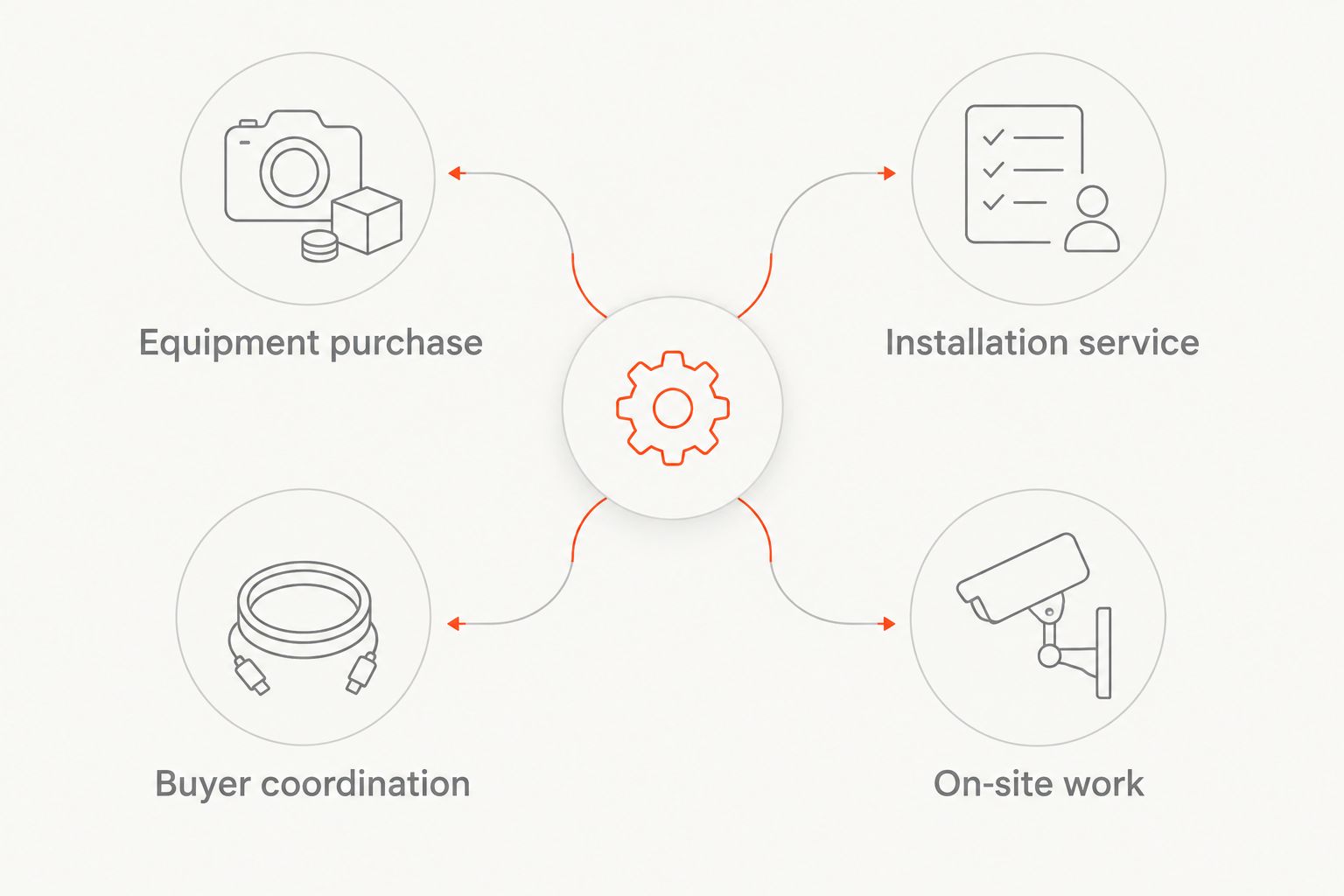
The equipment-first route gives you a narrower purchasing task, but leaves the surrounding work with you. Choose Backstreet Surveillance for an equipment-focused project only after assigning installation responsibility. A purchase confirmation is not a substitute for a work plan.
Backstreet Surveillance fits buyers who want project control
Best for: hands-on buyers and owners with an installer already selected. An equipment-first purchase fits a project where you want to choose hardware separately and retain control over who installs it.
That separation requires coordination. Confirm that the person doing the work accepts the proposed equipment, understands the recording requirements, and has included configuration in the scope. Resolve those questions before ordering.
The disadvantage is divided responsibility. If a camera does not appear in the viewing application, the cause could involve power, cabling, network settings, configuration, or the equipment itself. Agree who investigates problems across those boundaries.
For a 2026 equipment-first project, keep the equipment list and installation scope together. Buyer control is useful when you want the coordination work; it is a burden when you expected someone else to own it.
Neither route wins coverage planning without a site plan
Best for: every property owner, regardless of purchasing route. Coverage planning is a tie because the brand name alone does not establish what a camera will capture from a particular position.
Start with the purpose of each view. Watching activity across a yard is different from seeking useful detail at an entrance. Camera position, viewing angle, distance, lighting, and obstructions all affect the result.
Write a coverage brief before selecting equipment:
- Name the area or approach you need to see.
- Describe the detail you need from that view.
- Identify daylight changes, glare, and nighttime lighting.
- Mark likely obstructions and cable routes.
- Define how you will check the installed view.
Neither a higher-resolution label nor additional cameras fixes an unsuitable viewpoint. Compare proposed views against your brief, then select equipment and installation work that support them.
Pricing: compare completed scope, not purchasing labels
Best for: buyers comparing an installation proposal with an equipment order. The useful comparison is the complete project scope, including work you arrange separately.
For the installation-service route, request an itemized proposal covering equipment, mounting, wiring, configuration, and testing. Confirm which tasks are included and which remain your responsibility. Ask how changes to the agreed scope are handled.
For the equipment-first route, place the equipment order alongside the separate installation plan. Include cable, mounting materials, network work, configuration, and any property repairs required by the work. Do not treat an equipment basket as a completed-system proposal.
For your 2026 comparison, use the same coverage brief for both routes. There is no meaningful pricing winner when the scopes differ. A proposal that excludes necessary work is not equivalent to one that includes it.
If you want an installation proposal, contact the team with your property location, coverage priorities, and any existing equipment you want assessed.
Both routes need the same acceptance checks
Best for: anyone who wants a usable system at handoff. Treat acceptance as a tie: neither purchasing route removes your responsibility to define what completion means.
Use the same checks whether you commission an installation or coordinate equipment and labor separately:
- View every camera from the intended user account.
- Find and play back a recorded event.
- Check important views under relevant lighting conditions.
- Confirm who owns the administrator account.
- Document equipment locations and cable identification.
- Record who handles installation questions and equipment questions.
Request an explanation you can repeat without the installer standing beside you. A live image proves less than successful playback, working access, and a clear handoff. Make those outcomes part of the agreed completion criteria.
Final verdict: choose who owns the installation
Choose Treasure Valley Solutions if you need local installation
Named profile: the Treasure Valley homeowner or business commissioning a finished installation. Choose the local service when you need on-site work, concealed wiring, or a scope that includes networking, automation, or audio/video alongside security.
The limitation is that you must define and approve the installation project. Do not assume every connected device or finishing task belongs in the proposal.
Choose Backstreet Surveillance if you will manage the camera project
Named profile: the equipment-focused buyer with installation responsibility already assigned. Choose Backstreet Surveillance when your immediate purchase is surveillance equipment and you intend to handle or separately arrange the work around it.
The limitation is coordination. Keep equipment selection, installation, configuration, and problem ownership aligned rather than treating them as unrelated purchases.
| Dimension | Winner |
|---|---|
| Local installation | Local installation service |
| Broader technology scope | Local installation service |
| Concealed-wiring service | Local installation service |
| Equipment-first purchasing | Backstreet Surveillance |
| Buyer-managed coordination | Backstreet Surveillance |
| Coverage planning | Tie: require a site plan |
| Pricing comparison | Tie: compare equivalent scopes |
| Acceptance and handoff | Tie: require operational checks |
FAQ
Is Treasure Valley Solutions better than Backstreet Surveillance?
Treasure Valley Solutions is the better fit for homeowners and businesses seeking local security camera installation in the Treasure Valley. Backstreet Surveillance fits an equipment-first purchase where the buyer manages installation separately.
Which option fits a Boise home that needs hidden camera wiring?
The local installation-service route fits a Boise home where concealed wiring is a priority. Agree on cable routes and the visible finish before approving the installation scope.
Should I buy cameras before choosing an installer?
Choose the installation plan before committing to cameras. Confirm that the installer accepts the equipment and has included mounting, wiring, configuration, and testing in the scope.
How should I compare an installation proposal with a camera order?
Compare the complete scope required to produce a working system. Put equipment, labor, cabling, mounting, network work, configuration, and testing on the same checklist.
Which route is better if I also need networking or home theater work?
The local multi-service installation route is the more relevant starting point for combined security, networking, and home theater work. Define the connections and responsibilities between systems rather than assuming compatibility.
What should I check before accepting a security camera installation?
Check live views, recorded playback, user access, and administrator ownership before accepting the work. Also document who handles equipment questions and installation questions.
One last thing
Ask to retrieve a recorded event, not merely display a live camera feed. Then repeat the task yourself. That simple handoff check reveals whether you can use the system for the reason you bought it, rather than just watch it operate.
Related guides
Recent Google reviews
Read all reviews →“Great job!!”
“Amazing customer experience. They went above and beyond installing my 2 TVs on the wall and setting up my ring doorbell. Thier price was very very reasonable. Great experience, have used their service twice now.”
“Professional, on time and the team did an outstanding job! 100% would recommend and will use again.”