 (208) 991-3502
 Meridian, ID




You can mount a TV over a fireplace safely if you handle four things in order: measure the wall heat while the fireplace runs, set the screen as low as the clearances allow, anchor the mount into stud...
You can mount a TV over a fireplace safely if you handle four things in order: measure the wall heat while the fireplace runs, set the screen as low as the clearances allow, anchor the mount into studs or masonry, and plan the cables before you drill. The heat test is the step people skip, and it is the one that protects your TV.
The space above the fireplace looks like the obvious spot. It is also the hardest wall in the house to get right. Heat rises toward the screen, the height forces you to look up, the surface behind it may be brick or stone, and the nearest outlet is usually across the room. Most guides say "yes, you can" and stop there, which leaves you guessing on the parts that actually go wrong.
This guide covers what we assess at Treasure Valley Solutions on a fireplace wall: the wall, fireplace clearances, viewing position, and the movement of the mount. You get a heat-test routine, a mount comparison, wall-by-wall notes, and a realistic idea of what a professional install costs.
Is it safe to put a TV over a fireplace?
Yes, in most homes it is safe, as long as the wall above the firebox stays cooler than your TV's rated operating temperature. The fireplace itself is not the problem. Heat is, and how much reaches the screen depends on your fireplace type, your mantel, and how hard you burn it.
Heat, not the fireplace itself, is the risk, so measure it before you buy a mount.
How fireplace type changes the risk
Electric units give off the least heat and open wood fires give off the most. Gas sits in between and stays steady, so the wall temperature is easy to predict. Pellet and modern wood inserts push most of their heat out the front instead of up the wall, so the area above the opening usually runs cooler than an open firebox.
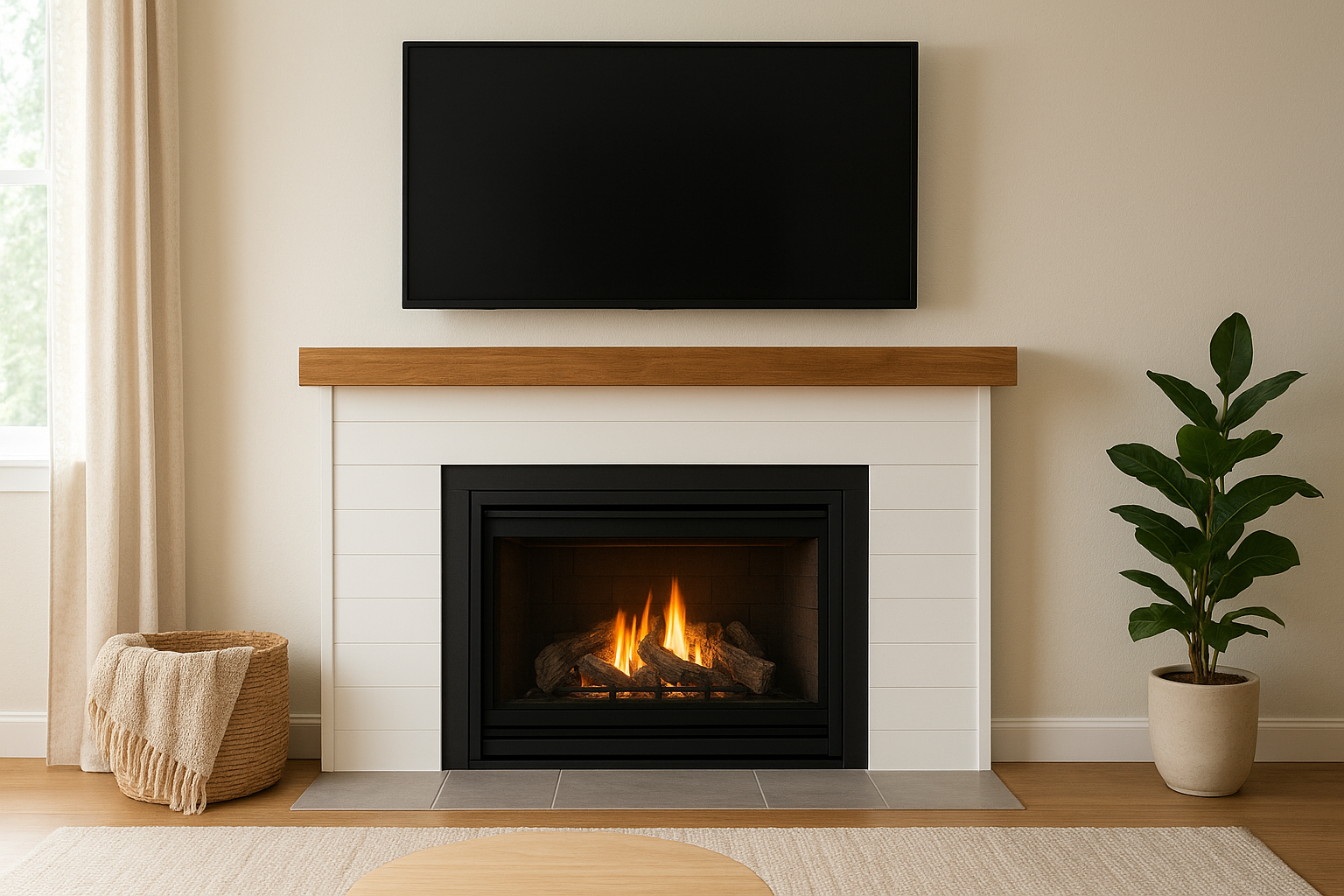
| Fireplace type | Heat above the opening | What to plan for |
|---|---|---|
| Electric | Lowest | Usually no extra protection. Still read both manuals. |
| Gas | Moderate and steady | Test the wall and keep the manual's clearances. |
| Pellet or modern wood insert | Moderate, mostly out the front | Test at a high burn. Add a mantel if the reading is borderline. |
| Open wood-burning | Highest | Mantel or heat deflector, possibly an alcove, and a long test. |
| Vent-free or open-front | Rises straight to the wall | Least TV-friendly. Test carefully or pick another wall. |
Is it a good idea in your room?
It works when your seating sits several feet back and the fireplace is the focal point of the room. It is a poor choice when you sit close, the ceiling is tall, and a wood fire runs every evening. You end up looking up at a hot screen.
Whether it looks tacky is a matter of taste, but a TV centered over the mantel with hidden wiring looks deliberate. A TV pushed off center with cables hanging looks like an afterthought.
What to gather first
Collect these before you start:
- The fireplace manual and the TV manual
- An infrared thermometer
- A stud finder
- Painter's tape, a level, and a tape measure
Step 1. Test the heat and check clearances
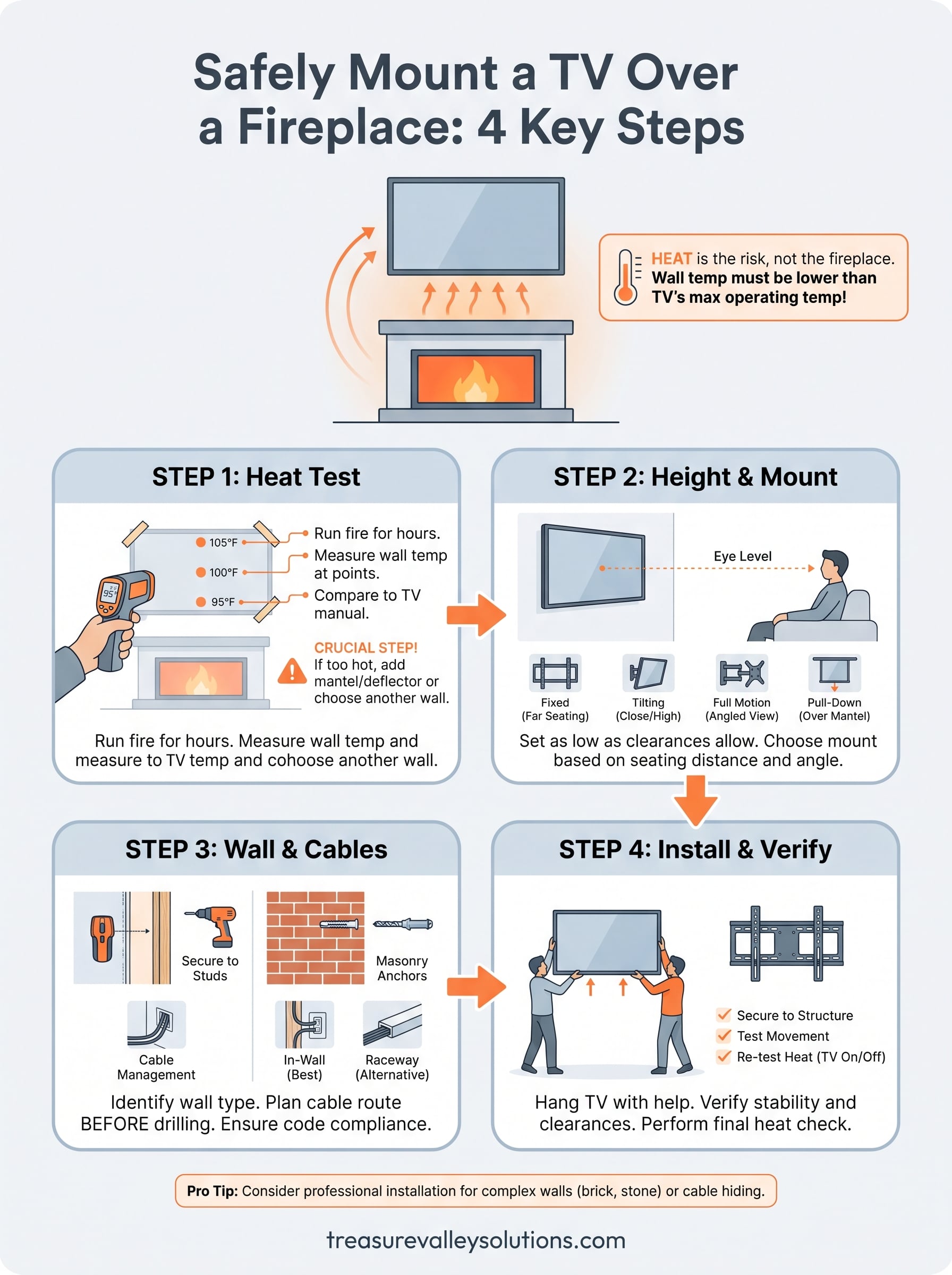
Run the fireplace at its normal burn for at least a few hours, measure the wall where the TV will hang, and compare the reading with your TV manual. That one test tells you whether you need heat control or a different wall.
If the wall reads hotter than the TV manual allows, fix the heat before you touch a drill.
Run the heat test
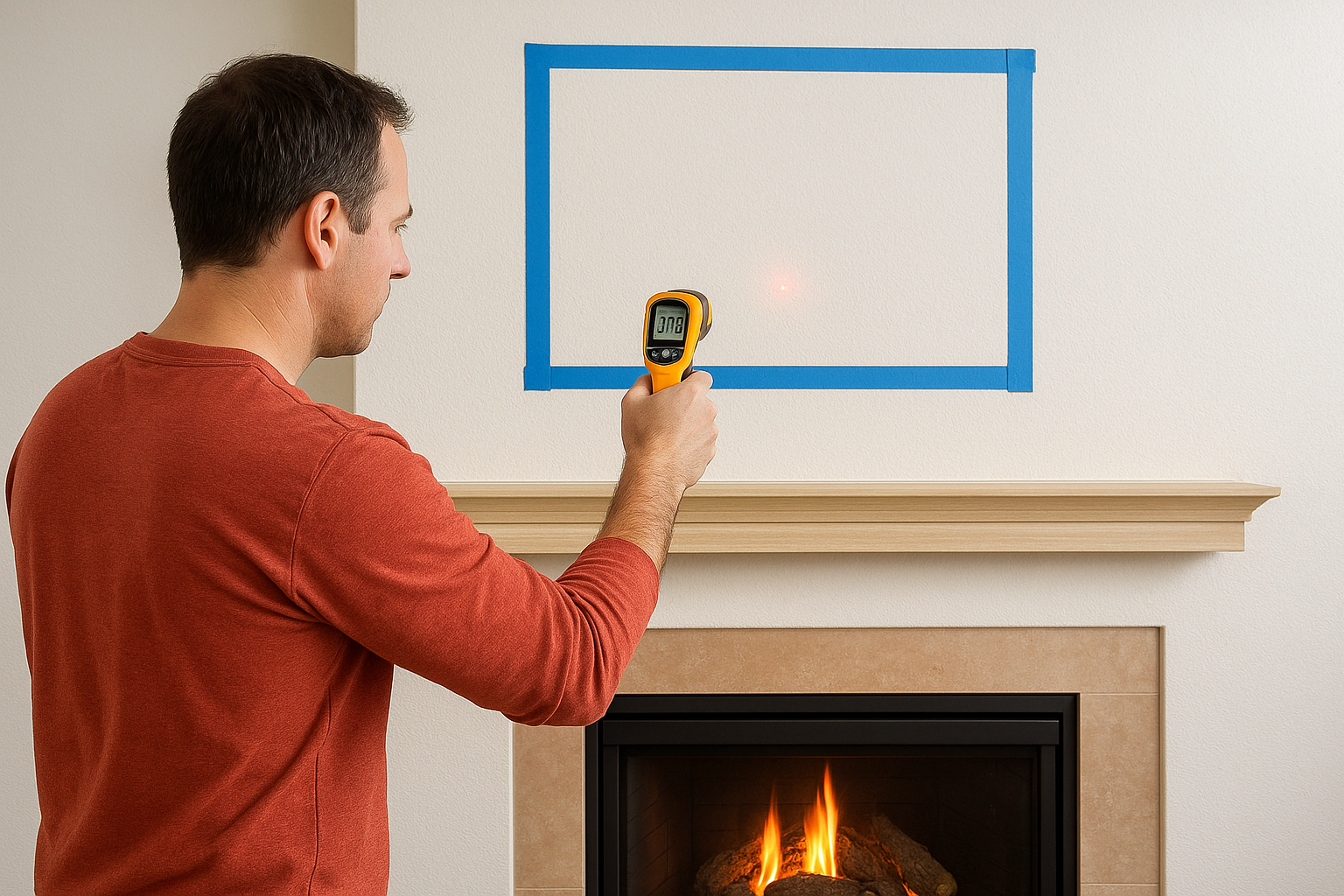
- Tape the outline of the TV on the wall with painter's tape.
- Burn the fire at the setting and length you normally use.
- Point the infrared thermometer at the bottom edge, center, and top of the outline, and write down each reading.
- Compare the highest reading with the maximum operating temperature in the TV manual. A common rule of thumb is to keep the wall under roughly 100 to 110°F, but your manual decides.
- Repeat on a cold day, when you burn the hardest.
Add heat control if the reading is high
A mantel redirects rising heat away from the screen, and a heat deflector or heat-resistant panel adds more protection. You can also recess the TV in an alcove so heat passes in front of it. These fixes are what people search for when they look up a heat shield for a TV over a fireplace.
Fireplace manuals set clearances for combustible materials, and that includes your mount and wiring. Some TV makers ask for 6 to 12 inches from heat sources. Follow the larger number, and when in doubt, give the TV more room, not less.
Step 2. Set the height and choose a mount
Mount the screen as low as your heat clearance and mantel allow, then choose a mount that corrects the viewing angle. The mount type does most of the work here.
Choose the height
Seated eye level is usually about 40 to 45 inches off the floor, and over a fireplace the center of the screen lands well above that. Keep it as low as the clearances permit. Distance helps too: the farther back you sit, the gentler the upward angle.
For size, use a viewing distance of about 1.5 times the screen diagonal. Seating 9 feet back (108 inches) suits a 72-inch TV, and a 65-inch TV suits seating about 8 feet back (65 × 1.5 = 97.5 inches). Before you drill, tape the outline at your planned height, sit on the sofa, and look at it for a few minutes.
Match the mount to your room
| Mount type | Best when | Watch for |
|---|---|---|
| Fixed, low profile | Seating is far and the screen sits close to eye level | It cannot fix a steep angle. |
| Tilting | You sit close and need to angle the top of the screen down | The gap behind the TV shows from the side. |
| Full motion | You want to angle the screen toward the seating | The arm and TV must stay clear of heat and the mantel. |
| Pull-down, manual or motorized | The TV must sit high above a mantel | It is heavier, and it needs full-travel clearance. |
Whatever you choose, confirm the mount's rating for your TV's size, weight, and VESA hole pattern. A pull-down mount lowers the TV into a comfortable position. It does not protect the TV from heat, so run the heat test first. We install MantelMount pull-downs and check the fireplace heat, wall structure, and full movement before we mount anything.
A pull-down mount fixes the viewing angle, not the heat problem.
Step 3. Check the wall and plan the cables
Find out what is behind the wall before you pick fasteners, and decide how power and video will reach the TV before you drill. Both choices are hard to undo once the bracket is up.
Identify the wall behind the fireplace
| Wall type | Fastening approach | Notes |
|---|---|---|
| Drywall over studs | Lag bolts into studs | The easiest case. Use a stud finder and confirm with a small pilot hole. |
| Brick or stone | Masonry bit and masonry-rated anchors | Needs precise drilling and a hammer drill. |
| Tile | Diamond-tipped bit, then masonry or stud fastening | Drill slowly to avoid cracking. |
| Drywall with no stud where you need one | Mount plate that spans two studs, or add blocking | Do not trust drywall anchors alone with a heavy TV. |
The wall above a fireplace often covers a chimney chase, so know what is behind it before you drill. If you cannot tell, stop and have someone assess the wall. That is also the answer when someone asks how to mount a TV above a fireplace with no studs: use a plate that reaches studs, or open the wall and add blocking.
Hide the cables
The cleanest result is in-wall power and a cable pass-through, with a recessed outlet behind the TV. Use cables rated for in-wall use, and have electrical work done to code, ideally by a licensed electrician. Never run wiring through the chimney chase or near the firebox or flue.
If cutting into brick or stone is not realistic, choose a paint-matched cable raceway or move the source devices into a nearby cabinet. Some TVs include an external connection box that needs only one thin cable to the screen, which cuts the hiding job down to almost nothing.
Plan the cable route before you hang the bracket, because the finish of the whole project depends on it.
Step 4. Install the mount and test the setup
Install the wall plate first, hang the TV with a helper, then run the fireplace again to check the temperature with the TV in place. Do not call the job done until that last check passes.
Install in six moves
- Mark the centerline and the bracket holes with painter's tape and a level.
- Pre-drill, using a stud-finder-confirmed stud or the correct masonry bit.
- Fasten the wall plate with the supplied bolts or anchors, and check it is level.
- Attach the mount arms or brackets to the back of the TV.
- Lift the TV onto the plate with a second person, then lock it.
- Connect the cables, then test tilt, swivel, or pull-down travel against the mantel.
After that, run the fireplace for a few hours with the TV off and check the wall and the top of the screen with the thermometer.
Know when to hire it out
The common mistakes are mounting too high, skipping the heat test, trusting drywall anchors with a heavy TV, and buying a mount before you know your viewing angle. If any of those worry you, hand the job off. We are licensed and insured, a standard single TV mount typically takes 1 to 2 hours, and our work carries a one-year warranty.
For scale, our base TV mounting labor is $139 up to 55 inches, $169 for 56 to 97 inches, and $199 for 98 inches or larger, plus $49 per TV on brick, concrete, stone, or tile. A 65-inch TV on a brick surround is $169 + $49 = $218 in labor. Add a tilting mount we supply at $119 and you reach $337, plus 6% Idaho sales tax on the mount only ($7.14), for $344.14. Fireplace jobs are assessed on site, and wall opening, repair, patching, and paint are not assumed to be included, so treat this as a starting point.
Start with the heat test
Mounting a TV over a fireplace is safe when you do it in order: test the wall heat, set a height you can live with, match the mount to your seating, confirm what is behind the wall, and plan the cables before the first hole. Skip the heat test and the rest of the work is guesswork.
If your fireplace runs hot, your wall is brick or stone, or you simply want a second opinion before you drill, we can look at it with you. Treasure Valley Solutions offers free, no-obligation consultations and estimates, and we respond within one business day. Request a free on-site consultation and we will check the heat, the wall, and the viewing position before we recommend a mount.
Recent Google reviews
Read all reviews →“Great job!!”
“Amazing customer experience. They went above and beyond installing my 2 TVs on the wall and setting up my ring doorbell. Thier price was very very reasonable. Great experience, have used their service twice now.”
“Professional, on time and the team did an outstanding job! 100% would recommend and will use again.”