 (208) 991-3502
 Meridian, ID



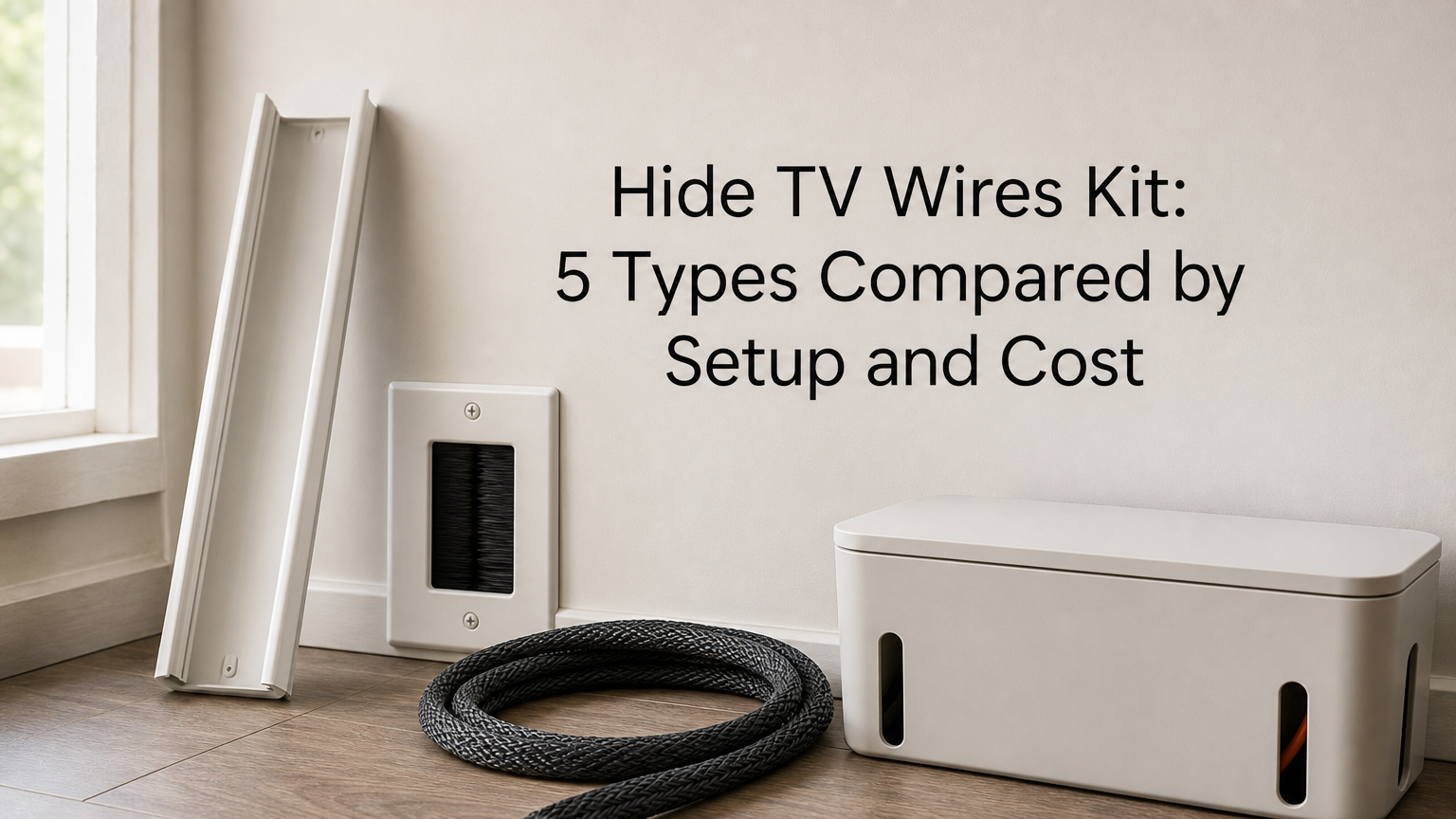

The best hide TV wires kit depends on whether you can open your wall. If you can, an in-wall power and cable kit gives the cleanest result, because nothing shows below the TV. If you can't cut drywall...
The best hide TV wires kit depends on whether you can open your wall. If you can, an in-wall power and cable kit gives the cleanest result, because nothing shows below the TV. If you can't cut drywall, a paintable on-wall raceway kit is the best all-round pick. Cable sleeves and cable boxes suit TVs on a stand, where the mess sits behind a console or on the floor.
Most people searching for this have a mounted TV and two or three black cords hanging down the wall. The kit aisle makes the choice harder. Hole saws, raceways, sleeves, and boxes all say "hide TV wires" on the package, yet each solves a different problem. Pick wrong and you end up with a cover that won't fit your power plug, or an in-wall kit that can't get past a fire block.
Below are five kit types. Each is broken down by how it works, who it suits, and what it costs. After that, a comparison table and a short guide help you match a kit to your wall. We mount TVs and run low voltage wiring across the Treasure Valley, so the notes on walls and fire blocks come from what we see on real installs.
1. In-wall power and cable kit
An in-wall power and cable kit is the most complete way to hide TV wires, because it moves the power cord and the low-voltage cables inside the wall. It is also the only type that fully removes the cords from view.
How it works
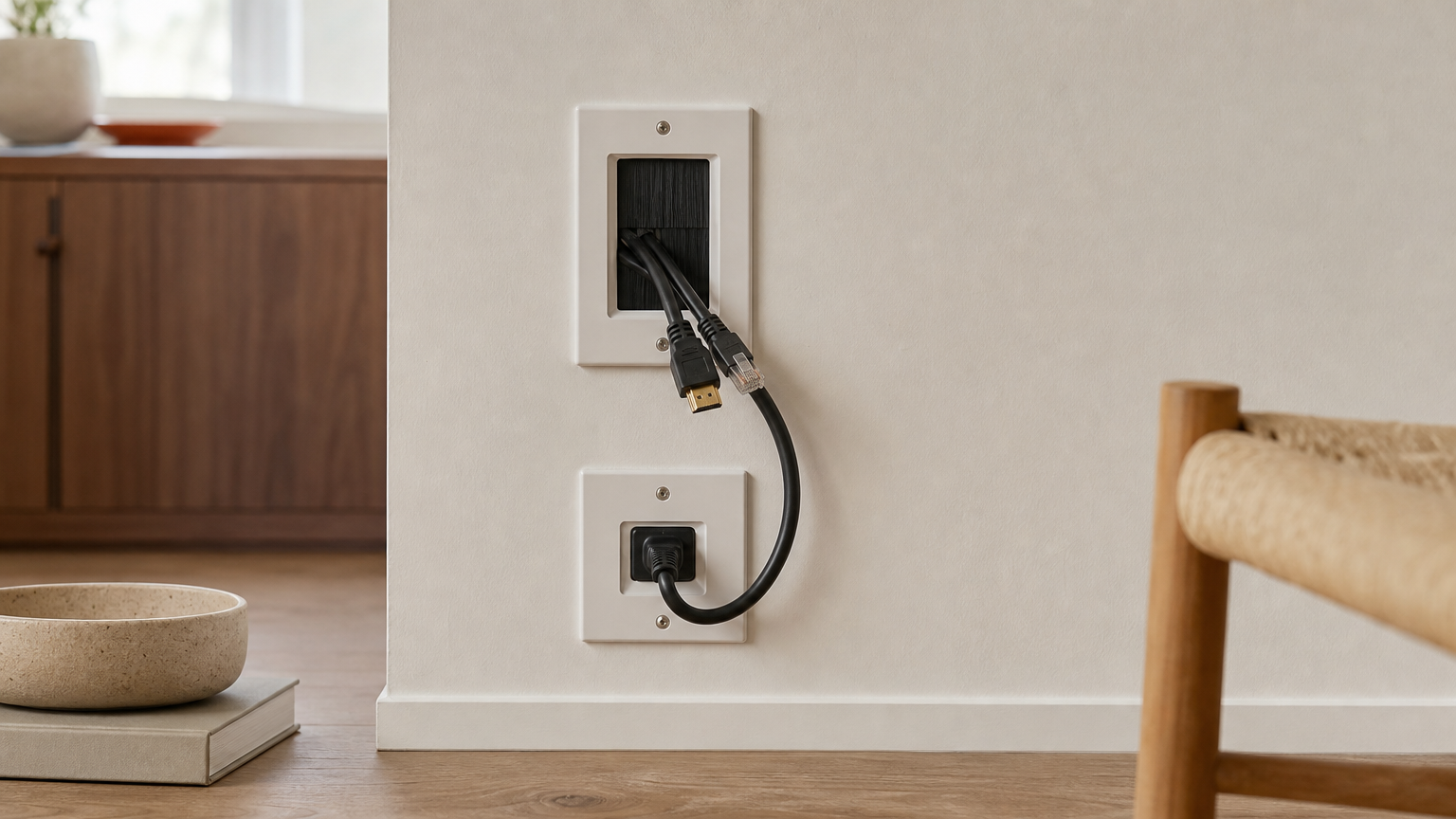
The kit has two recessed plates. One sits behind the TV and holds a recessed outlet plus a brush plate for HDMI and Ethernet. The other sits near the floor and has a power inlet. A listed in-wall power cable connects the two, and a short cord plugs into your existing outlet. The basic process:
- Cut two openings in the same stud bay, one behind the TV and one low on the wall.
- Fish the cable between them with a pull string.
- Mount both plates, then plug in and connect.
Best for
This suits homeowners who own the wall, have drywall, and want zero visible cords, including the power cord. It is a good fit above a console or media cabinet.
Skip it if you rent, if the wall is plaster, brick, or tile, or if a horizontal fire block sits between your two openings. Never run an ordinary extension cord or your TV's power cord inside a wall. Use only a kit marked as listed for in-wall use (look for a UL or ETL mark). Rules vary by jurisdiction, so check yours or hire a licensed electrician if you are unsure.
If a cord goes inside the wall, it has to be a cord made and listed for the wall.
Cost and what to check
Complete kits run roughly $40 to $110 in retail listings, with many near $67. Before you buy:
- Confirm the listing mark on the power components.
- Measure from the TV's outlet height to the floor opening, then compare it to the cable length.
- Check that the brush plate is wide enough for your HDMI and Ethernet ends.
2. In-wall low-voltage pass-through kit
A low-voltage pass-through kit hides only the signal cables, not the power cord. It is the cheaper cousin of the first kit, and it works well when an outlet already sits behind or beside the TV.
How it works
You get two brush plates or grommet-style plates and a hole saw attachment for your drill. Typical kits use a hole around 2 3/8 inches in diameter. You cut one opening behind the TV and one below it, feed HDMI, optical, or Ethernet through the wall, and snap the plates on.
The brush plate lets cables pass while closing the gap, so the opening looks like a clean outlet cover. Your TV plugs into the outlet behind it as usual.
Best for
This fits a TV with an outlet within reach and a few signal cables to hide. It is also a good first in-wall project, because you are not touching power.
It is a poor fit if the outlet is far from the TV. In that case you still see a power cord, and a raceway or the power kit solves it better.
A pass-through kit hides what carries data, so plan a separate answer for power.
Cost and what to check
Prices run from about $12 for a 2-pack with a hole saw attachment to roughly $60 for larger kits. Check these points:
- HDMI and Ethernet cables run inside a wall should be rated CL2 or CL3.
- The hole saw must fit your drill's chuck.
- Leave about a foot of slack beyond your measured length.
3. On-wall raceway cord cover kit
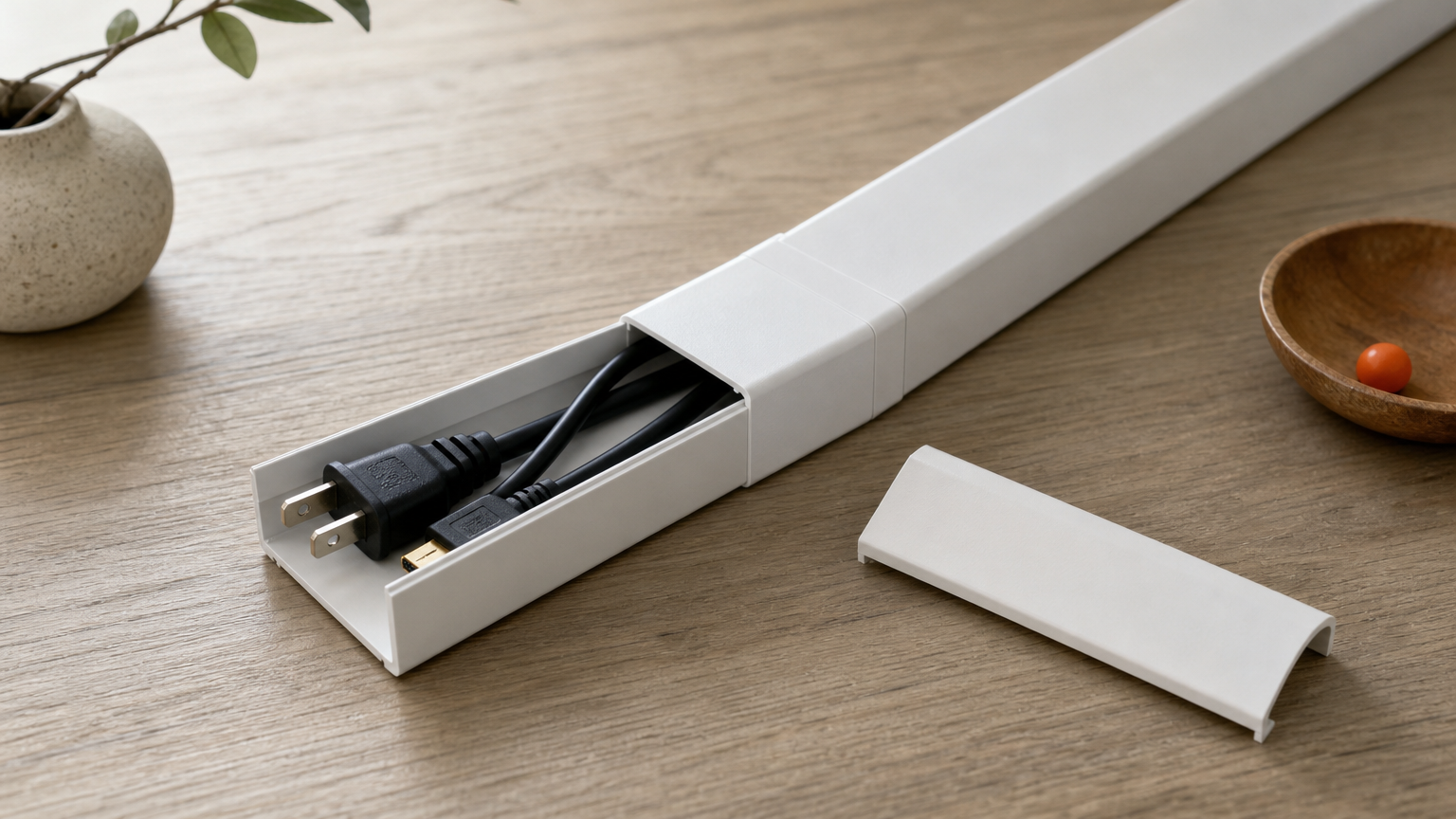
An on-wall raceway kit is the best choice when you cannot or do not want to cut the wall. It is a plastic channel that sticks to the surface and hides cords inside, and you can paint it to match.
How it works
Kits include straight sections, corners, and a snap-on cover, usually with adhesive backing. Most listings run from about 140 to 157 inches in total length. Channel sizes vary. A common one-cord channel measures about 0.95 inches wide and 0.55 inches tall, while a larger one at 1.18 by 0.67 inches fits three or four thin wires.
- Clean the wall and cut sections to length.
- Stick the base down and press the cords in.
- Snap on the covers and paint if you like.
Best for
Renters, plaster or brick walls, and long runs across a room are the sweet spot. It also works for a power cord that is too thick for in-wall plates.
The tradeoff is honesty about looks. A raceway is always visible. Painted to match the wall, it reads as a trim line, not a cord. Skip it if you want the wall to look untouched.
A raceway doesn't make cords disappear, it makes them look intentional.
Cost and what to check
Most kits cost $10 to $20. A 12-foot single-cable channel can be under $10, and a 157-inch multi-piece kit is often around $14. Check these:
- Match the channel's inside size to your thickest cable, because bulky plugs will not fit one-cord channels.
- Textured or freshly painted walls hold adhesive poorly, so wait for paint to cure and test a small piece first.
4. Cable sleeve kit
A cable sleeve kit bundles several cords into one tube. It tidies cords but does not hide them, so treat it as a helper, not a full answer.
How it works
Mesh braided sleeves expand around a bundle of cords. Zipper-style sleeves wrap around cables that already have plugs attached, which is easier when connectors are large. Adhesive clips hold the bundle against the wall or the back of a stand.
Turning four cords into one neat cable makes them far less noticeable. A black sleeve on a white wall is still obvious, though, so pick a color close to the wall or the furniture behind it.
Best for
Sleeves work well for TVs on a stand where cords drop behind a console and only the top few inches show. They also pair well with a raceway, bundling cords before you slide them into the channel.
They are a weak choice alone on a wall-mounted TV. If a cord runs down a bare wall, a sleeve makes it neater, not hidden.
A sleeve organizes cords, and organizing is not the same as hiding.
Cost and what to check
Expect about $13 to $15 for a 10-foot sleeve or a multi-pack of zipper sleeves. Before buying:
- Compare the sleeve's diameter with your cord bundle.
- Prefer zipper or split designs if you cannot unplug the cords.
- Add clips or ties, since a loose sleeve sags.
5. Cable management box
A cable management box hides the power strip and plug tangle, which is often the ugliest part of a TV setup. It is the right kit when the mess is at floor or shelf level.
How it works
The box is a lidded enclosure with slots on the sides for cords to enter and leave. You place a power strip and adapters inside, close the lid, and the cluster looks like a small storage box. Wood-look, bamboo, and plain plastic versions are common.
Set it behind a console or on a shelf. Run cords out through the slots, then bundle the visible stretch with a sleeve or run it through a raceway.
Best for
This is the best pick for a TV on a stand, a console with a power strip on the floor, or a bedroom TV with a dusty cord nest. It solves the plug pile that no wall kit touches.
It does nothing for cords on the wall. For a mounted TV, pair it with one of the earlier kits.
The wall kit hides the cord run, and the box hides where it ends.
Cost and what to check
Boxes cost about $17 to $30, with two-packs and small single boxes at the low end and wood sets above that. Look for:
- Interior size that fits your power strip with its plugs attached.
- Ventilation slots, so a loaded surge protector does not sit in a sealed box.
- Cord slots on both sides for flexible routing.
How to choose the right kit for your wall
Choose by your wall and your cords first, not by the product photo. A drywall wall you own points to in-wall kits, and a wall you cannot cut points to a raceway.
Side-by-side comparison
| Kit type | Cuts the wall | Hides power cord | Typical price | Effort |
|---|---|---|---|---|
| In-wall power and cable kit | Yes | Yes | $40 to $110 | High |
| In-wall low-voltage kit | Yes | No | $12 to $60 | Medium |
| On-wall raceway kit | No | Yes, visible channel | $10 to $20 | Low |
| Cable sleeve kit | No | No, bundles only | $13 to $15 | Low |
| Cable management box | No | Hides strip and plugs | $17 to $30 | Low |
A worked example
Say you have a 55-inch TV on a drywall wall and the outlet is low, near the console. A 157-inch raceway kit at about $14.25 plus a small can of wall paint handles it in under an hour, with a visible painted channel. An in-wall power kit at about $66.99 leaves the wall clean, costs roughly $53 more, and takes a careful afternoon the first time. If you own the home and plan to keep the TV there, the extra $53 is usually worth it. If you rent or might move the TV, the raceway wins.
When to skip the kit
Plaster, brick, tile, a fire block between your two openings, or a cord that must reach a far outlet are all reasons to stop and get help. Our TV mounting starts at $139 for TVs 55 inches or smaller and includes basic external cable management, and we also do low voltage wiring for retrofits. Wall repair is not assumed in the base price. We offer free on-site consultations with no obligation, so you can find out what your wall allows before buying anything.
Pick the kit that fits your wall
A good hide TV wires kit matches your wall, not the box art. In-wall power kits give the cleanest finish, low-voltage kits hide signal cables cheaply, raceways work wherever you can't cut, and sleeves and boxes tidy what the others leave behind. Measure your cord run, check what is inside the wall, and buy the simplest kit that solves your actual problem.
If your wall has plaster, a fire block, or a long run to the outlet, you can skip the guesswork. Share your setup and book a free on-site consultation with us, and we will tell you which route fits your wall.
Recent Google reviews
Read all reviews →“Very responsive and professional!”
“Great service and Follow Up”
“Great job!!”