 (208) 991-3502
 Meridian, ID



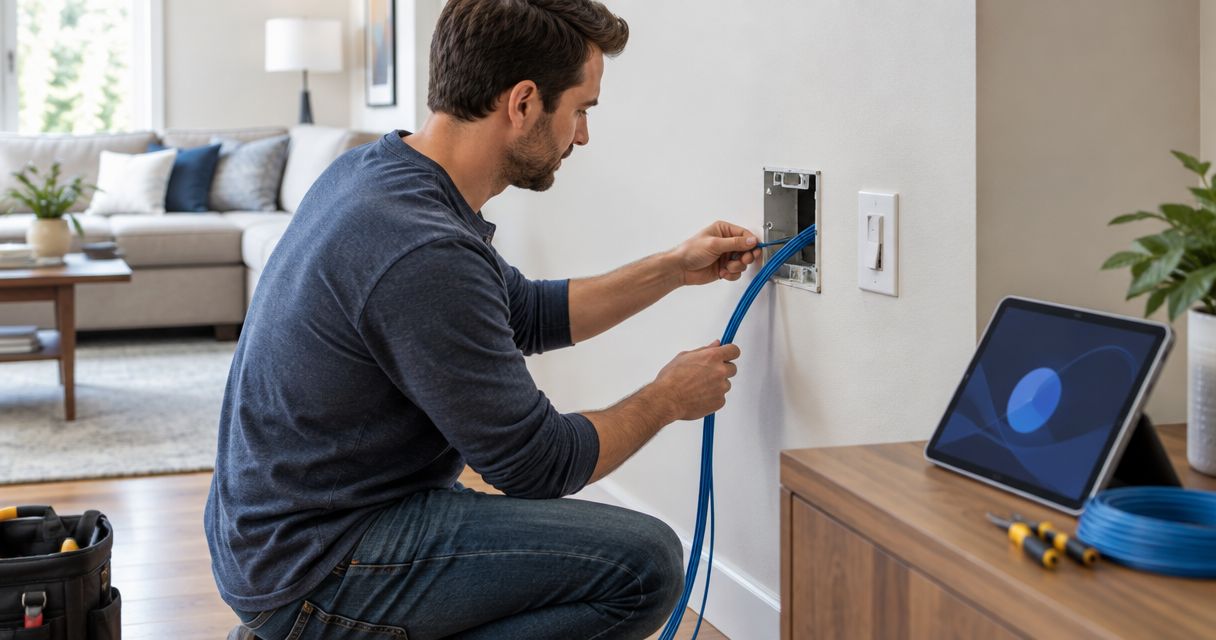

Can low voltage wiring be added to an existing home? Yes. Compare concealed routes, drywall access, cable choices, and what to confirm before work.
Yes, low-voltage wiring can be added to an existing finished home by routing cable through accessible attics, crawl spaces, wall cavities, or surface raceways. Completely concealed wiring depends on the route: blocking, insulation, and inaccessible ceilings can require small drywall openings, so confirm who handles patching and painting before work starts.
- Can low voltage wiring be added to an existing home? Yes; access determines whether drywall openings are necessary.
- Treasure Valley Solutions installs low-voltage wiring for homeowners in Boise, Meridian, and the greater Treasure Valley.
- Attics and crawl spaces support concealed cable routes; surface raceways avoid opening inaccessible walls.
- Confirm cable ratings, equipment power, testing, and drywall repair responsibilities before approving installation.
Why this matters
You do not need a full renovation to add wired networking, speaker cable, or security camera connections. You need a workable path between the equipment location and each device, with suitable cable and accessible terminations.
For a 2026 retrofit, plan the route before choosing final device locations. Moving a wall plate to an adjacent cavity can change the work involved. Treasure Valley Solutions provides low-voltage wiring and installation services for homes and businesses throughout the Treasure Valley.
Can low-voltage wiring be added to an existing finished home?
Yes. Finished walls change how installers reach the cable path; they do not automatically rule out new wiring. A successful retrofit starts with inspecting access above, below, and beside the rooms you want to connect.
The installation process follows this sequence:
- Map endpoints. Identify the equipment location, wall plates, speakers, cameras, and wireless access points.
- Inspect access. Check attic space, crawl-space access, framing direction, and existing openings before committing to a route.
- Confirm pathways. Select concealed paths, planned access cuts, or surface raceways that suit the house.
- Install cable. Use appropriate cable, protect it at penetrations, and avoid damaging concealed utilities.
- Test connections. Label both ends, verify the wiring, and test the connected equipment before closing access openings.
Ask the installer to explain the difficult part of each run. A cable drop down an accessible wall cavity is different from a route across a finished ceiling with no access from above.
Which wiring route is best for your finished home?
The best route balances concealment, access, and repair work. No method fits every room, and a single house can need several methods.
| Route | Best for | Main advantage | Main limitation |
|---|---|---|---|
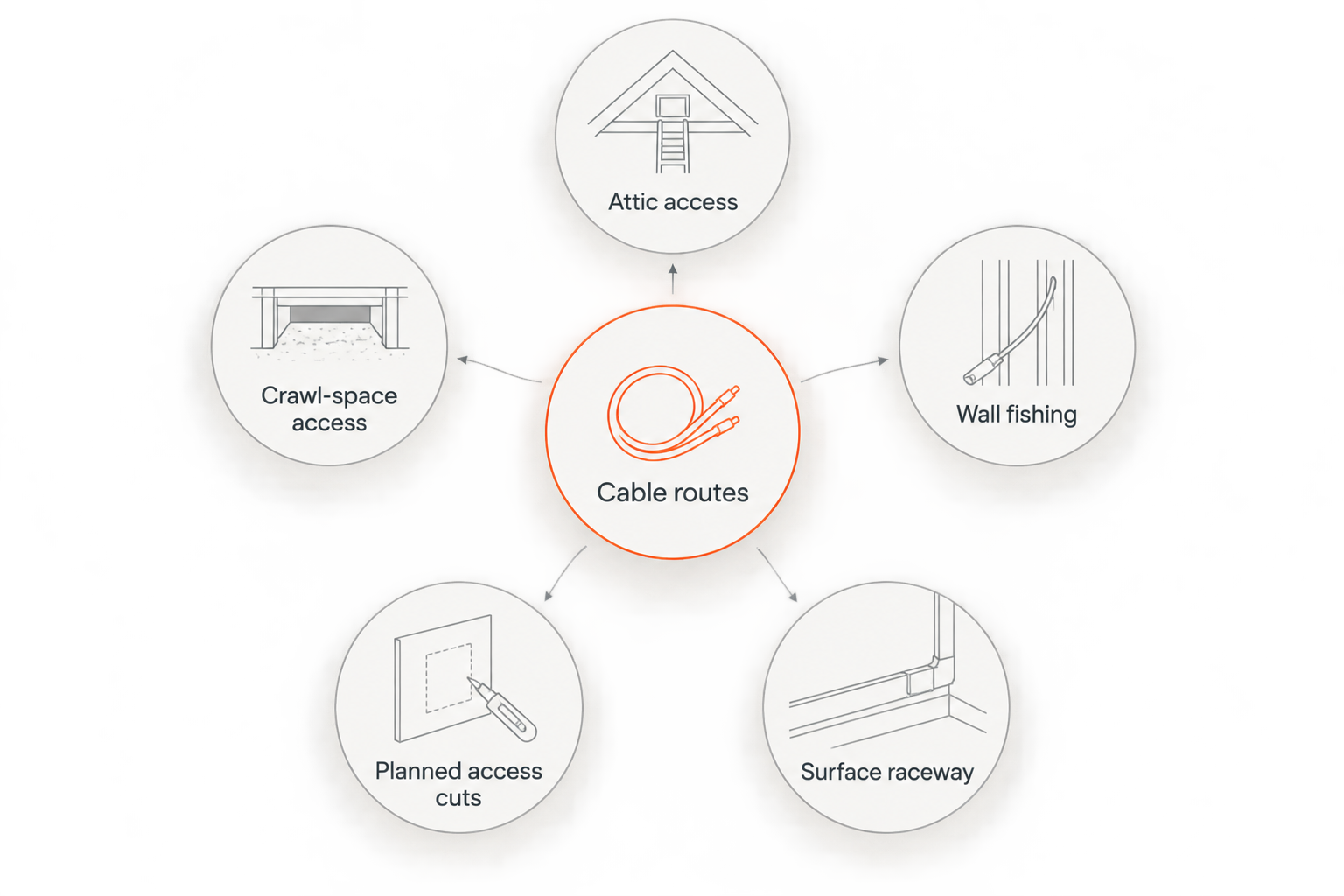
| Attic access | Upper-floor rooms beneath accessible attic space | Reaches wall cavities from above | Tight roof areas and insulation complicate access |
| Crawl-space access | Rooms above an accessible crawl space | Reaches floor-level wall locations from below | Beams, ducts, and inaccessible sections restrict routes |
| Wall fishing | Endpoints with a clear cavity between access points | Keeps cable concealed inside the wall | Blocking and insulation interrupt the path |
| Planned access cuts | Finished areas without a continuous accessible route | Allows controlled access around obstructions | Requires patching and finish work |
| Surface raceway | Rooms where opening walls is undesirable | Contains cable without hiding it inside the wall | Remains visible and needs a deliberate layout |
Choose the least disruptive route that still gives you a serviceable installation. Concealment is valuable, but equipment connections must remain accessible for troubleshooting and replacement.
A neat raceway along a planned edge can be preferable to an unpredictable series of wall openings. Conversely, an accessible attic can make concealed wiring practical without opening a long strip of drywall.
How do you plan the cable before opening walls?
Start your 2026 wiring plan with the equipment you intend to connect, not a shopping list of cable. Different signals, connectors, power requirements, and distances call for different decisions.
Map endpoints
Mark the actual mounting positions. A camera tucked under an eave, a ceiling access point, and a desk wall plate need different termination details, even if all use Ethernet cable.
Identify the central equipment location at the same time. It needs access for connections and maintenance, plus suitable power and ventilation for the equipment installed there. Do not choose a cabinet solely because it hides everything.
Match cable to equipment
Ethernet supports networking and, with compatible equipment, Power over Ethernet. Speaker cable connects passive speakers to amplification. Coaxial cable serves equipment that requires coaxial connections; it is not automatically interchangeable with an Ethernet run.
For standard copper Ethernet structured cabling, the familiar channel limit is 100 meters, typically allowing 90 meters of permanent cable and 10 meters of patch cords combined. These are standards-based channel limits, not a promise that any cable will support every Ethernet speed or power requirement over that distance.
Select the cable category and installation method for the intended application. Longer video connections also need a signal-specific plan rather than an assumption that any concealed cable will work.
Leave service access
Avoid burying connections that need inspection or replacement. Keep terminations accessible, respect the cable manufacturer's bend-radius and pulling requirements, and leave enough service slack for the planned connection.
Photograph accessible cable routes before openings are closed. Record which cable serves which room, not just which bundle enters the equipment cabinet. Those records make later changes easier to trace.
Why does disruption vary between homes?
The amount of opening and repair work depends on construction and access, not simply the number of devices. These factors determine whether an apparently short run is straightforward or difficult:
- Access above or below: An accessible attic or crawl space gives the installer a route that a finished floor assembly does not.
- Framing direction: Joists and studs determine whether a cable follows an open cavity or crosses repeated barriers.
- Blocking and fire barriers: Solid obstructions interrupt fishing paths and require an approved way through or around them.
- Insulation and existing utilities: Insulated cavities and concealed plumbing or electrical wiring restrict safe working space.
- Endpoint placement: Exterior walls, ceilings, and locations over doors can be harder to reach than nearby interior-wall positions.
- Finish requirements: Textured walls, wallpaper, cabinetry, and painted trim change how access openings must be restored.
During a 2026 site assessment, ask for the proposed route and the fallback route. “Concealed wiring” should describe an agreed result, not imply that drywall will never need to be opened.
Keep installation scope separate from finish restoration. The discussion of low-voltage wiring installation cost belongs alongside route planning, because access and restoration affect the work you authorize.
What safety details should the installer address?
Low-voltage wiring still needs correct cable selection and installation. A cable that works across a floor is not automatically suitable inside a wall, outdoors, or in a building space with special fire-rating requirements.
Cable ratings and separation
Use cable listed for its installed environment. Outdoor exposure, moisture, and in-wall installation each require attention to the cable's markings and intended use.
Do not place ordinary communications wiring in a line-voltage electrical box unless the arrangement is specifically permitted and properly separated. Required separation depends on the wiring method and applicable electrical rules; a single blanket clearance does not cover every installation.
Penetrations and concealed hazards
Locate existing utilities before drilling. Framing penetrations must respect structural requirements, and penetrations through fire-resistance-rated assemblies need the appropriate firestop system.
Older finishes and suspect materials also deserve attention before cutting. Resolve material concerns through appropriate evaluation rather than treating every wall as safe to drill or saw.
Power and local requirements
Power over Ethernet requires compatible power-sourcing equipment and compatible devices. Running a data cable alone does not guarantee that a camera or access point will receive power.
For work planned in 2026, confirm applicable permit and inspection requirements with the authority responsible for your address. If the project needs a new electrical receptacle, treat that as electrical work rather than folding it into a generic cable drop.
Can you prepare for cameras, speakers, and motorized shades together?
Yes. Planning related systems together lets you evaluate shared access before the walls are patched, while still choosing the correct cable and termination for each device.
A camera needs its viewing position considered alongside its cable route. A ceiling speaker needs clearance from framing and other obstructions. Neither location should be selected solely because it is convenient to drill.
Window treatments add another coordination point. With motorized shades for bay windows, angled window sections make the motor position and cable exit important planning decisions; confirm the selected shade's power and control requirements before running cable to the window.
Do not assume that “smart” means wireless or that wireless means no power connection. Confirm each device's requirements separately. Include access for replacing the device later, especially where a termination will sit behind trim or near a ceiling.
For your 2026 project scope, separate what you are installing now from what you are preparing for later. An accessible pathway can support future changes, but spare cable only helps when it suits the future equipment.
Can you add wiring without cutting drywall?
Yes, when an accessible route reaches the required endpoint without an obstructed cavity. Attics, crawl spaces, existing suitable pathways, and surface raceways can reduce or avoid access cuts, but the route must be checked before anyone promises a no-cut installation.
Is wired networking better than adding more Wi-Fi equipment?
Wired networking is best for fixed devices and access points when a practical cable route exists; Wi-Fi is best for mobile devices. The systems work together, and a new cable does not by itself correct poor access-point placement or an internet-service problem.
Can existing cable be reused instead of installing new cable?
Yes, if testing confirms that the existing cable, termination, condition, and route meet the new application's requirements. Connector appearance alone does not establish compatibility, and a cable that passes a basic continuity check has not necessarily demonstrated the performance required for the planned network.
What should your installation scope include?
Before approving a 2026 retrofit, ask for a written scope that identifies endpoints, cable types, visible components, and testing. Include the less visible responsibilities that tend to become disputes: moving furniture, protecting finishes, patching openings, and painting.
Use this checklist during the walkthrough:
- Mark each device and wall-plate location in the room.
- Identify the main cable route and any known obstructions.
- Agree on acceptable access openings and visible raceways.
- Confirm cable suitability and equipment power requirements.
- Specify labeling, termination, and the level of testing included.
- Assign responsibility for patching, texture matching, and painting.
- Request cable labels and a record of the completed connections.
Treasure Valley Solutions is a fit for Treasure Valley homeowners who want professionally installed low-voltage wiring. Professional installation addresses routing and connections, but concealed access and finish restoration still need an explicit scope; hiring an installer does not remove those constraints.
At handoff, operate the connected equipment rather than inspecting wall plates alone. Verify that the intended network connection, speaker channel, or camera feed works, and keep the connection records with your home documents.
Plan your finished-home wiring
Discuss device locations, cable routes, and installation scope for your Treasure Valley home.
FAQ
Can low voltage wiring be added to an existing home after construction?
Yes, low-voltage wiring can be added after construction using accessible building spaces, wall fishing, planned openings, or surface raceways. The home's framing and access determine the installation method.
Will installers have to open every wall to add Ethernet?
No, adding Ethernet does not require opening every wall. An accessible attic or crawl space can provide a main route, although individual drops can still require access openings.
Can I put Ethernet cable in the same box as an electrical outlet?
Do not put ordinary Ethernet terminations in a line-voltage outlet box unless a specifically permitted, properly separated arrangement is used. Have the installer confirm the applicable wiring method and requirements.
Can low-voltage wiring be completely hidden in a finished house?
Yes, low-voltage wiring can be completely hidden when the house provides a suitable concealed route. Some routes require drywall openings that must be repaired afterward.
Does a wired security camera still need power?
Yes, a wired security camera needs power. A compatible Power over Ethernet camera can receive data and power through Ethernet, while other cameras require a separate power arrangement.
Should I run spare cable while the installer has access?
Run spare cable when you have a defined future use and the cable suits that application. Otherwise, discuss an accessible pathway rather than assuming an unused cable will meet every future need.
Who patches the drywall after a wiring retrofit?
The party identified in your written scope handles drywall repair. Confirm patching, texture matching, and painting separately before installation begins.
One last thing
The shortest cable route is not always the least disruptive route. A longer path through accessible space can avoid a difficult finished ceiling, provided it stays within the application's cable limits and installation requirements.
Before approving the work, stand at each proposed endpoint and ask how the cable gets there. That question connects the finished appearance you want with the route the installer actually has to build.
Related guides
Recent Google reviews
Read all reviews →“Joe does a fantastic job!”
“Great service and very reasonably priced. Fast and efficient.”
“Professional and knowledgeable. Thank you so much for the extra effort in resolving my security issues.”