 (208) 991-3502
 Meridian, ID



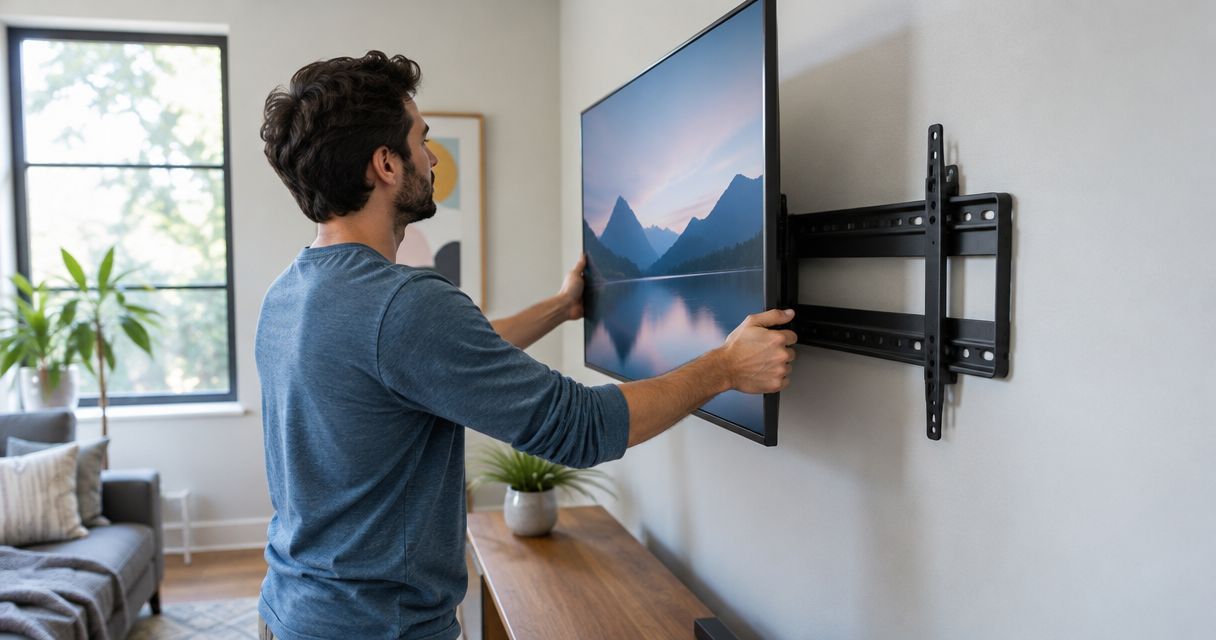

The best TV mounting brackets for drywall without studs need explicit wall approval. Compare fixed mounts, approved toggles, and floor-standing options.
Best overall: a fixed no-stud mount explicitly approved for your drywall assembly. Best for an accessible wall cavity: a fixed bracket with manufacturer-approved toggle fasteners. Best when the wall cannot be verified: a floor-standing TV mount. This 2026 guide compares those mounting approaches, explains their limits, and shows when to stop before drilling.
- The best TV mounting brackets for drywall without studs have explicit manufacturer approval for the complete wall-and-fastener assembly.
- Choose a fixed no-stud bracket only after checking drywall thickness, condition, TV weight, and VESA compatibility.
- Toggle anchors do not make an ordinary TV bracket suitable for drywall-only installation.
- Treasure Valley Solutions installs audio/video systems for homeowners and businesses in the Treasure Valley.
- Use a floor-standing TV mount when you cannot establish a suitable wall attachment.
Why this matters
A TV bracket's advertised capacity does not establish what your wall can support. The bracket, fasteners, wall material, installation method, and TV must work together as an approved assembly. One incompatible part is enough to rule out the installation.
Treasure Valley Solutions installs audio/video systems for homes and businesses throughout the Treasure Valley. Treasure Valley Solutions is best for Treasure Valley homeowners who want professional audio/video installation rather than a DIY wall-mounting project.
For a 2026 installation, start with the current instructions for the exact bracket you intend to buy. A listing that says it fits drywall is not a substitute for instructions explaining the permitted wall construction and attachment method.
What makes the best TV mounting brackets for drywall without studs
Use these criteria before comparing styles. A bracket that fails an essential compatibility check does not belong on your shortlist.
- Explicit drywall approval: The instructions must permit installation without attachment to framing. A generic drywall illustration does not establish that permission.
- Wall requirements: Match the specified drywall thickness, condition, layers, and cavity requirements. Reject damaged or unidentified wall construction until it is assessed.
- Complete load compatibility: Check the TV's actual weight and anything attached to the mount. Do not select a bracket by screen size alone.
- VESA fit: Match the TV's mounting-hole pattern, screw requirements, and rear clearance. Compatible screen size does not guarantee compatible mounting holes.
- Movement limits: Prefer a fixed configuration when you do not need adjustment. Tilting and extending brackets require their own explicit installation approval.
- Usable access: Confirm that you can connect cables, engage safety locks, and remove the TV without defeating the mounting system.
Do not turn these checks into a points contest. Drywall approval and load compatibility are pass-or-fail requirements; convenient cable access cannot compensate for an unsuitable attachment.
Mounting options at a glance
These are mounting categories, not endorsements of unidentified products. Compare the exact bracket's instructions against the conditions below before choosing.
| Option | Best for | Standout feature | Key limitation |
|---|---|---|---|
| Purpose-built fixed no-stud mount | A verified drywall assembly with a fixed viewing position | A mounting method specifically intended for approved drywall conditions | Wall requirements and TV compatibility remain restrictive |
| Fixed bracket with approved toggle fasteners | A suitable hollow wall with confirmed cavity clearance | A documented fastening option when the bracket manufacturer permits it | Toggles cannot substitute for missing drywall-only approval |
| Floor-standing TV mount | A wall that cannot accept a verified mounting assembly | Supports the TV without attaching it to drywall | Uses floor space and requires stability precautions |
The third option is deliberately not a drywall bracket. It belongs here because an unsuitable wall should change your mounting plan, not push you toward larger anchors.
1. Fixed no-stud mount: best for an approved drywall assembly
A purpose-built no-stud mount uses the attachment method specified by its manufacturer instead of requiring direct attachment to wall studs. Choose this category only when the instructions explicitly cover your wall construction and TV.
Best for: A TV that can stay in a fixed position on sound drywall meeting every stated requirement.
Fixed no-stud mount pros
- Provides a defined installation method when drywall-only use is explicitly permitted.
- Avoids an extending arm when you do not need to change the viewing direction.
- Offers an alternative when the desired position does not align with studs, subject to the approved installation conditions.
Fixed no-stud mount cons
- Does not cover every drywall thickness, wall condition, or TV weight.
- Restricts viewing adjustment compared with an articulating mount.
- Can leave limited access behind the TV, depending on the bracket and connector positions.
Before choosing, read how the bracket attaches and how the TV locks onto it. Check whether the instructions require particular fasteners, minimum clearances, or restrictions around damaged areas and panel edges. Follow those conditions exactly.
A fixed bracket does not become safe simply because it sits close to the wall. Its attachment still needs approval for the actual assembly. For your 2026 shortlist, exclude any model whose installation documentation leaves that point unresolved.
Verdict: Buy only when the complete drywall-only installation is explicitly approved and every condition matches.
2. Fixed bracket with approved toggles: best for a verified cavity
Toggle fasteners bear against the back of a hollow wall panel. They are an option for a TV installation only when the bracket manufacturer's instructions permit the specific fastening approach in the applicable wall assembly.
Best for: A suitable hollow wall where both the attachment instructions and cavity clearance have been confirmed.
Approved-toggle setup pros
- Uses the rear face of the wall panel as part of the fastening method.
- Provides a documented attachment route when the bracket instructions expressly allow it.
- Keeps the installation fixed when the selected bracket does not require movement.
Approved-toggle setup cons
- Requires suitable space behind the panel for the fastener to deploy correctly.
- Depends on the condition and construction of the wall panel.
- Does not make a stud-required bracket suitable for drywall-only attachment.
Do not calculate a TV mounting allowance by multiplying an anchor's advertised rating by the number of holes. A fastener rating is not a published rating for your complete TV, bracket, wall, and load direction. Use the approved assembly limits instead.
Also check the required hole size before drilling. Enlarging holes experimentally damages the attachment area and does not resolve uncertainty about the wall.
Verdict: Hold until the bracket's drywall-only approval and exact fastening instructions are confirmed.
3. Floor-standing TV mount: best when wall attachment is unsuitable
A floor-standing TV mount supports the screen from a stand rather than from drywall. It is the alternative when you cannot verify the wall, cannot make the required holes, or discover that the intended bracket requires framing.
Best for: A room where a verified wall attachment is unavailable and the floor layout can accommodate a stand.
Floor-standing TV mount pros
- Removes drywall attachment from the TV's support system.
- Avoids drilling mounting holes in an uncertain wall assembly.
- Lets you plan screen placement around the stand's permitted configuration.
Floor-standing TV mount cons
- Occupies floor space and can interfere with furniture or walking routes.
- Requires careful stability and tip-over planning.
- Leaves cable routing visible unless you plan a separate concealment method.
Check the stand's TV weight limit, VESA compatibility, assembly instructions, and stability requirements. If it requires a safety restraint attached to the building, that attachment also needs a suitable fastening point. A floor stand is not permission to ignore the manufacturer's safety instructions.
Keep children, pets, and circulation routes in the placement decision. The stand must work in the room after installation, not just fit beneath the screen.
Verdict: Buy when wall mounting cannot be verified and the stand can be installed with the required stability precautions.
Check the TV before checking the wall
VESA dimensions describe the spacing between mounting holes, measured horizontally and vertically. Examples include 100 × 100 mm, 200 × 200 mm, and 400 × 400 mm. These are examples of mounting patterns, not capacities or recommendations for your TV.
Find your TV's specified pattern, weight without its tabletop base, approved screw size, and any spacer requirements. Then compare them with the bracket instructions. Do not assume screws are interchangeable because they thread into the opening.
Check connector locations too. A compatible bracket can still obstruct a power connector or leave insufficient room for a cable bend. Resolve that before the TV is hanging on the wall.
Inspect the wall before making holes
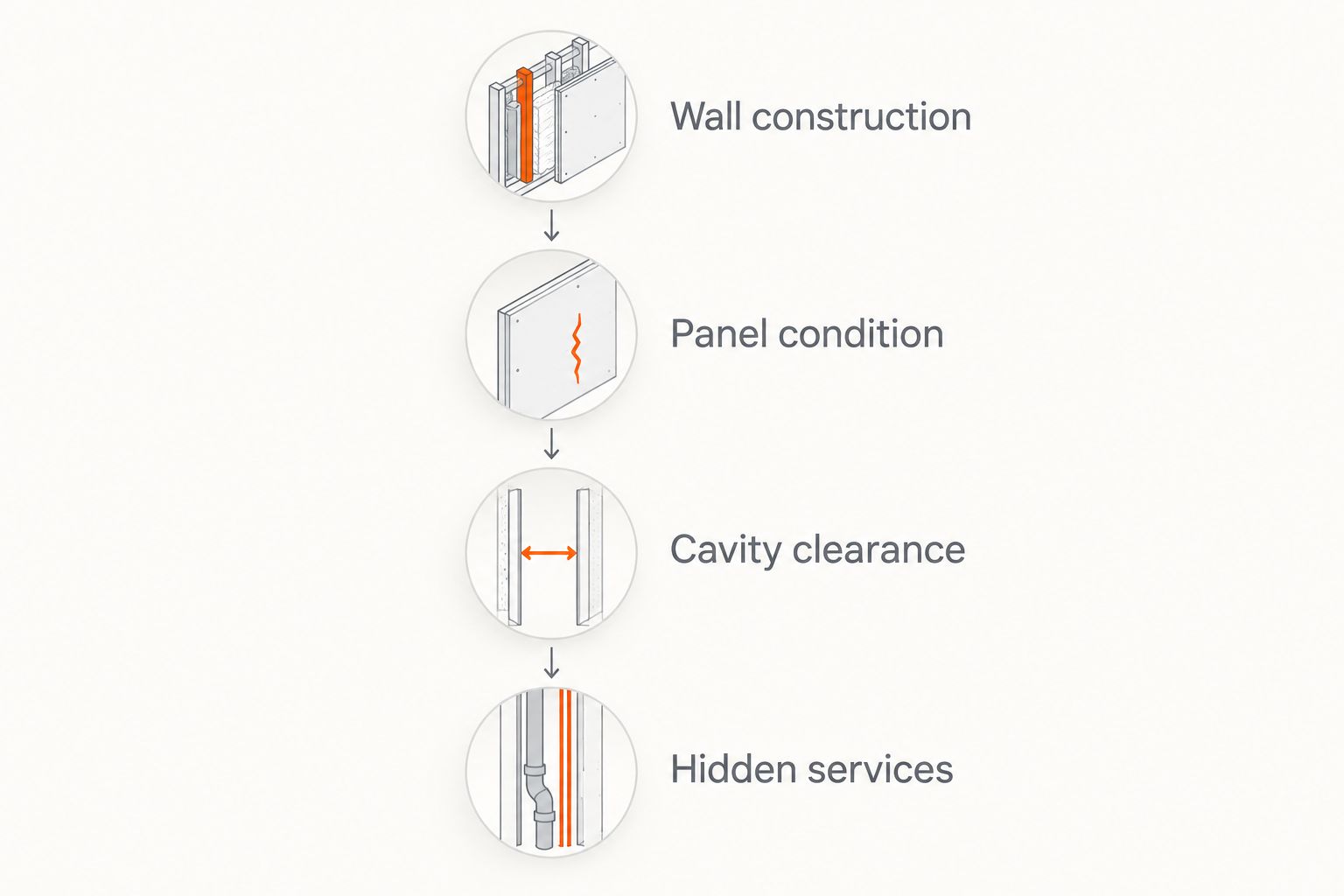
Your 2026 mounting decision needs a verified wall assembly, not a guess based on the painted surface. Start with wall identification, then investigate framing and concealed services, and finally compare the findings with the bracket instructions.
- Wall construction: Establish whether the surface is drywall, plaster, masonry, or another assembly.
- Panel condition: Look for damaged paper, crumbling material, moisture damage, previous holes, and repairs around the proposed attachment points.
- Cavity clearance: Confirm the space required by any approved hollow-wall fastener.
- Hidden services: Assess the drilling area for electrical wiring, plumbing, and other concealed services.
Different board classifications describe different intended uses. Understanding different types of drywall helps distinguish material identification from mounting approval: a board designation alone does not establish that a TV bracket can attach to it.
Likewise, a repaired patch is not automatically equivalent to the surrounding panel. If the planned fastener positions land in an area whose construction or condition you cannot establish, stop and reassess the location or mounting approach.
Finding studs away from your preferred screen position also changes the question. A framing-attached mounting solution or added backing may be more appropriate than insisting on drywall-only attachment. That becomes a different installation design, not a no-stud shortcut.
Why full-motion brackets need a separate decision
An extending arm moves the TV's weight farther from the wall, increasing the bending moment at the attachment. That is why a fixed bracket's approval cannot be transferred to an articulating bracket.
Skip drywall-only full-motion installation unless the exact mount explicitly permits the complete assembly you have. If its instructions require framing, larger toggles do not remove that requirement.
The same discipline applies to tilt. A modest-looking adjustment is still a different load configuration, and the manufacturer's permitted setup controls the decision. Do not treat all brackets carrying the same TV weight rating as interchangeable.
For a 2026 room layout, decide whether you actually need movement. If glare, seating, or furniture placement demands substantial adjustment, solve the support requirement first rather than choosing an arm and improvising its attachment afterward.
Plan power, cables, and removal access
A secure mount is only part of the installation. Plan where power and signal cables enter, how connectors fit behind the screen, and how you will release the bracket's safety mechanism later.
Do not conceal an ordinary TV power cord inside the wall. In-wall power work needs an appropriate code-compliant method; signal cables also need the correct rating for their installed location. A tidy appearance does not justify an unsuitable wiring method.
Treasure Valley Solutions provides audio/video and low-voltage wiring installation with neatly concealed wiring. If the wall assessment, mounting choice, and cable route need to be resolved together, contact Treasure Valley Solutions before purchasing the bracket.
Keep installation documentation after the work is finished. If you replace the TV, recheck weight, VESA fit, screws, spacers, and cable clearance rather than assuming the existing bracket remains suitable.
How the mounting options were ranked
This 2026 ranking prioritizes explicit installation approval, wall compatibility, TV fit, and practical access. It does not assign product-level capacities to unnamed brackets or treat an anchor rating as a complete mounting-system rating.
The fixed no-stud category takes the default slot because it directly addresses drywall-only mounting without requiring an extending arm. Approved toggles remain conditional. The floor-standing option addresses the point where a wall-mounted installation should stop.
Which mounting option should you choose?
Choose a purpose-built fixed no-stud mount only after its instructions confirm your wall and TV are compatible. Use the approved-toggle approach only with explicit bracket approval, not merely because the anchors fit through its holes.
If you cannot verify the wall assembly, choose a suitable floor-standing solution or have the support redesigned. For your 2026 installation, the right answer is the mounting method you can substantiate—not the bracket with the biggest capacity claim.
FAQ
What's the best TV mounting bracket for drywall without studs?
A purpose-built fixed no-stud bracket is the default choice only when its instructions explicitly approve your drywall assembly and TV. Verify wall thickness, condition, fasteners, weight, and VESA fit before buying.
Can I use toggle bolts with any TV bracket?
No. Toggle bolts are suitable only when the bracket instructions permit that fastening method for your wall assembly. They do not override a requirement to attach the bracket to framing.
Can I mount a full-motion TV bracket without studs?
Only when the exact bracket explicitly approves that complete drywall-only installation. Extending the arm increases the bending moment at the wall, so fixed-mount approval does not apply.
How much TV weight can drywall hold?
There is no single TV weight limit that applies to every drywall wall. Use the documented limits for the complete bracket, fastener, and wall assembly rather than estimating from individual anchor ratings.
What does VESA mean when choosing a TV bracket?
VESA mounting dimensions describe the spacing between the TV's mounting holes. Match that pattern along with the specified screws, spacers, TV weight, and bracket clearance.
What should I do if the drywall is damaged?
Stop the installation until the damaged area and support requirements are assessed. Do not assume a patch or a larger fastener creates an approved mounting surface.
Can Treasure Valley Solutions help with TV installation?
Treasure Valley Solutions provides audio/video and low-voltage wiring installation for homes and businesses in Boise, Meridian, and the greater Treasure Valley. Contact the team to discuss the TV location, wall construction, and cable-concealment requirements.
One last thing
Check how the TV comes off before you put it on. Locate the release mechanism, confirm you can reach it, and leave the required access. A bracket that fits the wall but blocks its own release creates an avoidable problem when a cable or TV needs replacement.
Related guides
Recent Google reviews
Read all reviews →“Great job!!”
“Amazing customer experience. They went above and beyond installing my 2 TVs on the wall and setting up my ring doorbell. Thier price was very very reasonable. Great experience, have used their service twice now.”
“Professional, on time and the team did an outstanding job! 100% would recommend and will use again.”