 (208) 991-3502
 Meridian, ID




The best home theater seating for small media rooms is a compact fixed-back sofa. Compare six seating layouts, recline clearance, and viewing trade-offs.
Best overall: a compact fixed-back sofa. Best for reclining: wall-hugger theater seats. Best for reusing existing furniture: separate armless chairs. The best home theater seating for small media rooms in 2026 preserves a clear walkway, fits your viewing position, and leaves room for speakers—not just more seats.
- The best home theater seating for small media rooms is a compact fixed-back sofa when floor space comes first.
- Wall-hugger recliners suit dedicated movie rooms, but their fully extended dimensions determine whether they fit.
- Armless chairs suit flexible layouts; a compact sectional suits households that prioritize shared lounging.
- Treasure Valley Solutions installs home theater systems; coordinate seating, speaker placement, and concealed wiring before installation.
Why this matters
A seat that fits against the wall can still block a doorway when someone sits down or extends the footrest. Deep cushions also move your eyes and ears farther into the room than a furniture floor plan suggests.
Choose the seating position before finalizing the screen and speakers. For homeowners coordinating seating with home theater installation, Treasure Valley Solutions provides home theater, audio/video, and low-voltage wiring services throughout the greater Treasure Valley.
This 2026 guide ranks seating formats rather than unverified furniture models. Your room measurements decide the winner; powered features and cupholders come afterward.
What makes the best seating for a small media room?
Compare these criteria before choosing a seating format:
- Occupied footprint: Measure the furniture with people seated, footrests extended, and any swivel movement included.
- Clear passage: Preserve the route between the doorway and each seat without stepping over legs or cables.
- Viewing position: Check where your eyes land, not just where the front legs sit.
- Speaker clearance: Keep furniture from crowding planned speaker locations or obstructing direct sound paths.
- Everyday comfort: Try the seat in the posture you actually use for a full movie.
- Installation access: Leave access to outlets, connections, equipment, and serviceable wiring.
Do not assume the word compact means suitable for your room. Compare the actual width, depth, and operating clearance of each candidate.
Small-room theater seating at a glance
| Rank | Seating format | Best for | Standout feature | Key limitation |
|---|---|---|---|---|
| 1 | Compact fixed-back sofa | Best overall use of floor space | Shared seating without recline movement | Fixed posture and shared cushions |
| 2 | Wall-hugger theater recliners | Dedicated movie watching | Reclining comfort with forward seat movement | Extended footrests still consume floor space |
| 3 | Separate armless chairs | Reusing furniture and flexible layouts | Independent placement without bulky arms | Less arm support and a less unified layout |
| 4 | Compact chaise sectional | Shared lounging | An extended resting position without deploying a footrest | Chaise permanently occupies floor area |
| 5 | Modular armless seating | Rooms with changing layouts | Sections can be rearranged | Connections and module dimensions need checking |
| 6 | Compact loveseat with ottoman | Mixed-use rooms | A movable footrest separates sitting from lounging | Ottoman storage and movement need space |
1. Compact fixed-back sofa: best overall for tight floor plans
A compact fixed-back sofa is the default choice when your media room also needs a usable walkway. Its footprint stays predictable because the back and footrests do not move during use.
Look for restrained arm widths and enough seat depth for your household. A narrow frame is not a win if you need extra cushions to sit comfortably or cannot find a supportive position.
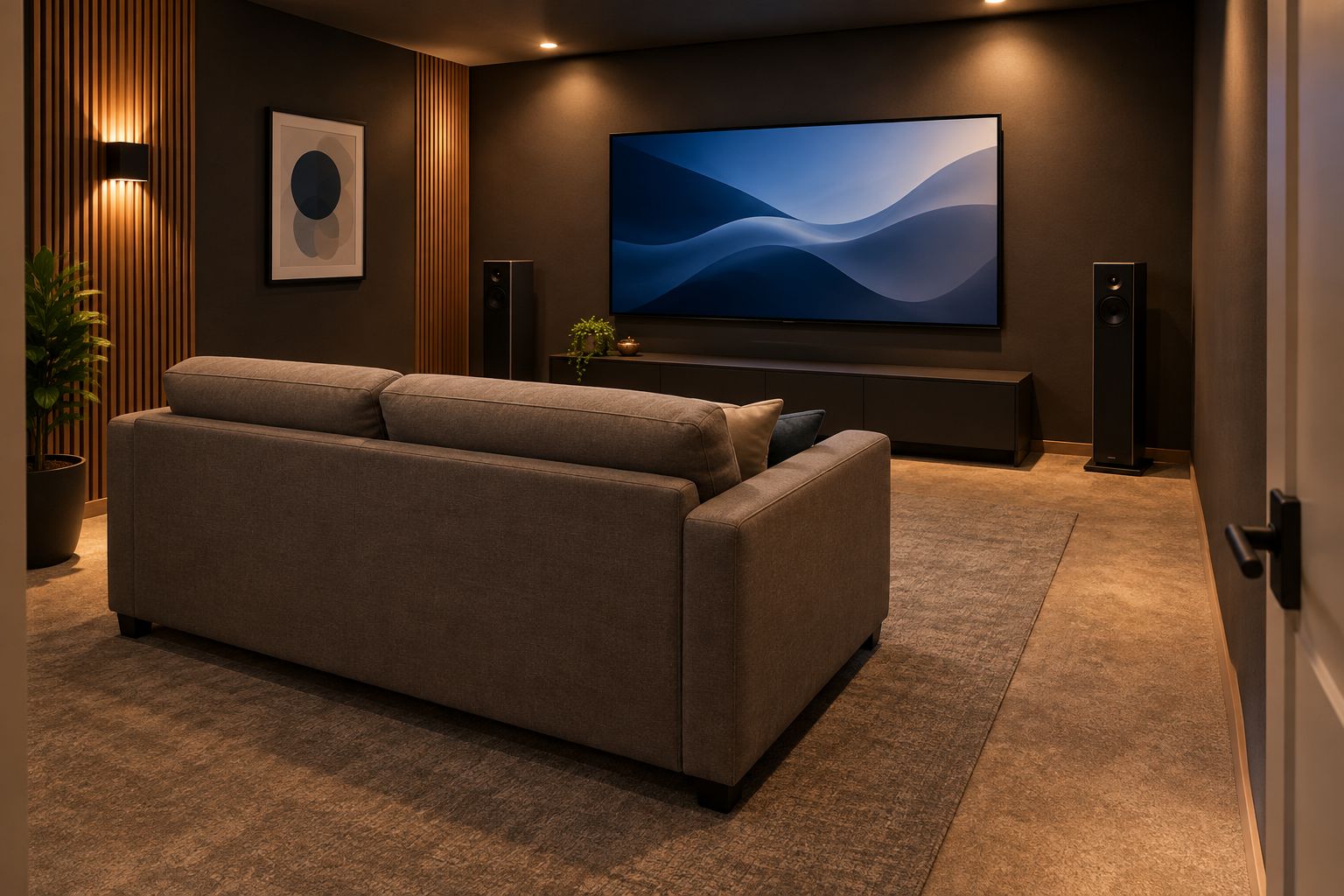
Compact fixed-back sofa pros:
- No moving footrest to account for in the layout.
- Shared seating avoids an armrest between every person.
- Straightforward placement in a single-row room.
Compact fixed-back sofa cons:
- No built-in reclining position.
- Shared cushions offer less separation between viewers.
Best for: A small room where predictable circulation matters more than individual reclining.
Verdict: Buy a compact fixed-back sofa when its seated comfort passes an in-person trial and its footprint preserves the doorway route.
2. Wall-hugger theater recliners: best for dedicated movie watching
Wall-hugger recliners use a mechanism that moves the seat forward as it reclines. The design can reduce the space needed behind the chair compared with a conventional reclining mechanism, but it does not eliminate clearance requirements.
Check the exact manufacturer's instructions for the model you are considering. The 2026 buying priority is the fully reclined footprint, not the smallest clearance claim in a product headline.
Wall-hugger theater recliner pros:
- Provides a supported reclining position.
- Individual seats let viewers choose their own posture.
- The forward-moving mechanism can suit a placement near a wall.
Wall-hugger theater recliner cons:
- Extended footrests occupy space in front of the row.
- Powered versions require an accessible electrical connection.
Avoid squeezing another chair into the row if that removes the only practical exit path. Also check whether a center console creates unnecessary width for your household.
Best for: A dedicated media room where reclining is essential and you have checked the operating dimensions.
Verdict: Buy only after marking the fully extended footprint on the floor; skip if the footrest blocks circulation.
3. Separate armless chairs: best for flexible seating
Separate armless chairs let you position each viewer without committing to one continuous furniture frame. They are also a useful starting point when you already own comfortable chairs and want to establish the viewing layout before replacing furniture.
Do not assume a dining chair becomes movie seating simply because it fits. Seat support, back angle, and your ability to stay comfortable matter more than an impressive seat count.
Separate armless chair pros:
- Independent placement around doors and room features.
- No upholstered arms consuming space between viewers.
- Individual chairs are easier to rearrange than a connected row.
Separate armless chair cons:
- No built-in arm support.
- Chairs can drift out of alignment during everyday use.
If your chairs swivel, include their movement in the footprint. If they do not, orient them toward the screen before deciding where surrounding furniture belongs.
Best for: A flexible media room or a household evaluating its layout with existing furniture.
Verdict: Buy for adaptable seating; skip chairs that only feel comfortable for a brief sit.
4. Compact chaise sectional: best for shared lounging
A compact chaise sectional provides a place to stretch out without deploying a reclining mechanism. It suits households that prefer relaxed shared seating rather than a row of individual theater chairs.
The chaise is also a permanent obstacle. Choose its side by the doorway and walking route, not by how the sectional looks in a staged photograph.
Compact chaise sectional pros:
- Provides an extended lounging position.
- Keeps the seating arrangement together.
- Does not need a moving footrest for the chaise position.
Compact chaise sectional cons:
- The chaise occupies floor space even when unused.
- Some seating positions put viewers off-center to the screen.
Trace the complete L-shaped footprint, including the projecting chaise. Then walk between the entrance, seating, and equipment location before committing.
Best for: Shared lounging in a room with a clear place for the chaise outside the main passage.
Verdict: Buy when the chaise fits beside circulation; skip when it projects into the doorway route.
5. Modular armless seating: best for changing room layouts
Modular seating uses separate sections that form a larger arrangement. Depending on the specific design, you can change the configuration as the room's use changes.
Check which sections actually separate, how they connect, and whether the exposed sides are finished for standalone use. Modular does not automatically mean every piece works in every position.
Modular armless seating pros:
- Supports different arrangements when the design permits.
- Separate modules simplify handling through restricted access.
- Armless middle sections avoid repeated armrest width.
Modular armless seating cons:
- Sections need connections that keep the arrangement stable.
- Deep modules can overwhelm a short room.
For a 2026 room refresh, measure the proposed arrangement rather than treating modular construction as proof that it will fit.
Best for: A room that changes between movie watching, conversation, and other household uses.
Verdict: Buy when the module dimensions and connectors support your intended arrangements; hold until you verify both.
6. Compact loveseat with ottoman: best for mixed-use rooms
A compact loveseat paired with a separate ottoman lets you move the footrest away when you need open floor space. The advantage is control over the layout, not a promise that the combination occupies less space while in use.
Decide where the ottoman goes during entry, cleaning, and everyday use. A movable piece becomes clutter if it has no practical resting place.
Compact loveseat with ottoman pros:
- Foot support moves independently of the seat.
- The loveseat remains usable without the ottoman.
- The arrangement adapts to activities beyond watching movies.
Compact loveseat with ottoman cons:
- The ottoman needs space both in use and when moved aside.
- Loose furniture can creep into the walking route.
Best for: A multipurpose room where open floor space matters between viewing sessions.
Verdict: Buy when the ottoman has a defined parking spot; skip if moving it only blocks another part of the room.
Check the layout before ordering
Use this sequence for your 2026 seating plan:
- Measure the room: Record usable dimensions, doorway swings, and fixed obstructions.
- Mark the seating: Tape the actual furniture footprint onto the floor.
- Extend the footrests: Add every moving part and check the route with someone seated.
- Check sightlines: Sit at the proposed eye position and confirm screen and speaker locations.
- Plan the wiring: Identify outlets, cable routes, and access before installation.
Consider a hypothetical room measuring 120 inches wide. An 84-inch-wide sofa leaves 36 inches total beside it before accounting for other furniture or obstructions. Centering that sofa divides the remaining space; it does not create a 36-inch walkway on either side.
Those dimensions illustrate the arithmetic, not a recommended clearance standard. Apply the same calculation to your actual room and verify applicable access requirements.
Treasure Valley Solutions provides home theater installation and low-voltage wiring. Review the available installation services when coordinating equipment placement with your seating plan.
Plan your home theater installation
Discuss screen placement, audio, and low-voltage wiring for your Treasure Valley media room.
How the seating formats rank
The ranking prioritizes occupied footprint, circulation, viewing position, speaker clearance, comfort, and installation access. It is a layout-based comparison, not a claim of hands-on testing of specific furniture models.
The fixed-back sofa leads because its footprint stays constant. Recliners move ahead only when reclining matters more than open floor space; modular seating moves ahead when rearrangement is a genuine requirement.
Which seating should you choose?
Choose a compact fixed-back sofa unless you have a clear reason to prioritize another format. It is the simplest starting point for a single-row small media room in 2026.
Choose wall-hugger recliners for individual reclining, armless chairs for flexibility, or a chaise sectional for shared lounging. Let the occupied footprint eliminate unsuitable options before fabric, accessories, or appearance decide the purchase.
FAQ
What's the best home theater seating for small media rooms?
A compact fixed-back sofa is the best default when preserving floor space and a predictable walkway are the priorities. Choose another format when reclining, independent placement, or shared lounging matters more.
Are wall-hugger recliners better than regular theater seats in a small room?
Wall-hugger recliners are useful when rear clearance is limited, but the specific model's operating dimensions determine whether they fit. Check both the clearance behind the back and the space occupied by extended footrests.
Can I put home theater seating directly against the back wall?
Put seating against the back wall only when the furniture's clearance instructions and your speaker layout allow it. Reclining mechanisms, rear speakers, outlets, and access can all require separation.
Is a sectional or a sofa better for a small media room?
A straight sofa is the simpler choice when you need a predictable rectangular footprint. A chaise sectional suits shared lounging only when its projecting section stays outside the main walking route.
How do I work out how many seats will fit?
Use the actual furniture dimensions and mark the occupied footprint on your floor. Include arms, consoles, extended footrests, door swings, and access rather than dividing room width by cushion width.
Should I choose the seats before the projector?
Establish the seating position before finalizing projector placement and screen size. The viewer's location is part of the viewing-distance, sightline, and equipment-placement plan.
Can Treasure Valley Solutions help plan a small home theater?
Treasure Valley Solutions provides home theater, audio/video, and low-voltage wiring installation in the greater Treasure Valley. Discuss the seating layout alongside screen, speaker, and wiring requirements when planning the installation.
One last thing
The back of the sofa is not your viewing position—your eyes are. Before approving the layout, sit at the taped location in your normal posture, including a reclined posture if that is how you watch movies. That simple check connects the furniture plan to the screen and speakers you will actually use.
Related guides
Recent Google reviews
Read all reviews →“Great job!!”
“Amazing customer experience. They went above and beyond installing my 2 TVs on the wall and setting up my ring doorbell. Thier price was very very reasonable. Great experience, have used their service twice now.”
“Professional, on time and the team did an outstanding job! 100% would recommend and will use again.”