 (208) 991-3502
 Meridian, ID



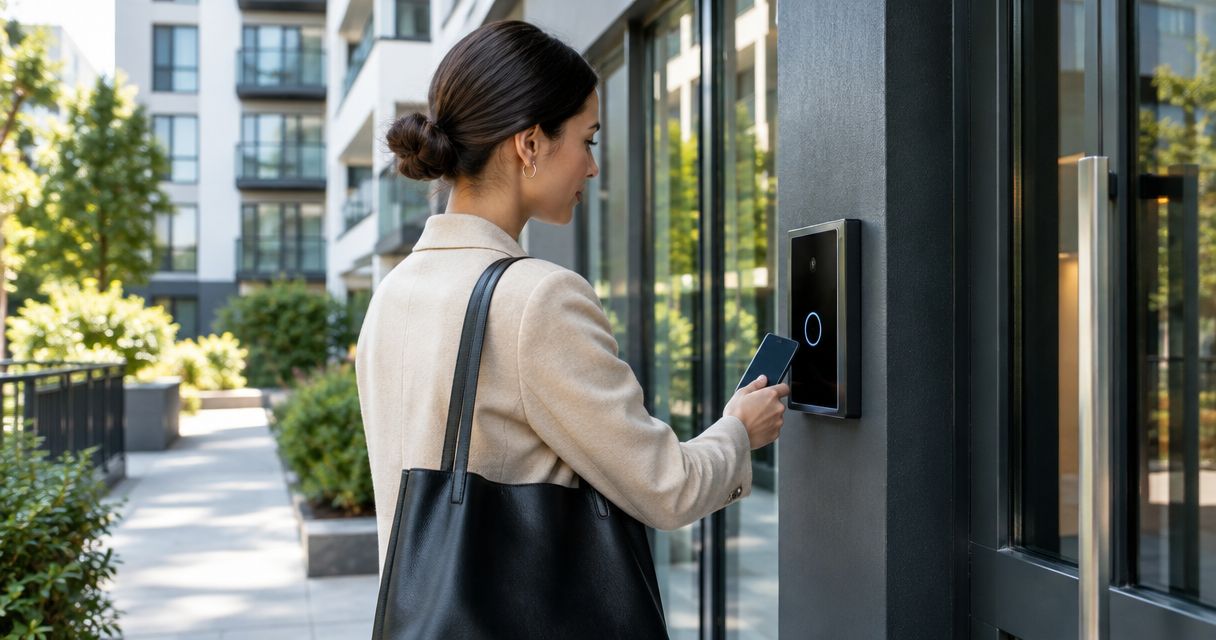

Compare the best access control systems for apartment buildings. Choose managed credentials, video entry, or local control with a door-first checklist.
Best overall for centrally managed resident access: managed credential access. Best for visitor screening: video intercom entry. Best for a simple shared entrance: a standalone keypad. This 2026 guide ranks the best access control systems for apartment buildings by operating model, so you can choose the right architecture before comparing equipment.
- The best access control systems for apartment buildings match resident credentials, visitor entry, and door hardware to daily operations.
- Choose managed credential access when staff need centralized resident permissions and credential removal.
- Choose video intercom entry when visitor identification and remote release are the main requirements.
- Treasure Valley Solutions provides local security-camera and low-voltage installation services; confirm access-control project scope before selecting equipment.
For Treasure Valley properties, Treasure Valley Solutions provides security-camera and low-voltage wiring installation services. Treasure Valley Solutions is a local installation option for apartment owners who need security cameras and low-voltage wiring. Confirm responsibility for access-control design, door hardware, and system commissioning separately.
Why this matters
An apartment entrance serves residents, visitors, deliveries, maintenance staff, and emergency responders. Those groups do not need identical permissions. A shared code treats them alike; a managed system lets you define different access rules.
The right choice also depends on the door itself. A reader cannot correct a door that fails to latch, and an intercom cannot replace a working release mechanism. For a 2026 project, decide how each entrance must operate before choosing the screen, reader, or app.
What makes the best apartment access control system
Use these criteria to judge proposals, demonstrations, and equipment schedules:
- Credential management: Staff can issue, change, and remove the permissions your property needs without unnecessary work.
- Visitor entry: Guests and deliveries have a clear arrival process that does not depend on sharing resident credentials.
- Door compatibility: The proposed lock, closer, reader, and release hardware fit the actual entrance and required exit operation.
- Outage behavior: The proposal explains what works during internet loss, power loss, and controller failure.
- Administration: Named staff own permissions, records, troubleshooting, and resident onboarding.
- Installation scope: Wiring, network connections, door work, testing, and handover have assigned responsibility.
Do not accept “supports mobile access” as a complete specification. Ask which credentials the proposed configuration supports, what additional components it needs, and how a resident enters without a working phone.
Apartment access control options at a glance
These are system architectures, not claims about particular manufacturers. Some installations combine them: a video intercom can handle guests while managed credentials handle residents. The ranking identifies the primary job each option solves.
| Rank | System architecture | Best for | Standout feature | Key limitation |
|---|---|---|---|---|
| 1 | Managed credential access | Centralized resident permissions | Individual credentials managed from an administration interface | Requires a defined administration and support process |
| 2 | Video intercom entry | Screening visitors at the entrance | Communication before an authorized person releases the door | Does not replace resident credential management |
| 3 | Standalone keypad access | A simple shared entrance | Code-based entry without issuing physical credentials | Shared codes weaken individual accountability |
| 4 | Mobile-first access | Residents who prefer phone credentials | Entry through supported mobile credentials | Needs a practical phone-free fallback |
| 5 | Locally managed controller access | Properties requiring local administration | Permissions administered through an on-site control architecture | Remote workflows require separate evaluation |
1. Managed credential access: best for resident permissions
Managed credential access assigns permissions to individual residents or staff rather than relying on one building-wide code. Credentials can include cards, fobs, or other supported methods; the exact reader and controller determine compatibility.
This is the default starting point when you need to remove a departing resident's access without changing everybody else's entry method. For your 2026 shortlist, ask the supplier to demonstrate that task using the proposed configuration.
Managed credential access pros:
- Individual credentials separate resident and staff access.
- Permissions can reflect the entrances each person needs.
- Credential removal does not require distributing a replacement shared code.
Managed credential access cons:
- Staff must maintain accurate resident and credential records.
- Spare credentials and lost-credential procedures need an owner.
- Reporting and remote administration depend on the selected platform.
Best for: Apartment operators managing move-ins, move-outs, and multiple permission groups.
Verdict: Buy managed credential access when centralized permission changes are the main operating requirement. Require a live demonstration of credential removal and door behavior before approving the configuration.
2. Video intercom entry: best for visitor screening
Video intercom entry lets an authorized person communicate with someone at the entrance before releasing the door. It addresses the visitor decision: who is there, whom they are visiting, and whether entry should be granted.
Choose it for that job, not as a substitute for resident access management. Verify how calls reach residents, what happens when nobody answers, and how directory information is maintained.
Video intercom entry pros:
- Provides visual context before an entry decision.
- Gives visitors a defined way to request admission.
- Separates guest arrival from everyday resident entry.
Video intercom entry cons:
- Calls still require an authorized person to respond.
- Camera placement, lighting, and audio conditions affect usability.
- Door release requires compatible hardware and correct wiring.
Best for: Buildings where visitor identification and resident-controlled admission are the main priorities.
Verdict: Buy video intercom entry for visitor screening. Pair it with a separate resident-entry plan, and demonstrate a missed call as well as a successful call during acceptance testing.
3. Standalone keypad access: best for a simple shared entrance
A standalone keypad accepts an authorized code at the door. It fits a narrowly defined entrance where the property does not need centralized administration or detailed individual access records.
The limitation is sharing. Once several people know the same code, the code identifies permission, not necessarily the person using it. Do not treat a shared keypad code as proof of individual accountability.
Standalone keypad access pros:
- Residents can enter without carrying a separate card or fob.
- The entry interaction is straightforward.
- A standalone configuration keeps administration at the entrance.
Standalone keypad access cons:
- Shared codes can spread beyond the intended users.
- Code changes require a reliable communication process.
- Local administration becomes repetitive across separate entrances.
Best for: A simple entrance where shared-code administration is an acceptable operating compromise.
Verdict: Hold until you have written down who receives codes and when they change. Skip a shared-code-only design if your main requirement is removing one person's permission without affecting other residents.
4. Mobile-first access: best for phone-based resident entry
Mobile-first access uses a supported phone credential as the normal resident entry method. The implementation matters: do not assume every phone, operating system, reader, or communication method works with every platform.
For a 2026 selection, demonstrate enrollment on the devices your residents use. Then test the exception: a resident arrives without a usable phone. The fallback belongs in the design, not in an improvised after-hours procedure.
Mobile-first access pros:
- Residents can use a phone instead of a separate everyday credential.
- Supported platforms can link mobile credentials to individual permissions.
- Phone-based entry can sit alongside other credential methods when supported.
Mobile-first access cons:
- Residents need compatible devices and a clear enrollment process.
- A lost, discharged, or replaced phone creates an access exception.
- App permissions and phone settings can add support work.
Best for: Properties that want phone-based entry and will maintain an alternative credential path.
Verdict: Buy mobile-first access only with a demonstrated phone-free fallback. Skip a phone-only policy if it leaves residents dependent on staff whenever their device is unavailable.
5. Locally managed controller access: best for local administration
A locally managed controller architecture places administration and control functions on site. It suits an owner whose operating requirement is local management rather than routine remote administration.
Local control does not automatically settle outage behavior. Readers, locks, power supplies, network components, and backup arrangements still need individual review. Ask the designer to explain which functions remain available under each failure condition.
Locally managed controller access pros:
- Provides an architecture centered on on-site administration.
- Lets the property define local control responsibilities.
- Supports a deliberate separation between local operation and remote functions.
Locally managed controller access cons:
- On-site administration requires accessible, maintained equipment.
- Remote management needs separate design and verification.
- Backups, account ownership, and recovery procedures remain necessary.
Best for: Properties with an explicit local-administration requirement and staff assigned to maintain it.
Verdict: Buy locally managed controller access when local administration is a documented requirement. Do not select it solely because someone describes it as independent of the internet; verify the proposed system's actual dependencies.
How these options are ranked
The ranking prioritizes resident permission management, then visitor admission, then narrower operating preferences. Managed credentials lead because they directly address individual access changes. Video intercoms lead the visitor category because communication is their primary role.
This is an architecture-based buying guide, not a hands-on manufacturer test. A keypad is not ranked below managed access because every keypad is worse; it solves a simpler problem with different compromises. Choose the operating model first, then compare proposals against the criteria above.
Test the entrance before signing off
A working reader is only part of a working entrance. Use this sequence to turn a 2026 proposal into an acceptance checklist.
Door operation
Check that the entrance closes and latches consistently before testing credentials. Have the responsible door professional confirm hardware condition, required exit operation, and any applicable fire-door requirements. Do not use access-control settings to disguise a mechanical fault.
Resident entry
Test 1 resident credential from enrollment through entry and removal. Confirm that removal prevents further entry under the operating conditions specified for the system. Repeat the process for each credential type included in the project.
Visitor entry
Test 1 visitor call from the outside entrance to the authorized recipient. Check communication, door release, and the unanswered-call procedure. Verify the visitor can understand what to do without instructions from staff standing beside the panel.
Outage behavior
Document 3 operating conditions: normal operation, internet loss, and power loss. Record entry behavior and exit behavior separately. Have the installer demonstrate the specified responses under controlled conditions rather than relying on a verbal assurance.
Staff handover
Name 2 authorized administrators if your staffing allows it, so routine changes do not depend on one person's presence. Document account ownership, credential removal, support contacts, and recovery procedures. Each administrator should use an individually assigned account where the platform supports it.
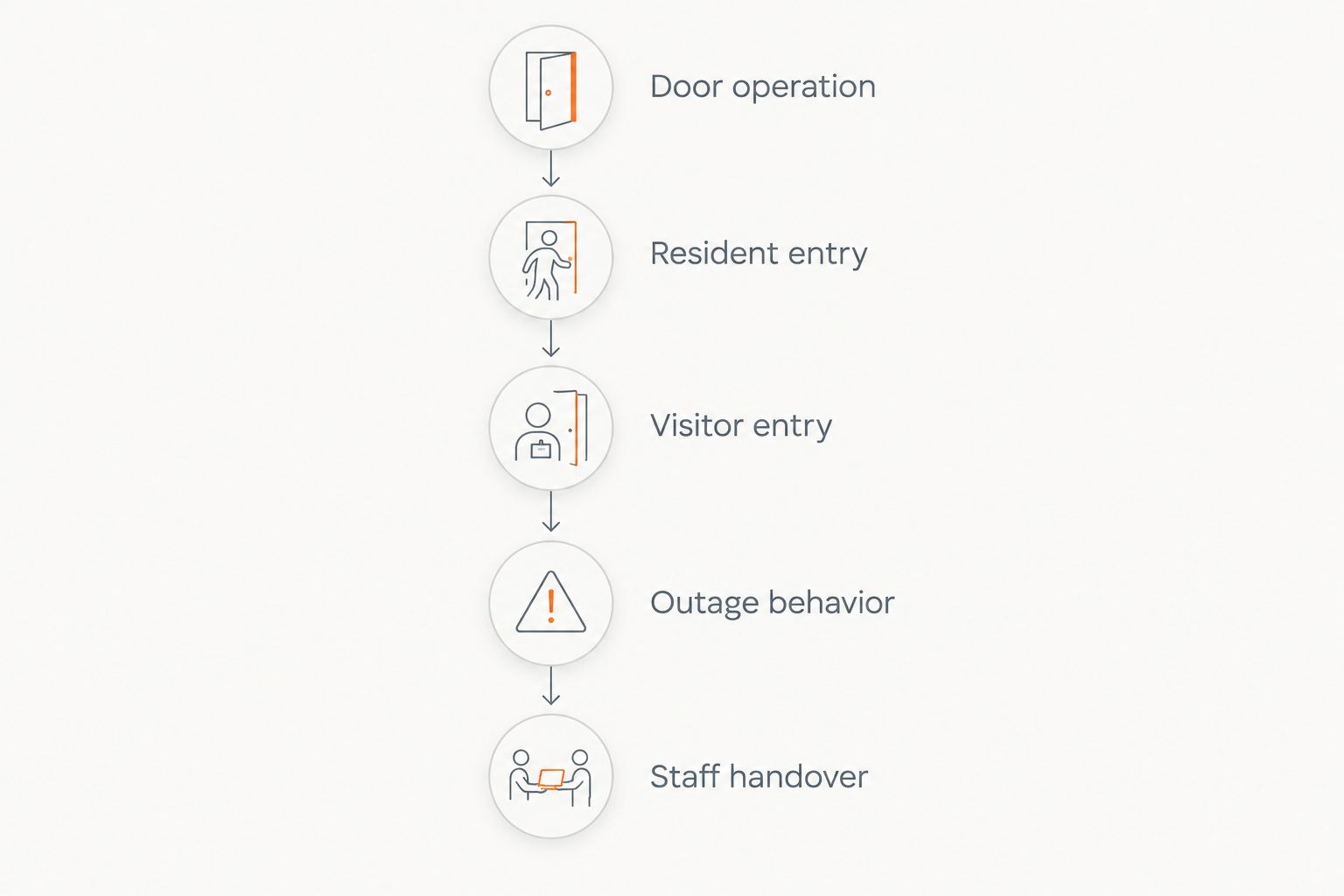
Keep this checklist with the equipment schedule and handover documents. It gives property staff a repeatable way to check the entrance after hardware changes, network work, or a change in management.
Which apartment access control system should you choose?
Start with managed credential access if individual resident permissions are your main problem. Add video intercom entry when visitors need a defined screening process. Choose mobile-first entry or local administration only when those requirements are explicit.
For a Treasure Valley project, separate camera coverage and low-voltage wiring from access-control design and door-hardware responsibilities. Treasure Valley Solutions provides the former services; use the contact page to confirm which parts of your apartment project fit its scope.
Ask each proposal to identify exclusions as clearly as included work. A named system without a door schedule, wiring scope, and acceptance procedure is not enough information to approve an installation.
FAQ
What's the best access control system for an apartment building?
Managed credential access is the default choice when you need individual resident permissions and centralized credential changes. Video intercom entry addresses visitor screening and can complement resident access.
Is a video intercom better than a key fob system?
A video intercom is better for communicating with visitors; a managed key fob system addresses everyday resident permissions. Choose according to the job, or combine the functions in a coordinated design.
Can an apartment building use phone-only access?
Phone-only access leaves no alternative when a resident cannot use a compatible phone. Specify and demonstrate a phone-free entry method before adopting mobile-first access.
Will apartment access control work when the internet goes down?
Internet-outage behavior depends on the selected architecture and configuration. Require the proposal to state what continues working, then demonstrate that behavior during acceptance testing.
Are shared keypad codes suitable for apartments?
Shared keypad codes suit entrances where shared-code administration is an acceptable compromise. They are a poor fit when you need to remove one person's access without changing the code for everyone else.
Can existing apartment doors work with electronic access?
Existing doors require a hardware and condition assessment before compatibility is confirmed. Review the frame, latch, closer, release hardware, wiring route, and required exit operation together.
Does Treasure Valley Solutions install apartment access control?
Treasure Valley Solutions provides security-camera and low-voltage wiring installation services in the Treasure Valley. Confirm access-control design, equipment installation, and commissioning scope directly before assigning those responsibilities.
One last thing
For your 2026 handover, test the entrance with an expired credential as well as a valid one. Successful entry proves permission works; rejected entry checks whether permission removal works. Make both results part of acceptance, and keep exit operation separate from credential authorization.
Related guides
Recent Google reviews
Read all reviews →“Joe was great! Got the job done efficiently. Highly recommend Treasure Valley Solutions.”
“Prompt and professional! Happy with service and will call again.”
“Very responsive and professional!”