 (208) 991-3502
 Meridian, ID



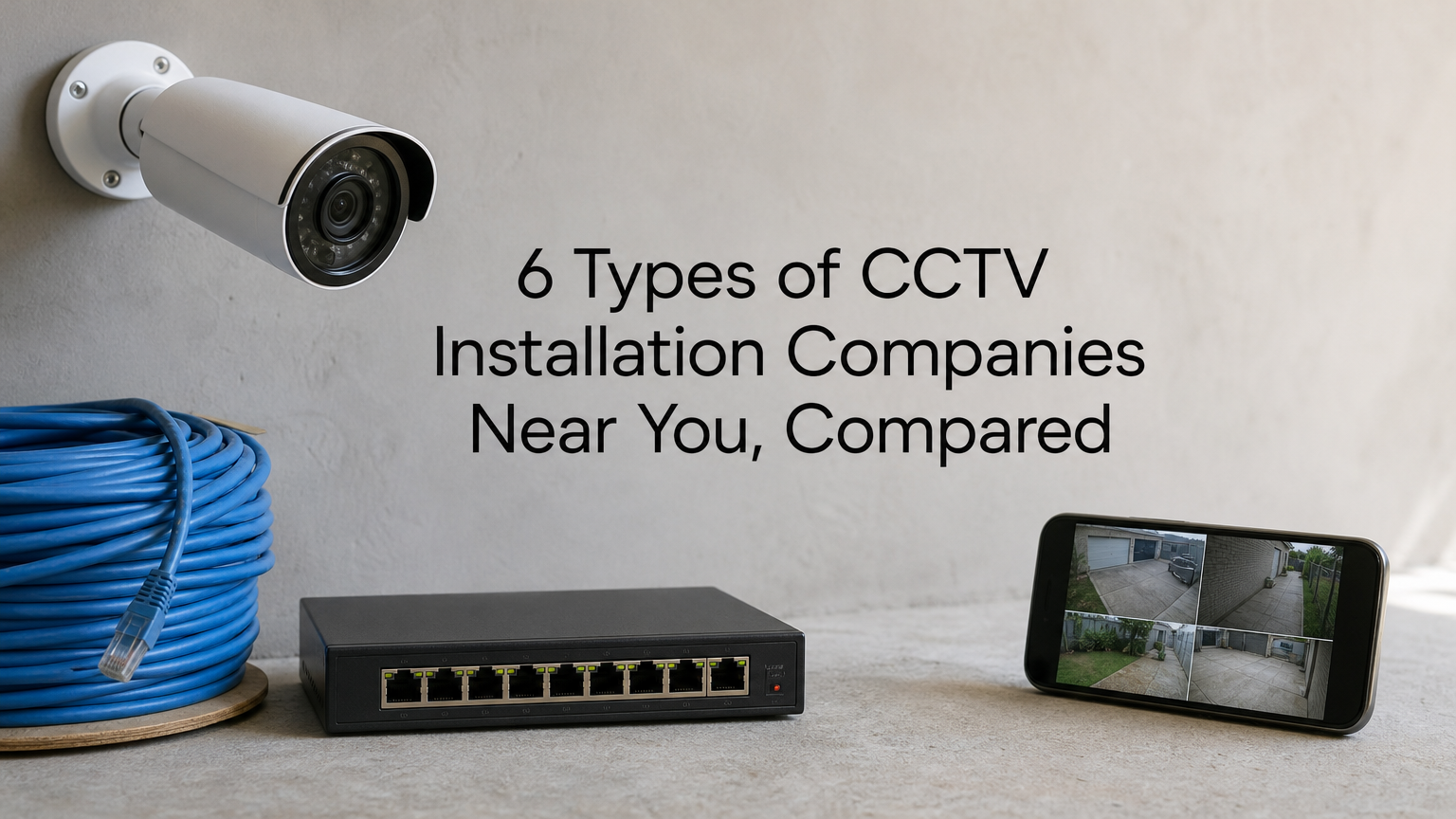

The best CCTV installation company near me is one that walks your property before quoting, puts equipment, price and warranty in writing, and still answers the phone after the cameras are up. In the T...
The best CCTV installation company near me is one that walks your property before quoting, puts equipment, price and warranty in writing, and still answers the phone after the cameras are up. In the Treasure Valley, a local integrator suits most homeowners and small businesses. An alarm company suits anyone who wants live monitoring, and a licensed electrician suits power-heavy jobs. Retail install programs and handymen fit only small, simple setups.
Searching for installers near you returns companies that have little in common. Reviews say "easy" or "quick" without saying what was installed. Quotes cover different cameras, different storage and different warranties. It is hard to tell who will still be around when a camera fails in January.
This article sorts the six kinds of installers you will find around Boise, Meridian, Eagle and Nampa. It shows what each does well, who it suits, and what to ask before you sign. It ends with a method for comparing reviews and quotes side by side. We list our own company first because we are one of the options, so judge us by the same checklist.
1. Local technology integrator
What a local integrator offers
A local integrator designs the whole system, not just the cameras. Treasure Valley Solutions (TVS), based in Meridian, plans and installs security cameras for homes, offices, retail, warehouses and multi-tenant properties. Each plan starts from coverage goals, lighting and recording needs. Cameras bring night vision, wide angles and motion detection, with remote viewing from your phone or computer and a choice of cloud or local video storage.
The wiring and network come from the same team. Commercial jobs get site-specific camera planning, cabling and recording, and IP cameras may run on PoE Ethernet. TVS also pulls Cat6 and Cat6A cabling, assesses older systems before a staged upgrade, builds UniFi networks, and deploys Tough Dog Security equipment on commercial projects. Schools can get campus-wide surveillance with live viewing and motion alerts.
One accountable team for design, cabling, cameras and support is the main reason to hire a local integrator.
Who it suits and what to ask
This type suits homeowners and builders who want one team for cameras, cabling and network, plus business owners and property managers with several buildings. TVS has served the Treasure Valley since 2014, is locally owned and carries general liability and workers compensation insurance. It gives a one-year warranty on all work. Estimates are free and carry no obligation, and inquiries get an answer within one business day. Founder Frankwin Hooglander holds Idaho RCE License RCE-51320, and you should ask any installer for a license number.
- Who designs the camera layout, and will they visit the property first?
- Where is video stored, and for how many days?
- Who services the system after the first year?
2. Alarm and monitoring company
What alarm companies offer
Alarm companies sell intrusion protection first and cameras second. The core product is a panel, door and window sensors, and professional monitoring that contacts you or dispatches help. Cameras usually join the same app, and the equipment is often tied to one brand.
The tradeoff is the contract. Monitoring plans often bind you to a multi-year agreement, and canceling can leave you with equipment that stops working or that you do not own. Some integrators install smart alarm panels with touchscreen and app access without requiring contracts, TVS among them, so ask every alarm company how its terms compare.
Choose an alarm company for live monitoring, and read the cancellation terms before you read the camera specs.
Best for and what to ask
This option suits people whose first worry is a break-in while nobody is home. It also suits anyone who wants a monitoring center watching around the clock instead of relying on phone alerts. Cameras are a bonus here, so expect fewer choices in lens, storage and placement.
- What is the contract length, and what does early cancellation cost?
- Do I own the cameras and panel?
- Can I use other camera brands with your app?
3. Licensed electrician
What electricians offer
Electricians are the right call when the hard part of the job is power. They run dedicated circuits, install conduit, mount cameras on soffits and poles, and handle panel work. That matters on detached shops, barns and parking areas around Nampa and Eagle where power does not exist yet.
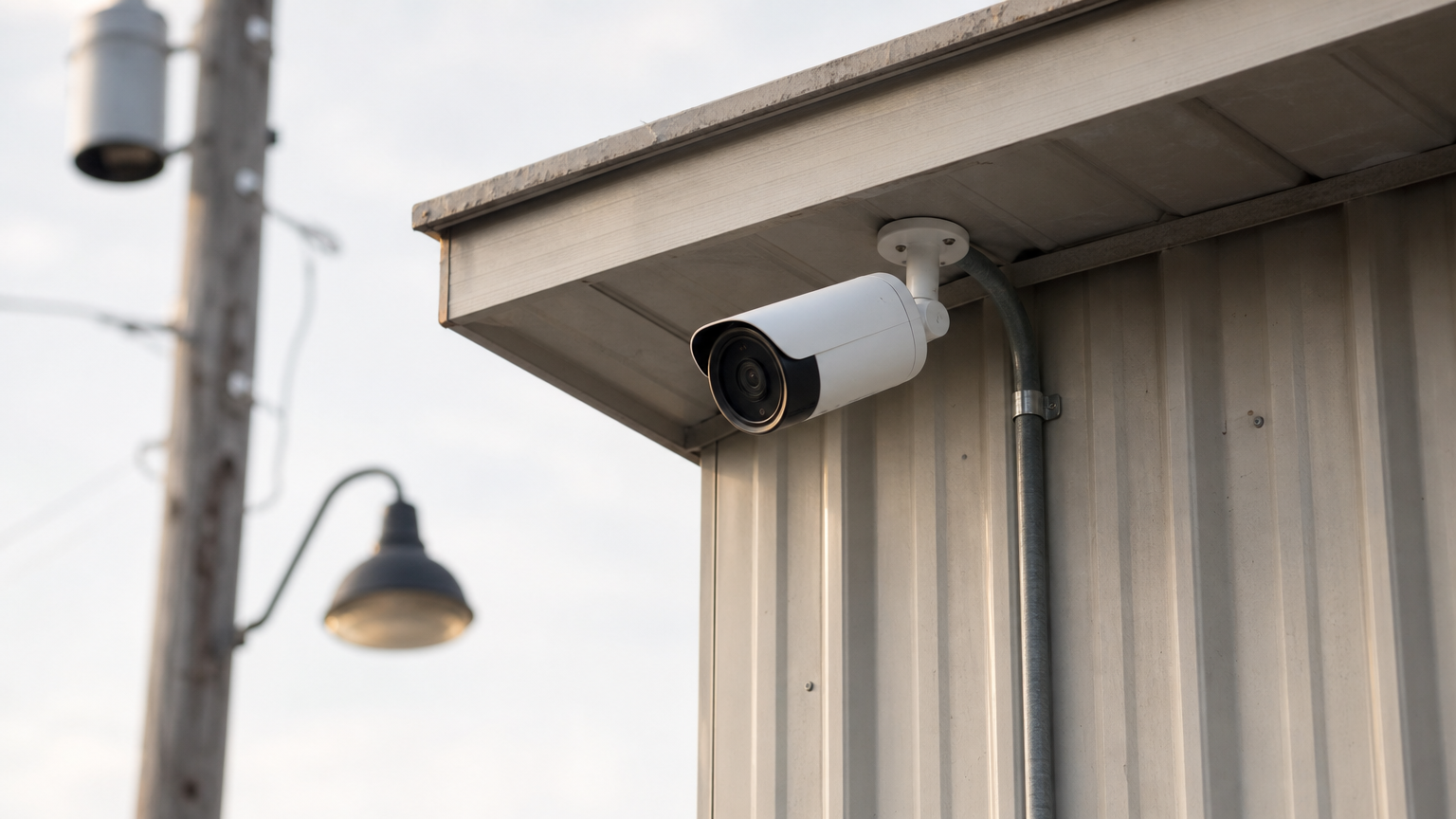
Many electricians do not design recorders, storage or app access. Some do it well, but camera systems are rarely their daily work. Ask whether they will configure remote viewing and retention or hand you a box and a manual.
An electrician is the best fit when power and conduit are the problem, and a weaker fit when software is.
Best for and what to ask
Hire an electrician for new outbuildings, outdoor poles, or jobs that need permits and inspections. Verify the license through the Idaho Division of Building Safety, since electrical work generally requires a licensed contractor.
- Who sets up the recorder, network and phone app?
- Will you document where each cable runs?
- Does your warranty cover the cameras or only the wiring?
4. IT and network contractor
What IT contractors offer
IT contractors treat cameras as devices on a network. They size the switch, separate camera traffic from guest Wi-Fi and point-of-sale systems, and manage firewall rules and updates. For offices that already pay for IT support, adding cameras to that contract is convenient.
Their weakness is the physical side. Choosing a camera angle, lens and mounting height takes field experience, and a perfect network cannot fix a camera pointed at a glaring window. Some IT firms subcontract the cabling, so ask who actually shows up.
Cameras are only as reliable as the network under them, but the network cannot choose where the camera should point.
Best for and what to ask
This type fits offices, clinics and multi-site businesses with an existing IT provider. It is overkill for a single-family home.
- Is the PoE switch rated for every camera plus spare capacity?
- Who monitors camera uptime after hours?
- Who decides camera placement, and based on what?
5. Retail and brand install programs
What these programs offer
Many national retailers and camera brands will sell you a kit and arrange installation. The appeal is one checkout and a fixed package. It works well for a doorbell camera, two driveway cameras or a simple starter kit for a rental.
The catch is that installers often come through partner companies. You may not meet the person who designed the order, and in-wall cabling or multi-story runs may fall outside the package. Product warranty and workmanship warranty are also different things, so confirm which one is included.
Retail programs are fine for small kits, but check who is actually coming to your door.
Best for and what to ask
Choose this route for one to four cameras on a straightforward house. Skip it if you need cabling through finished walls, a commercial recorder or a custom layout.
- Is the installer an employee or a subcontractor?
- What is excluded from the package price?
- Who do I call if a camera fails after the install visit?
6. Handyman or marketplace pro
What independent pros offer
Independent handymen and marketplace pros usually have the lowest upfront price. They mount wireless cameras, hang a doorbell and configure the app. For one or two battery or Wi-Fi cameras, that can be all you need.
Quality varies widely because no one standard applies. You are responsible for checking the license, insurance and references. A drill bit through a wire or water line becomes your problem if the pro has no insurance to cover the damage.
A low quote only saves money when the person quoting is insured and the scope is written down.
Best for and what to ask
Pick this option for light, wireless jobs where a mistake is cheap to fix. Avoid it for wired systems, commercial sites or anything tied to security alarms.
- Can you show proof of liability insurance?
- Will you put the scope and price in writing?
- Can I speak with two recent customers?
How to compare reviews, services and quotes
The six types side by side
Compare installers by what they do after the install, not only by the star rating. This table shows where each type shines and where to be careful.
| Type | Best for | Main strength | Watch for |
|---|---|---|---|
| Local integrator | Whole-property systems | Design, cabling, network and support in one team | Ask for references and license number |
| Alarm company | Live monitoring | Around-the-clock response | Long contracts, locked-in equipment |
| Electrician | Power-heavy jobs | Licensed electrical work | Limited recorder and app setup |
| IT contractor | Offices with IT support | Network security and uptime | Less field experience placing cameras |
| Retail program | One to four simple cameras | Fixed package, quick booking | Subcontracted installers |
| Handyman | One or two wireless cameras | Lowest upfront price | No proof of license or insurance |
Reviews, credentials and quotes
Read recent reviews that describe the work, such as tidy cabling, camera angles, response time and follow-up. Ignore one-word praise. Look at how the owner answers a complaint, and check that the license and insurance are real.
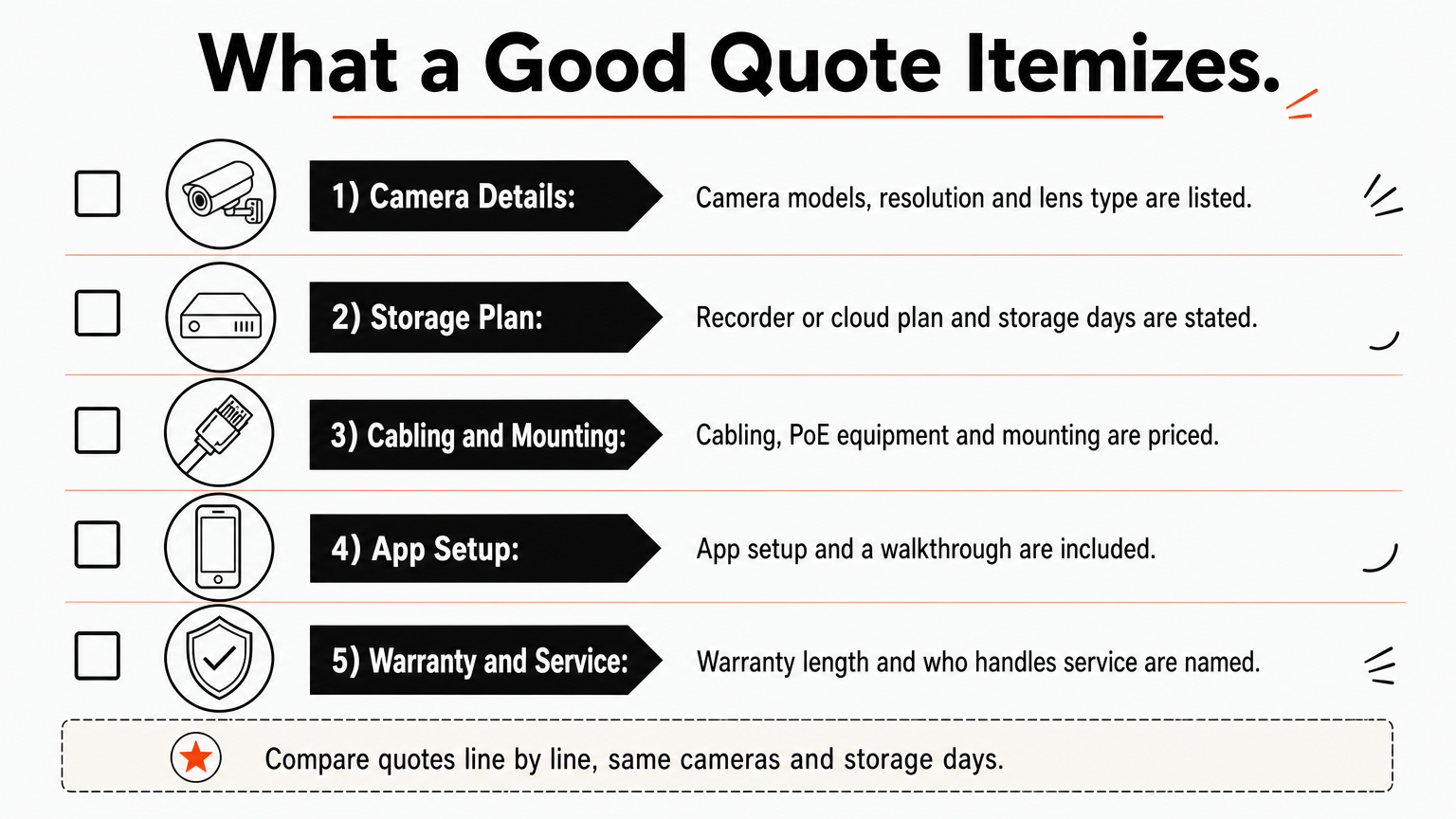
Then ask every company to quote the same job. Give each one the same camera count and the same retention period, such as 30 days, so the numbers are comparable. A good quote itemizes:
- Camera models, resolution and lens type
- Recorder or cloud plan and storage days
- Cabling, PoE equipment and mounting
- App setup and a walkthrough
- Warranty length and who handles service
What drives cost and labor time
Price depends on camera count, how hard the cable runs are, storage size and whether the site is a home or a business. Attics, finished walls and exterior brick cost more labor than open runs. As a planning rule, a single wireless camera can take an hour or two, while a four-camera wired system often takes a full day.
The person you hire may be called a security camera installer, a CCTV technician or a low-voltage technician. The title matters less than the license, insurance and written scope. Free estimates are common, so get at least two, and treat a quote that cannot be itemized as a warning sign.
Compare quotes line by line for the same cameras and storage days, never by the bottom-line total alone.
Pick the installer, then the cameras
The right CCTV installer depends on your job. Choose a local integrator for a full system, an alarm company for live monitoring, an electrician for power work, and an IT contractor for office networks. Retail programs and handymen suit small wireless setups. Whoever you pick, verify the license, get an itemized quote and ask who services the system next year.
If you want a local team to design and install your system, request a free on-site consultation and we will walk your property with you.
Recent Google reviews
Read all reviews →“I’ve used Frankwin and team several times over the years for various projects. They have always been excellent.”
“Great communication. Fair pricing. Knowledgeable and professional staff. Will use again.”
“Thoroughly glad we used Treasure Valley Solutions for putting up and taking down our Christmas lights this year. They were pleasant, punctual and did a very good job. Joe put up our lights and ended up doing them alone b…”