 (208) 991-3502
 Meridian, ID



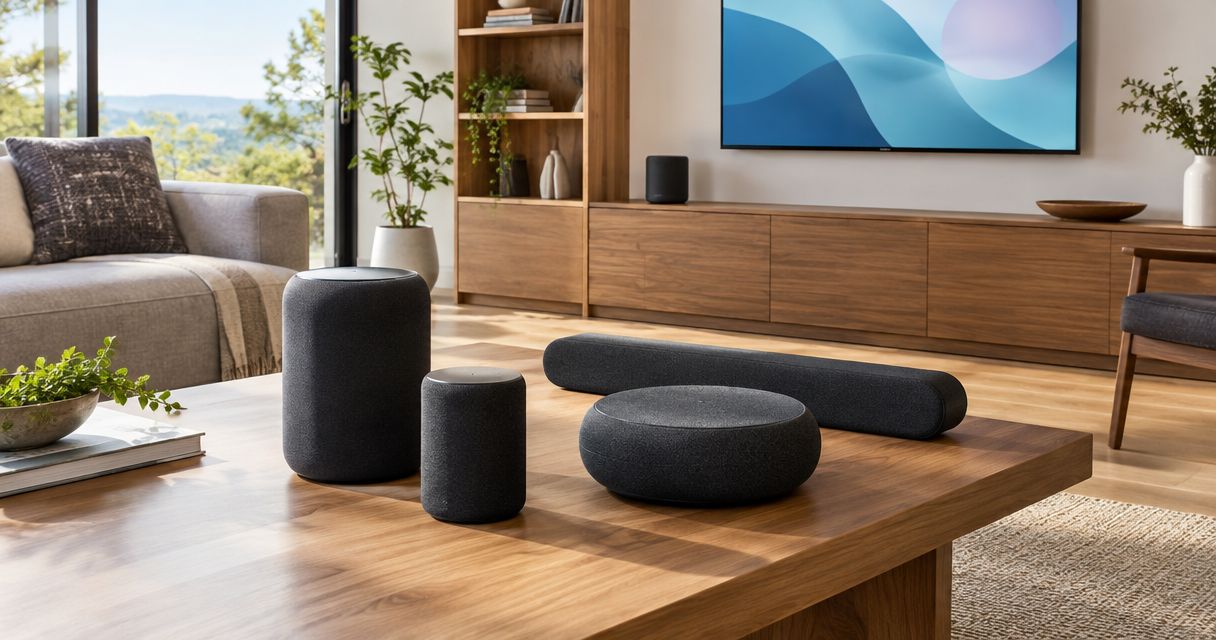

The best Sonos speakers for whole-home audio start with Era 100. Compare five picks for stereo, spatial audio, patios, and practical room-by-room planning.
Best overall: Sonos Era 100. Best for spatial audio: Sonos Era 300. Best for dedicated stereo listening: Sonos Five. Best for patio portability: Sonos Move 2. Best for compact travel use: Sonos Roam 2. These are the best Sonos speakers for whole-home audio in 2026 when you match each room to its listening job rather than buy the same speaker everywhere.
- The best Sonos speakers for whole-home audio start with Era 100 for everyday room-by-room listening.
- Choose Sonos Era 300 for spatial audio and Sonos Five for dedicated stereo music.
- Sonos Move 2 suits home-to-patio listening; Sonos Roam 2 prioritizes compact portability.
- Treasure Valley Solutions installs whole-home audio systems for homeowners and businesses in Idaho’s Treasure Valley.
Why this matters
Whole-home audio has two separate jobs: play music where you want it and keep everyday control simple. A speaker that works well beside a kitchen counter is not automatically the right choice for a listening room or an exposed patio.
Treasure Valley Solutions is best for Treasure Valley homeowners who want professionally installed whole-home audio with neatly concealed wiring. For a project involving placement, networking, and installed audio, Treasure Valley Solutions provides local installation services rather than a speaker-only purchase.
Start with your rooms and listening habits. Choose the hardware afterward.
What makes the best Sonos speakers for whole-home audio?
Use these criteria for a 2026 system plan:
- Room fit: A speaker needs a practical location with power, suitable clearance, and sound directed toward listeners.
- Listening format: Everyday background music, focused stereo listening, and spatial audio call for different setups.
- Grouping: Sonos speakers join room groups over the home network; Bluetooth is a separate connection method.
- Placement freedom: Portable speakers move between spaces. Plug-in speakers need a permanent outlet location.
- Installation finish: Visible cords, shelf space, mounting, and network coverage belong in the plan before equipment selection.
No speaker wins every category. The strongest default is the one that handles ordinary listening without making every room a dedicated audio project.
Sonos whole-home speakers at a glance for 2026
| Rank and speaker | Best for | Standout feature | Key limitation |
|---|---|---|---|
| 1. Sonos Era 100 | Everyday room-by-room music | Compact speaker with Wi-Fi and Bluetooth | No Dolby Atmos playback |
| 2. Sonos Era 300 | Spatial-audio listening | Directional driver arrangement for Dolby Atmos music | Placement needs more attention |
| 3. Sonos Five | Dedicated stereo listening | Music-focused design with analog line-in | No Bluetooth or Dolby Atmos |
| 4. Sonos Move 2 | Home-to-patio portability | Rechargeable battery and outdoor-friendly construction | Larger to carry than Roam 2 |
| 5. Sonos Roam 2 | Compact travel use | Small portable design with Wi-Fi and Bluetooth | Not the default for a main listening room |
1. Sonos Era 100: best Sonos speaker for everyday rooms
Sonos Era 100 is the default pick for kitchens, offices, and bedrooms where music accompanies the day. It supports Wi-Fi listening within a Sonos system and Bluetooth playback from a nearby device.
Choose Sonos Era 100 when you want a straightforward room speaker without building the room around music. Two matching units can form a stereo pair when you want separate left and right channels.
Sonos Era 100 pros:
- Compact format fits more shelves and counters than larger speakers.
- Wi-Fi supports room grouping within the Sonos system.
- Bluetooth adds a direct playback option.
- A matching pair provides a path to stereo listening.
Sonos Era 100 cons:
- It does not play Dolby Atmos audio.
- It needs outlet power rather than a rechargeable battery.
- Analog line-in requires a compatible adapter rather than a built-in audio jack.
Best for: Everyday music in individual rooms, with the option to group those rooms together.
Put Sonos Era 100 where listeners actually spend time, not wherever the nearest unused outlet happens to be. A speaker tucked behind kitchen appliances defeats the point of choosing a compact design.
Verdict: Buy Sonos Era 100 as the default whole-home room speaker.
2. Sonos Era 300: best Sonos speaker for spatial audio
Sonos Era 300 is the pick for a room where Dolby Atmos music is a deliberate priority. Its driver arrangement projects sound in multiple directions rather than treating the cabinet as a conventional forward-facing speaker.
That design makes placement part of the purchase decision. Give Sonos Era 300 an open location and follow the manufacturer's clearance guidance instead of enclosing it in a crowded cabinet.
Sonos Era 300 pros:
- Supports Dolby Atmos music from compatible sources.
- Provides Wi-Fi grouping with other Sonos rooms.
- Supports Bluetooth for direct playback.
- Works as a dedicated spatial-audio listening option.
Sonos Era 300 cons:
- Dolby Atmos playback depends on compatible content and playback methods.
- An enclosed shelf works against its directional sound design.
- It takes up more space than Sonos Era 100.
Best for: A living room or listening space where spatial music matters more than compact placement.
Do not choose Sonos Era 300 merely because it occupies a higher position in the product range. If your listening is mostly background playlists while cooking, Sonos Era 100 remains the cleaner fit.
Verdict: Buy Sonos Era 300 for a planned spatial-audio room; skip it for cramped shelving.
3. Sonos Five: best Sonos speaker for dedicated stereo listening
Sonos Five belongs in a music-first room. It supports Wi-Fi playback and includes a 3.5 mm analog line-in for an external audio source.
A matching pair separates left and right channels for a dedicated stereo setup. A turntable connection still needs the appropriate phono preamp stage; the speaker's line input does not replace that requirement.
Sonos Five pros:
- Suits a permanent, music-focused installation.
- Includes analog line-in without a separate USB-C audio adapter.
- Supports stereo pairing with another Sonos Five.
- Joins other Sonos rooms for grouped playback.
Sonos Five cons:
- It has no Bluetooth playback.
- It does not support Dolby Atmos music.
- Its larger cabinet needs deliberate shelf or furniture space.
Best for: Listeners who want a dedicated stereo music setup, including an appropriate analog source connection.
Separate stereo speakers across the listening area rather than putting both together on one narrow shelf. The point of a stereo pair is left-right separation, not simply adding another cabinet.
Verdict: Buy Sonos Five for focused stereo listening; skip it when portability or Bluetooth is essential.
4. Sonos Move 2: best Sonos speaker for home-to-patio listening
Sonos Move 2 is the practical choice when the same speaker serves an indoor room and a patio. It supports Wi-Fi at home and Bluetooth away from the home network.
Sonos specifies up to 24 hours of battery playback. Actual runtime depends on use, so treat that figure as a manufacturer rating rather than a promise for every listening session.
Sonos Move 2 pros:
- Rechargeable operation avoids needing an outlet beside every listening spot.
- Wi-Fi lets it join the home Sonos system.
- Bluetooth supports listening away from home.
- Its carrying handle suits regular movement between nearby spaces.
Sonos Move 2 cons:
- It is bulkier to pack than Sonos Roam 2.
- Battery operation still requires a charging routine.
- It is not a substitute for a permanently designed outdoor speaker installation.
Best for: Homeowners who move music between the house, garage, and patio.
Plan where Sonos Move 2 charges before deciding it solves an outdoor audio problem. A portable speaker only serves the patio if somebody carries it outside and brings it back.
Verdict: Buy Sonos Move 2 for regular home-to-patio use, not unattended outdoor installation.
5. Sonos Roam 2: best Sonos speaker for compact travel use
Sonos Roam 2 is the smallest portable choice in this shortlist. It supports Wi-Fi for use within a home Sonos system and Bluetooth for direct playback elsewhere.
Sonos specifies up to 10 hours of battery playback. Its compact format makes it easier to pack, but portability is the reason to choose it—not an expectation that it replaces a larger room speaker.
Sonos Roam 2 pros:
- Compact enough for frequent carrying.
- Bluetooth works away from the home network.
- Wi-Fi connects it to the home Sonos system.
Sonos Roam 2 cons:
- Its small format is not the default for a main listening space.
- Its stated battery runtime is shorter than Sonos Move 2's.
- It needs charging rather than permanent outlet-powered operation.
Best for: Travel, occasional outdoor listening, and personal listening around the house.
Verdict: Buy Sonos Roam 2 for portability; skip it as the foundation of whole-home audio.
Plan the installation before filling every room
A 2026 whole-home audio plan should distinguish between speakers you place on furniture and speakers built into the room. Sonos Era 100, Sonos Era 300, and Sonos Five remain visible objects with power cords. Buying wireless audio does not make electrical power disappear.
For Treasure Valley Solutions whole-home audio projects, homeowners can discuss networking, audio/video installation, and concealed wiring as parts of the same room plan. Decide which compromises you accept before choosing equipment.
Visible speakers or concealed speakers?
Visible speakers simplify access and make relocation straightforward. Concealed speakers shift the work into speaker selection, construction details, wiring, and amplification.
If the design calls for hiding in-wall speakers, the covering becomes part of the acoustic design: material directly in front of a speaker affects the sound reaching the room. Decorative slat panels should not be treated as acoustically invisible.
Do not enclose a Sonos tabletop speaker behind decorative panels and assume it behaves like an installed architectural speaker. These are different installation choices.
Power, network, placement, control
Settle these four items before mounting anything:
- Power: Identify the outlet or charging location and the cable route.
- Network: Check Wi-Fi where each speaker will actually sit.
- Placement: Keep speaker openings clear and preserve practical access.
- Control: Decide which rooms play together and who operates them.
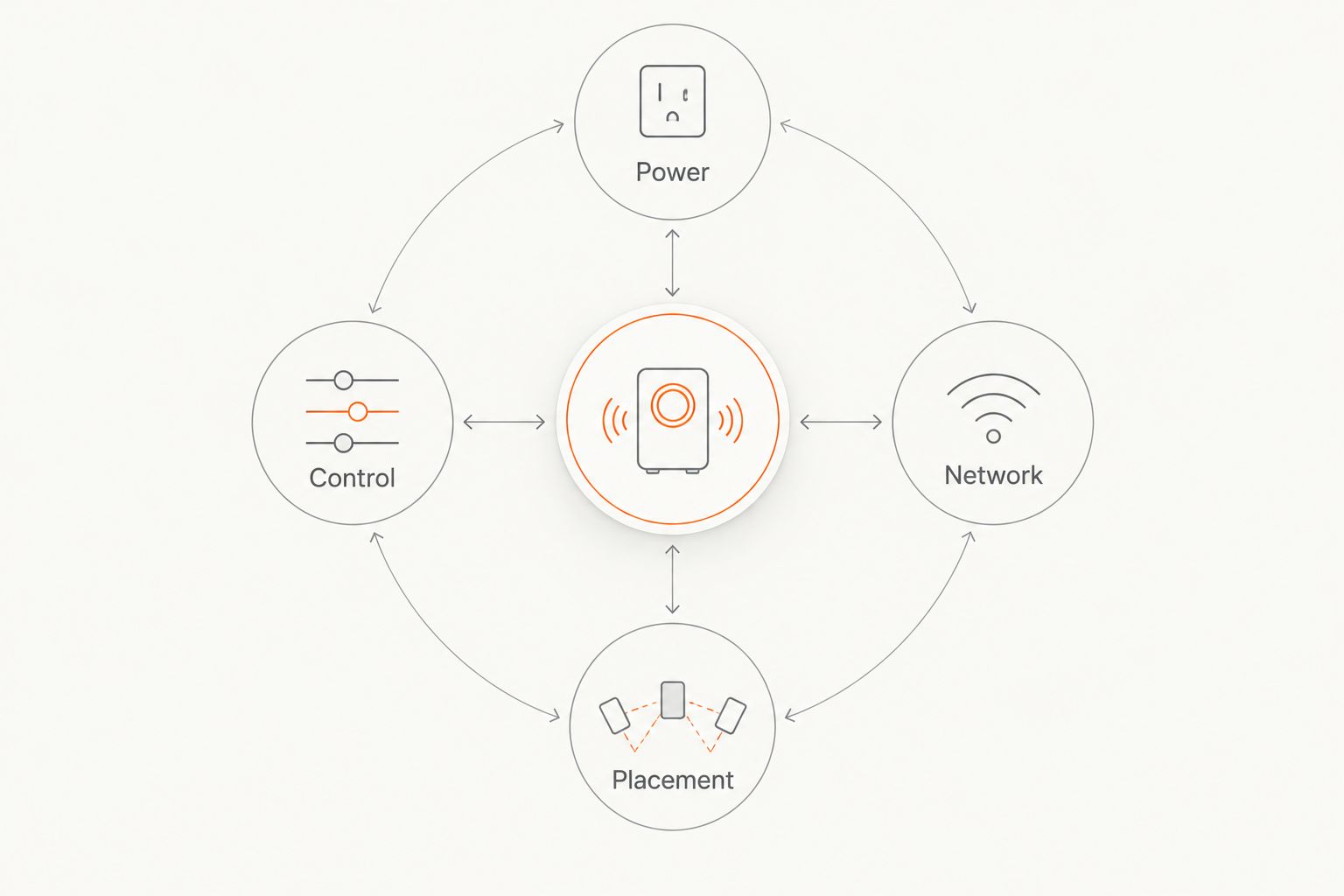
Test coverage in the proposed speaker locations, not just beside the router. Reliable playback depends on the network reaching the rooms you want to group.
How the speakers rank
The 2026 ranking follows room fit, listening format, grouping, placement freedom, and installation finish. It is a use-case ranking, not a claim that every speaker was tested in the same house.
Sonos Era 100 takes the default slot because it combines a compact plug-in format with Wi-Fi and Bluetooth. Sonos Era 300, Sonos Five, Sonos Move 2, and Sonos Roam 2 each earn a separate recommendation for a different listening job.
The battery figures above are Sonos manufacturer specifications for the named models, referenced for this 2026 guide. Neither battery rating measures sound quality or whole-home network performance.
Which Sonos speaker should you choose?
Start with Sonos Era 100 for everyday rooms. Add Sonos Era 300 only where you want spatial audio, or choose Sonos Five where dedicated stereo listening takes priority.
Choose Sonos Move 2 for a speaker that regularly travels between the house and patio. Choose Sonos Roam 2 when carrying size matters more than establishing a permanent room system.
For a 2026 installation, buy around the room plan rather than a uniform speaker count. Different rooms can use different models while still belonging to the same Sonos system.
FAQ
What's the best Sonos speaker for whole-home audio?
Sonos Era 100 is the default choice for everyday whole-home audio. Its compact design, Wi-Fi grouping, and Bluetooth support suit ordinary room-by-room listening.
Can different Sonos speakers play music together?
Different compatible Sonos models can play together in groups over the home network. Grouping rooms is different from creating a stereo pair, which requires a supported matching speaker combination.
Is Sonos Era 300 better than Sonos Five?
Sonos Era 300 is the better fit for Dolby Atmos music, while Sonos Five fits dedicated stereo listening and analog line-in use. Choose by listening format rather than assuming one replaces the other.
Do Sonos speakers need power cables?
Sonos Era 100, Sonos Era 300, and Sonos Five need outlet power. Sonos Move 2 and Sonos Roam 2 have rechargeable batteries but still need charging.
Can I use Bluetooth for whole-home Sonos grouping?
Bluetooth is not the connection used for whole-home Sonos room grouping. Use the home network for grouped playback; Bluetooth serves direct playback from a nearby device.
Which Sonos speaker should I use outside?
Sonos Move 2 suits regular home-to-patio listening, while Sonos Roam 2 suits compact portability. Neither recommendation means leaving a portable speaker permanently exposed outdoors.
Should I choose installed speakers instead of tabletop Sonos speakers?
Choose installed speakers when concealed equipment is a priority and the project includes suitable wiring and amplification. Tabletop Sonos speakers fit projects where visible cabinets and accessible power cords are acceptable.
One last thing
Wireless audio still needs a wiring plan. Before buying, mark every outlet, charging spot, and visible cord on the room layout. That simple check exposes installation problems that a speaker comparison cannot solve.