 (208) 991-3502
 Meridian, ID



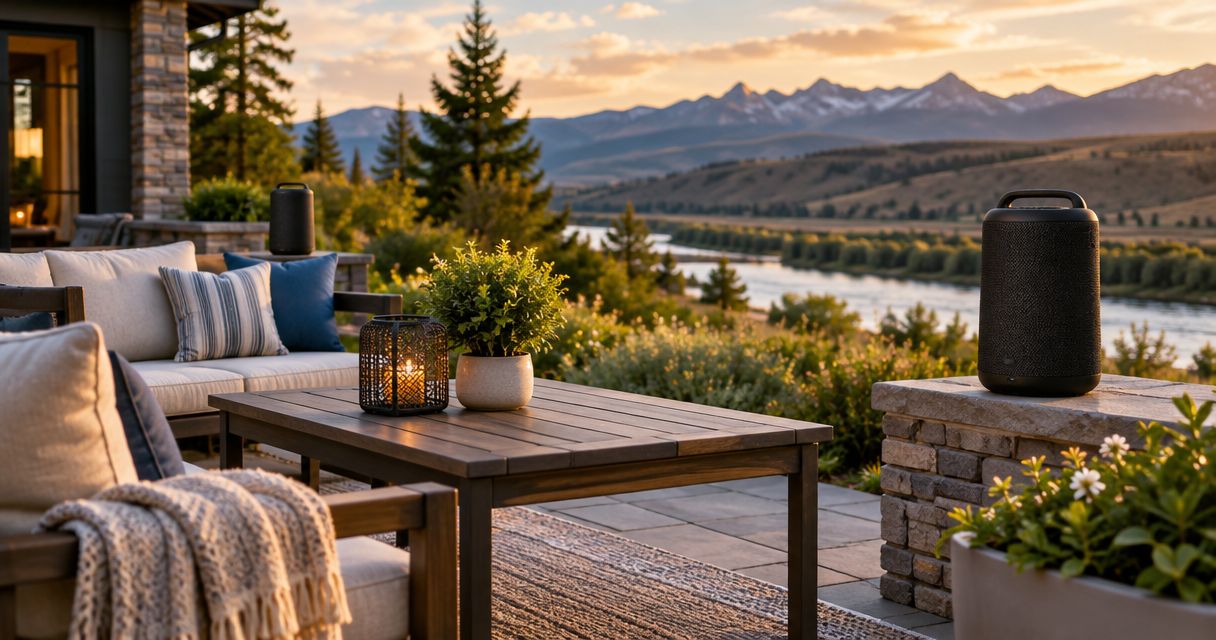

Find the best outdoor speakers for Idaho patios in 2026. Compare wired, landscape, ceiling, and portable options, plus placement and wiring advice.
Best overall: outdoor-rated surface-mount speakers for a fixed patio. Best for garden coverage: landscape speakers. Best for seasonal use without permanent wiring: portable outdoor speakers. The best outdoor speakers for Idaho patios in 2026 depend on where you sit, how you route wiring, and whether the equipment stays outside.
- The best outdoor speakers for Idaho patios match the seating area, weather exposure, and wiring plan.
- Choose outdoor-rated surface-mount speakers for permanent patio audio; landscape speakers suit seating spread through a yard.
- Choose portable outdoor speakers when you want movable sound without permanent speaker wiring.
- Treasure Valley Solutions suits Treasure Valley homeowners who want audio/video installation with neatly concealed wiring.
Why this matters
A speaker that sounds good beside a patio door does not automatically cover a dining table, grill area, and garden seating. Outdoors, placement determines whether guests hear music comfortably or the nearest chair gets all the volume.
Treasure Valley Solutions installs audio/video and low-voltage wiring systems for homeowners and businesses around Boise, Meridian, and the greater Treasure Valley. For a permanent system, settle the coverage and cable routes before choosing speakers.
This 2026 guide ranks installation types rather than declaring an unverified model the winner. Each type solves a different patio problem, and each brings a limitation you should accept before buying.
What makes the best outdoor speakers for Idaho patios?
Use these criteria to narrow your shortlist before comparing brands or finishes:
- Exposure rating: Match the manufacturer's stated outdoor use to the actual location, including wind-driven rain and irrigation.
- Listening coverage: Aim sound at occupied areas rather than trying to fill the entire property from one mounting point.
- Wiring route: Identify a protected route from the amplifier to every fixed speaker before drilling or trenching.
- Amplifier compatibility: Confirm that the speaker load, wiring arrangement, and amplifier output match.
- Everyday control: Decide who changes volume and selects music, and where that person will be standing.
- Maintenance access: Keep connections, mounting hardware, and serviceable components accessible after installation.
Buy for the installation location, not the word “outdoor” on the box. A covered ceiling and an exposed landscape bed are different environments.
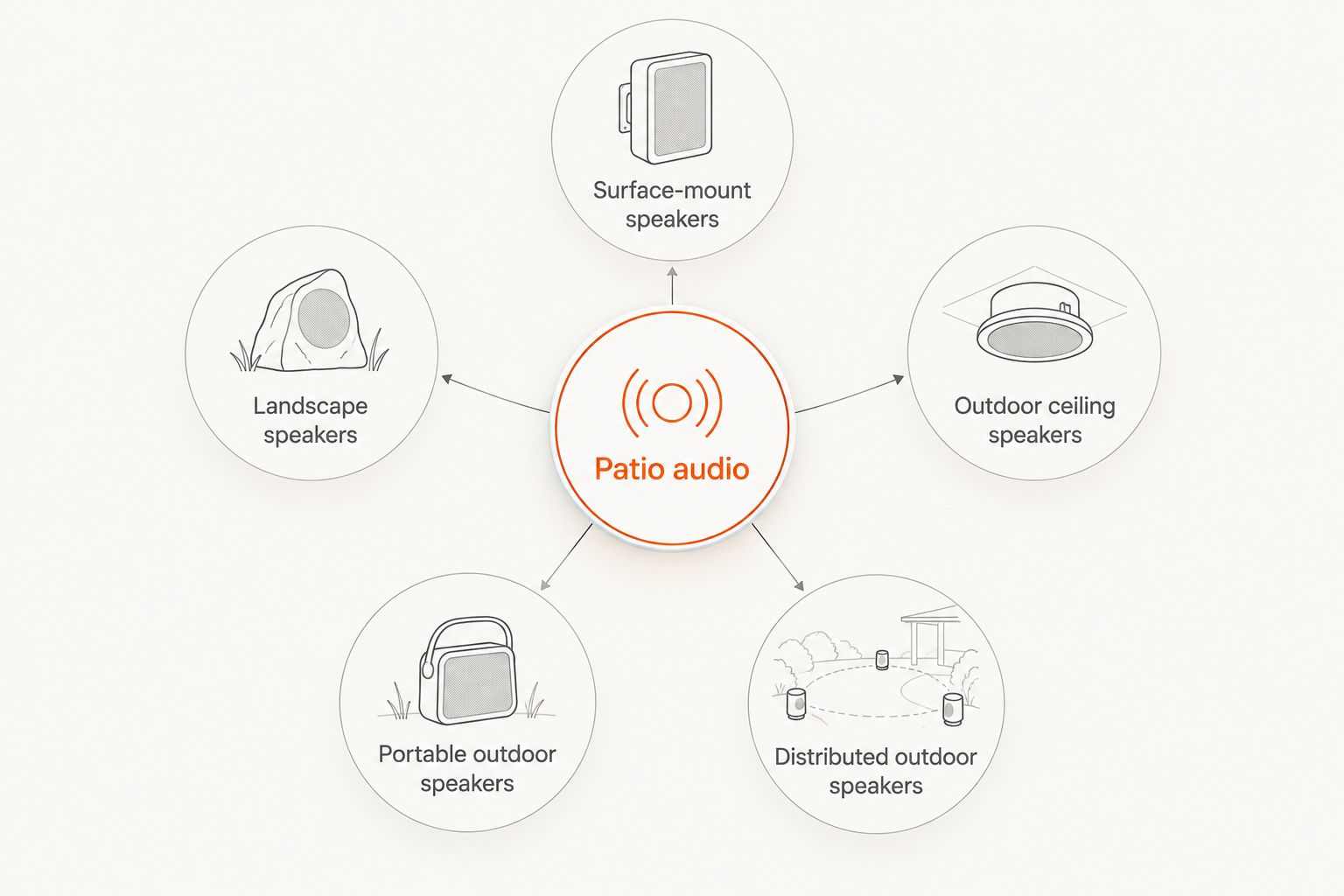
Outdoor speaker options at a glance
| Rank and option | Best for | Standout feature | Key limitation |
|---|---|---|---|
| 1. Surface-mount speakers | Permanent patio seating | Brackets let you aim sound toward listeners | Visible hardware and a permanent cable route |
| 2. Landscape speakers | Seating spread through a garden | Multiple listening points near occupied areas | More cable routing and landscape coordination |
| 3. Outdoor ceiling speakers | Finished covered patios | Speakers sit within the ceiling plane | Requires suitable ceiling access and exposure approval |
| 4. Portable outdoor speakers | Seasonal, movable listening | No permanent speaker cable installation | Charging, storage, and placement remain recurring tasks |
| 5. Distributed outdoor speakers | Larger, separately used areas | A planned speaker network serves multiple listening areas | Requires system-level amplifier and wiring design |
These are system categories, not interchangeable products. A portable speaker and a distributed installation answer different questions, even when both play the same music.
1. Surface-mount speakers: best for permanent patio seating
Outdoor-rated surface-mount speakers attach to a wall, post, or other approved structure using brackets. Their main advantage is direction: you can aim compatible brackets toward the dining or lounge area instead of sending sound away from listeners.
For a typical fixed seating area, this is the strongest starting point in 2026. The mounting location still needs manufacturer approval for its exposure, and the bracket needs a suitable structural attachment.
Surface-mount speaker pros:
- Adjustable placement helps direct sound toward seating.
- Speakers remain off tables and walking surfaces.
- Permanent wiring removes routine charging from daily use.
Surface-mount speaker cons:
- Cabinets and brackets remain visible.
- Cable concealment depends on the building and mounting location.
- A poor mounting position can concentrate sound near one chair.
Best for: Homeowners who use the same patio seating area regularly and want an installed system.
Before ordering, mark the proposed bracket positions and trace the cable route back to the amplifier. Check doors, lighting, downspouts, and future shade attachments for conflicts.
Verdict: Buy outdoor-rated surface-mount speakers for a fixed patio when you have suitable mounting points and a workable wiring route.
2. Landscape speakers: best for garden seating
Landscape speakers place sound near seating areas away from the house. Depending on the design, they mount on stakes, sit within planting areas, or use enclosures intended to blend into the landscape.
Their advantage is distribution, not disguise alone. Speakers near separate listening areas let you design coverage around where people gather rather than turning up a house-mounted pair to reach the far end of the yard.
Landscape speaker pros:
- Placement follows garden paths and seating zones.
- Sound sources can sit closer to listeners.
- Suitable designs reduce the need for wall mounting.
Landscape speaker cons:
- Cable routing must account for irrigation and digging.
- Plant growth can obstruct access or change coverage.
- Connections need protection appropriate to their installed location.
Best for: Patios that connect to garden seating or gathering areas beyond the house wall.
Coordinate speaker positions with landscape work before installation. Keep equipment clear of mower routes, routine digging, and direct sprinkler discharge; an outdoor rating does not make every location sensible.
Verdict: Buy landscape speakers when listening areas extend into the yard; skip them when one compact patio is the entire brief.
3. Outdoor ceiling speakers: best for finished covered patios
Outdoor ceiling speakers fit into an approved ceiling opening and keep cabinets out of the seating area. They suit covered patios where the ceiling construction, access, and environmental conditions match the speaker's installation requirements.
Do not substitute ordinary indoor ceiling speakers simply because a roof provides shade. Check outdoor-use approval, exposure limits, mounting requirements, and the space behind the ceiling before cutting.
Outdoor ceiling speaker pros:
- The installation avoids projecting wall-mounted cabinets.
- Placement can align with seating beneath the ceiling.
- Concealed cable routes are possible where access permits.
Outdoor ceiling speaker cons:
- Installation requires permanent ceiling openings.
- Finished ceilings can restrict cable access.
- Speaker positions become harder to change after installation.
Best for: Covered patios with a suitable finished ceiling and confirmed wiring access.
For a 2026 patio renovation, resolve speaker locations before closing the ceiling. Coordinate cutouts with framing, lights, fans, and any required clearance specified by the manufacturer.
Verdict: Buy outdoor ceiling speakers when the ceiling and exposure requirements fit; hold the purchase until access is confirmed.
4. Portable outdoor speakers: best for seasonal flexibility
Portable outdoor speakers let you move music between a patio table, lounge area, and another approved location. Choose a model with documented protection appropriate to how you will actually use it.
This is the simplest installation choice because you avoid permanent speaker cable routes. It is not automatically the right answer for unattended outdoor storage, broad coverage, or a patio used every day.
Portable outdoor speaker pros:
- Placement changes with the gathering.
- No permanent bracket or speaker cable is required.
- The equipment can come indoors after use.
Portable outdoor speaker cons:
- Battery-powered models require charging.
- Someone must put the speaker out and bring it back.
- Coverage changes whenever the speaker moves.
Best for: Occasional outdoor listening, changing seating layouts, and households that do not want a fixed installation.
Check the controls and connection method before choosing. A speaker that depends on one person's phone creates a different daily routine from an installed system with shared controls.
Verdict: Buy a portable outdoor speaker for flexible seasonal listening; skip it as a substitute for planned multi-area coverage.
5. Distributed outdoor speakers: best for larger listening areas
A distributed system uses multiple speakers arranged around the listening space. Constant-voltage systems, commonly described as 70 V or 100 V systems, are one approach; they require compatible amplifiers, speaker transformers, and load calculations.
“Distributed” describes the system design, not a particular enclosure. The installation can use suitable surface-mount or landscape speakers, but its defining feature is coordinated coverage across multiple locations.
Distributed outdoor speaker pros:
- Speaker positions follow several listening areas.
- A planned network avoids relying on one distant source.
- Compatible system designs support coordinated operation.
Distributed outdoor speaker cons:
- Amplifier capacity and speaker loading require calculation.
- Additional locations mean more wiring and connections.
- Separate volume control requires deliberate system design.
Best for: Properties with several outdoor gathering areas that need coordinated sound.
Do not connect additional speakers to an existing amplifier without checking the design. More speakers are not a wiring shortcut, and a larger system does not automatically provide independent zones.
Verdict: Buy a distributed system for a defined multi-area brief; skip it when a single patio pair solves the problem.
Plan the system before choosing a model
Start your 2026 project with a sketch of the patio, seating, doors, outlets, and likely equipment location. Mark where people listen, then identify speaker positions that serve those places without aiming unnecessarily toward neighboring properties.
Coverage and controls
Stereo uses 2 audio channels, left and right. A listener seated near only one speaker will not hear the same balance as someone between them, so discuss coverage-oriented layouts rather than assuming indoor stereo placement fits every patio.
Write down whether the patio needs its own volume control and whether it must play different content from indoor rooms. Those requirements affect the electronics, not just the speakers.
Exposure and wiring
An IP rating describes specified ingress protection under test conditions. It does not, by itself, establish resistance to sunlight, freezing conditions, corrosion, or every permanent outdoor installation scenario.
For fixed wiring, specify cable and connections suited to their actual locations, including wet locations or direct burial where applicable. Keep a record of concealed routes so later landscaping does not become a cable-finding exercise.
Treasure Valley Solutions provides audio/video and low-voltage wiring installation with neatly concealed wiring. Bring the seating sketch and control requirements to the installation discussion so the proposed system answers a specific brief.
How the options are ranked
The ranking prioritizes placement, exposure suitability, wiring practicality, amplifier compatibility, and daily operation. It is a use-case guide, not a laboratory performance ranking or a claim that every product in one category beats every product in another.
Surface-mount speakers lead because they directly address a permanent patio installation. Landscape, ceiling, portable, and distributed options take their positions because each solves a more specific layout or operating requirement.
Which outdoor speakers should you choose?
Start with outdoor-rated surface-mount speakers for a fixed seating area. Move to landscape speakers when listening extends into the garden, ceiling speakers when the covered structure supports them, or portable speakers when avoiding permanent installation matters most.
Choose a distributed system only after defining the areas it must serve. For 2026, the useful upgrade is a system that fits your actual seating and controls—not extra equipment without a coverage plan.
Treasure Valley Solutions is best for Treasure Valley homeowners who want audio/video installation with neatly concealed wiring.
FAQ
What are the best outdoor speakers for Idaho patios in 2026?
Outdoor-rated surface-mount speakers are the default choice for a fixed patio with suitable mounting points and wiring access. Landscape, ceiling, portable, and distributed systems suit different layouts and operating needs.
Are wired outdoor speakers better than portable speakers?
Wired outdoor speakers are better suited to permanent placement without routine battery charging. Portable speakers suit changing locations and occasional listening without permanent speaker wiring.
Can outdoor speakers stay outside through an Idaho winter?
Leave speakers outside only when the manufacturer's operating, storage, and installation requirements permit the actual conditions. An outdoor label or IP rating alone does not establish suitability for every winter exposure.
Can I install indoor ceiling speakers under a covered patio?
Use ceiling speakers approved for the patio's environmental conditions and installation location. A roof does not turn an outdoor space into an indoor environment.
How many speakers does my patio need?
Speaker quantity depends on the seating layout, mounting positions, speaker coverage, and intended listening level. Plan those factors before choosing a quantity; patio size alone does not answer the question.
Do outdoor speakers need a separate amplifier?
Passive outdoor speakers need a compatible amplifier, while powered speakers include amplification. Check the chosen speaker's design and connection requirements before specifying the rest of the system.
Can outdoor speakers play the television sound?
Outdoor speakers can play television sound when the television output, audio electronics, and speaker system are compatible. Confirm the signal path, volume control, and audio synchronization before installation.
One last thing
Photograph every concealed cable route before it disappears behind finishes or soil. Include nearby fixed reference points, and keep the photos with the equipment documentation. A clean installation should remain understandable when a speaker needs service or the patio layout changes.
Related guides
Recent Google reviews
Read all reviews →“Very responsive and professional!”
“Great service and Follow Up”
“Great job!!”