 (208) 991-3502
 Meridian, ID




You landed here because you saw the word ubiquity somewhere and wanted a fast, clear answer. Maybe you're double-checking a vocabulary word for a paper, or maybe you actually meant Ubiquiti, the netwo...
You landed here because you saw the word ubiquity somewhere and wanted a fast, clear answer. Maybe you're double-checking a vocabulary word for a paper, or maybe you actually meant Ubiquiti, the networking brand behind routers and access points you've heard techs mention. Either way, this guide sorts out the confusion and gives you a real answer in plain language.
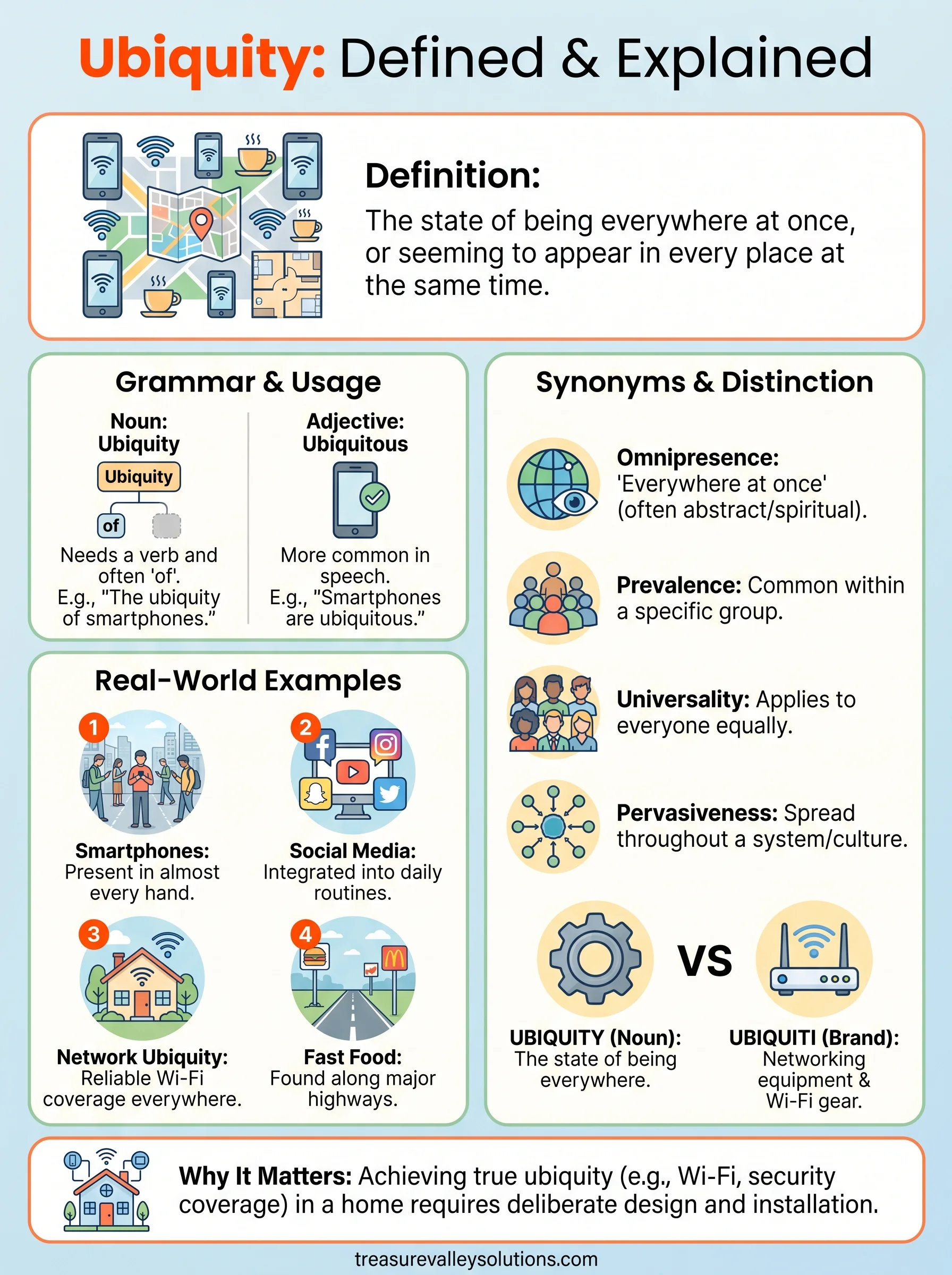
Ubiquity means the state of being everywhere at once, or seeming to appear in every place at the same time. It's a noun built from the adjective "ubiquitous," and you'll see it used to describe anything from smartphones to fast food chains to, yes, wireless technology that blankets a building. Below, we break down the precise definition, walk through several real-world example sentences, and list synonyms you can swap in when you want variety in your writing.
At Treasure Valley Solutions, we deal with a related kind of ubiquity every day: the goal of making reliable Wi-Fi, smart controls, and security cameras and alarm systems present in every corner of a home or business. So after we cover the word itself, we'll touch on why true network ubiquity matters and how it connects to the smart home technology we design and install in Meridian, Idaho and the wider Treasure Valley.
Why ubiquity matters in everyday language
Words earn a permanent spot in the dictionary when they capture something people need to describe often, and ubiquity does exactly that. We live surrounded by things that show up everywhere at once: smartphones, social media apps, coffee shops on every corner. Without this word, you'd be stuck saying "it's everywhere" over and over, which gets repetitive fast in writing or conversation. Ubiquity gives you a single, precise term for a pattern you notice constantly, which is why it shows up in news articles, marketing copy, academic papers, and casual conversation alike.
A word for modern saturation
Grasping the ubiquity meaning helps you talk about technology, culture, and consumer trends with more nuance. Businesses strive for it, describing their goal as achieving "market ubiquity" or wanting their product to become "ubiquitous" among a target audience. Journalists reach for it when covering how quickly a new app or gadget spreads into daily routines. Even scientists use it to describe how common a phenomenon is across ecosystems or populations.
Ubiquity is the word you use when something has stopped being rare and started being everywhere.
Why precision matters when you write it
Sloppy writers default to phrases like "very common" or "everywhere you look," but those phrases feel flat next to a sharper word choice. Reaching for ubiquity instead signals that you've thought carefully about your language, and it often reads as more formal or intentional. That matters in professional writing, whether you're drafting a business proposal, a research paper, or even a product description.
Understanding this word also helps you avoid a common mix-up. Some readers land on articles about ubiquity while actually searching for Ubiquiti networking equipment and installation, the company behind UniFi gear. The words sound almost identical, but one describes a linguistic concept and the other is a brand name. Knowing the difference saves you from confusing your vocabulary lesson with your tech shopping list, and it's worth pausing here before you keep reading further into the definition and examples ahead.
How to use ubiquity correctly in a sentence
Grammatically, ubiquity is a noun, so it needs a verb and often a preposition to make a complete thought. You'll usually pair it with "of" to specify what's everywhere, as in "the ubiquity of smartphones" or "the ubiquity of fast food chains." Skipping that connector leaves the sentence feeling incomplete, since ubiquity rarely stands alone the way an adjective might.
Switching between the noun and its adjective form, ubiquitous, changes the sentence structure entirely. Compare these two correct versions:
- Noun form: "The ubiquity of streaming services has changed how families watch TV."
- Adjective form: "Streaming services have become ubiquitous in modern households."
Both sentences say the same thing, but the adjective version often sounds more natural in casual speech, while the noun version fits better in formal or analytical writing.
Use "ubiquity of" for the noun and "ubiquitous" as the adjective, and you'll never misuse either form.
Common mistakes to avoid
Writers sometimes treat ubiquity as if it needs a plural form, but it doesn't. You won't say "ubiquities" unless you're discussing multiple distinct instances across a technical or academic context, which is rare. Another slip is dropping the preposition, producing awkward phrases like "ubiquity smartphones" instead of "the ubiquity of smartphones." Double-checking for that small connector keeps your sentence structure clean and your meaning obvious to readers.
Real-world examples of ubiquity
Seeing the word in action makes it stick faster than any dictionary definition. Consider how often you hear people describe the ubiquity of smartphones, noting that nearly every person you pass on the street is holding one. Cultural commentators talk about the ubiquity of social media, pointing out that platforms like Instagram and TikTok have worked their way into daily routines across almost every age group. Marketers chase this same effect when they talk about brand ubiquity, hoping their logo becomes as recognizable as the Nike swoosh or the Starbucks siren.
When a brand, habit, or technology reaches ubiquity, you stop noticing it as unusual and start expecting it everywhere you go.
Examples across different fields
Here's how the term shows up across a few common contexts:
| Field | Example sentence |
|---|---|
| Technology | "The ubiquity of Wi-Fi has made hardwired connections feel outdated." |
| Retail | "Fast food chains have achieved near-total ubiquity along American highways." |
| Culture | "Streaming apps have reached a level of ubiquity that cable TV never had." |
| Smart homes | "Homeowners now expect ubiquity of coverage from their security cameras and lighting controls." |
That last row hits close to home for us. Achieving genuine ubiquity in a house or office, where a signal, a camera, or a light switch responds no matter which room you're in, takes deliberate home network and Wi-Fi design. It's exactly what our whole-home automation and control systems are built to deliver across the Treasure Valley.
Synonyms and related words for ubiquity
Sometimes you want a different word to avoid repeating ubiquity three times in one paragraph, or you need a synonym that fits a slightly different shade of meaning. English gives you several solid options, though none of them capture the exact combination of "everywhere" and "constant" quite like ubiquity does. Picking the right substitute depends on whether you're describing physical presence, cultural saturation, or sheer frequency.
Words that mean nearly the same thing
Omnipresence stands closest in meaning, often used in religious or philosophical contexts to describe something present in all places at once. Prevalence works well when you're talking about how common something is within a population or group, and universality fits when you want to stress that something applies to everyone without exception. Pervasiveness is another strong pick, especially when describing how something has spread into every corner of a system or culture.
Reach for omnipresence, prevalence, or pervasiveness when you need variety, but none of them fully replace the precision of ubiquity.
| Synonym | Best used for |
|---|---|
| Omnipresence | Spiritual or abstract "everywhere at once" |
| Prevalence | Frequency within a specific group |
| Universality | Something applying to everyone equally |
| Pervasiveness | Gradual spread through a culture or system |
The related adjective form
Don't forget ubiquitous, the adjective version you'll use far more often in everyday speech than the noun itself. It pairs naturally with nouns like "ubiquitous presence" or "ubiquitous computing," a phrase tech researchers use to describe devices embedded so deeply into daily life that people stop noticing them.
Putting ubiquity into perspective
Now you can use ubiquity correctly, spot the difference between it and the networking brand Ubiquiti, and swap in synonyms like omnipresence or pervasiveness when your writing needs variety. That's the whole vocabulary lesson wrapped up in one clean, useful package.
But words describing "everywhere at once" mean something practical when you're standing in a house with a dead Wi-Fi zone or a security blind spot by the back door. True ubiquity of coverage in a home or business doesn't happen by accident. It takes deliberate placement of access points, cameras, and controls by someone who understands how signals travel through walls, floors, and furniture.
If you're picturing that kind of seamless coverage for your own space, see photos of finished installations we've completed to see how we've made smart technology genuinely ubiquitous across homes and businesses throughout the Treasure Valley. We build systems where the technology just works, everywhere, every time.