 (208) 991-3502
 Meridian, ID



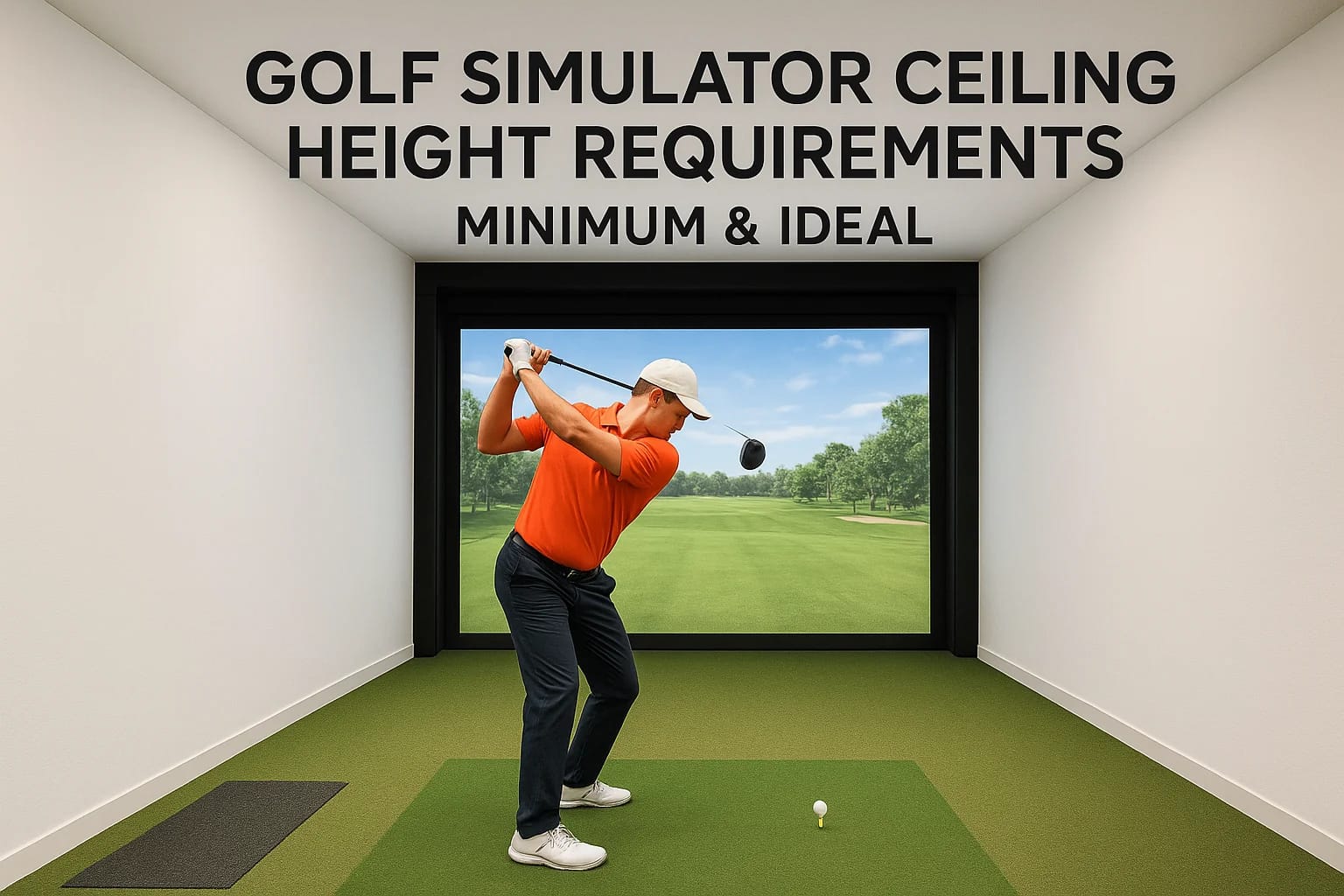

You've picked out the screen, the launch monitor, maybe even the software package, but before any of that matters, you need to answer one critical question: will your ceiling actually work? Golf simul...
Golf Simulator Ceiling Height Requirements: Minimum & Ideal
You've picked out the screen, the launch monitor, maybe even the software package, but before any of that matters, you need to answer one critical question: will your ceiling actually work? Golf simulator ceiling height requirements trip up more people than you'd expect, and getting it wrong means either a destroyed ceiling tile on your first driver swing or, worse, a complete room redesign after the money's already spent.
The short answer is that most golfers need a minimum of 9 feet, but "most golfers" might not be you. Your height, your club selection, the steepness of your swing plane, all of these shift the number. A 5'7" player with a flat swing has very different clearance needs than someone 6'3" who swings upright. The actual requirement for your space depends on your specific setup, not a generic recommendation from a product listing. And that's before factoring in flooring, impact screens, projector placement, and everything else that shares that vertical space.
At Treasure Valley Solutions, we design and install custom entertainment and AV spaces for homeowners across the Boise and Meridian area, including dedicated golf simulator rooms. We've seen firsthand what happens when ceiling height gets overlooked during the planning phase, and it's never a quick fix. This guide breaks down the exact minimum and ideal ceiling heights you need, how to measure correctly for your body and swing, and what to do if your space falls short.
What ceiling height requirement really means
When someone talks about golf simulator ceiling height requirements, they're really asking: how much vertical space does a club in motion need at its highest point during a full swing? The answer isn't a fixed number because it depends on a combination of your body mechanics, club length, and swing style. The ceiling doesn't just need to clear your head when you stand still. It needs to clear the clubhead at the very top of your backswing or follow-through, whichever comes higher, and those two points can sit several feet above where most people assume.
The Geometry Behind a Full Swing
Think of your swing as an arc moving through three dimensions. At address, the club sits low near the ground. As you rotate into your backswing, the club travels up and back, and the highest point of that arc occurs near the top of the backswing for most golfers. For a driver, which has the longest shaft in the bag at 45 to 48 inches, that top-of-backswing position can place the clubhead considerably above your own head, depending on how upright or flat your swing plane is.
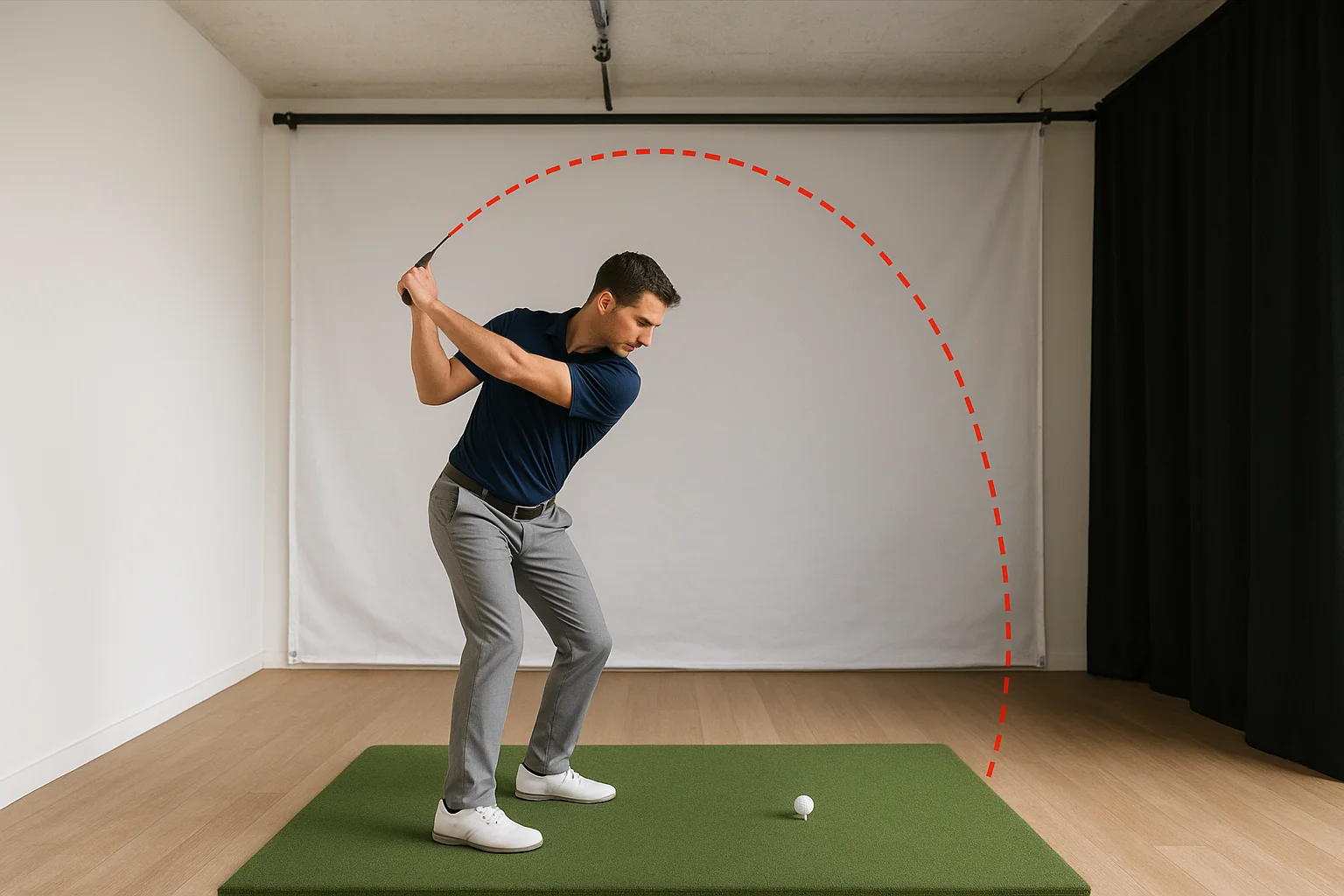
Your shoulder height and arm length factor directly into this calculation. A taller player starts the swing from a higher position, which means the arc traces higher through the backswing. Even two or three inches of height difference between golfers can translate to a meaningful change in the vertical space needed at the top of that arc. This is why a generic ceiling height number pulled from a product spec sheet often misses the real picture.
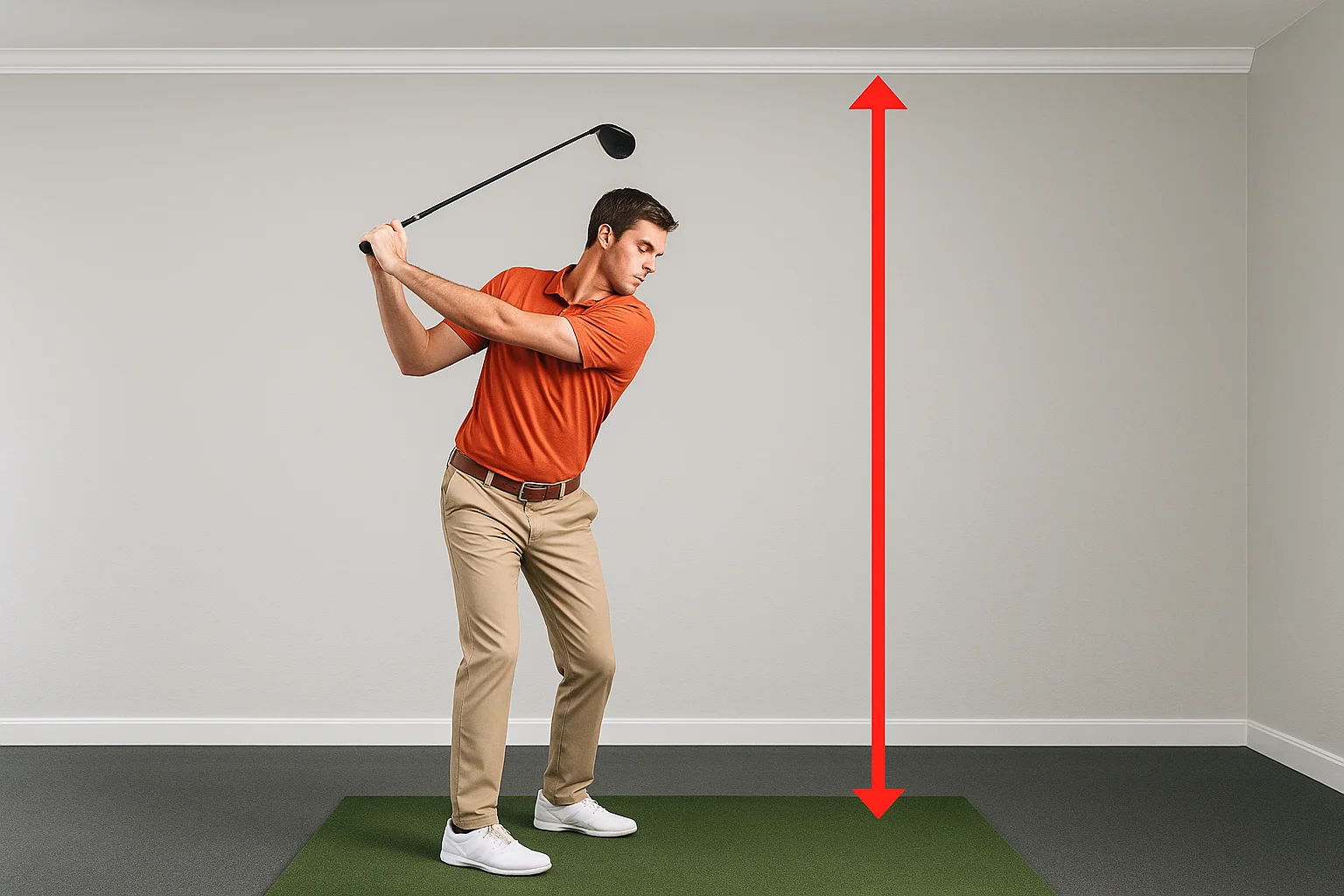
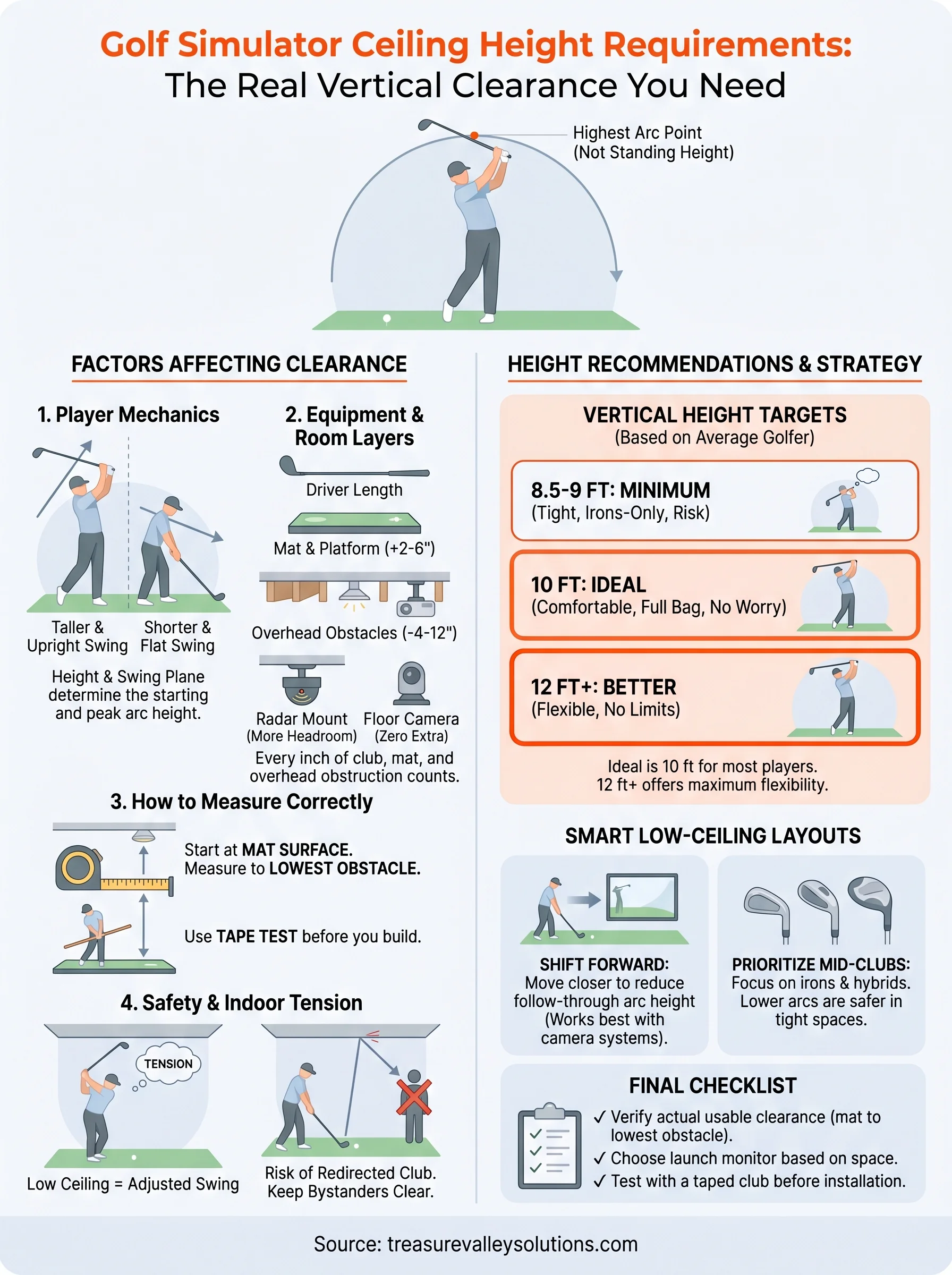
The ceiling height you need is not determined by your standing height. It's determined by the highest point your clubhead reaches during a full swing, which is almost always well above your head.
Why Clearance Isn't the Same as Ceiling Height
This is where a lot of first-time simulator buyers miscalculate. Your actual usable clearance is not the number on the tape measure from floor to ceiling. Several things eat into that space before your swing even enters the equation. Flooring matters immediately: a hitting mat typically adds 1.5 to 2 inches of height. Installing a raised platform or a dedicated hitting deck with padding underneath can cost you another 2 to 4 inches before you even pick up a club.
Overhead elements take clearance from the top. Ductwork, ceiling joists, light fixtures, and projector mounts all hang below the raw ceiling height, and they don't always stay neatly to the sides of the room. A projector mounted near the center of the space might drop 6 to 10 inches below the ceiling, and that projector often needs to sit somewhere above or near the swing zone for the image to hit the screen at the right angle and size.
When you factor in both ends, a room with a 9-foot ceiling might deliver only 8 feet and a few inches of real swing clearance once you account for a mat and basic overhead lighting. That's a meaningful difference, and it's the kind of detail that separates a comfortable, playable simulator room from one where every driver swing carries real risk. Golf simulator ceiling height requirements only make practical sense when you measure the actual usable space, not just the raw structural number on the blueprint.
Minimum vs ideal heights for most golfers
Before you commit to a specific room, you need two numbers in your head: the floor-level minimum where swinging becomes possible, and the comfortable target where swinging feels natural. These numbers aren't the same, and understanding the gap between them helps you make a smarter decision about which space to convert before installation begins.
The 8.5-Foot Minimum
Eight and a half feet is widely cited as the lowest workable ceiling height for an average golfer using a driver, and that number applies to someone around 5'9" to 5'11" with a moderately flat swing plane. At this height, you can complete a full swing, but the margin is tight enough that any deviation from your normal mechanics can send the clubhead into the ceiling. You're not practicing freely; you're practicing carefully, which is a meaningful difference if you're trying to build or maintain a real swing.
At 8.5 feet, most golf simulator ceiling height requirements for irons and shorter clubs are satisfied without much worry. The problem arrives the moment you pull out a driver or a 3-wood. Longer shafts trace higher arcs, and the clearance that felt adequate with a 7-iron can disappear quickly when you step up to the full-length clubs you actually need to practice.
If your ceiling sits below 9 feet after accounting for your mat and any overhead fixtures, you should seriously consider limiting your simulator use to irons-only or adjusting your swing to compensate before you build the room.
Why 10 Feet Changes the Experience
Ten feet is the number that most professional installers recommend as the sweet spot for the widest range of golfers and swing types. At this height, a player up to 6'4" with a standard swing plane can practice with every club in the bag without adjusting mechanics or holding back on the backswing. You stop thinking about the ceiling and start thinking about your game, which is the entire point of building a simulator room.
Twelve feet and above opens the room even further, accommodating upright swing planes and taller players without any real concern. Rooms in this range also give you more flexibility with projector placement and overhead lighting, since you're not fighting for every inch of vertical space. If your garage or basement already clears 10 to 12 feet, that space is genuinely worth prioritizing over a tighter option.
How player height and club length change it
No two golfers need the same vertical clearance, and that's not a vague disclaimer. Your body dimensions and the clubs you swing create a specific overhead envelope that either fits your space or doesn't. Understanding exactly how these two variables interact gives you a concrete starting point before you finalize which room to use and what modifications it might need.
Your Standing Height Sets the Baseline
Your height determines where your swing arc begins. A taller golfer addresses the ball from a higher position, which means their hands and arms move through a higher plane during the backswing. Every inch of standing height adds roughly a proportional amount to the vertical space the club travels through at the top of that arc. Someone at 5'6" and someone at 6'2" can swing with identical mechanics and still require noticeably different ceiling clearances just because their bodies start the motion from different positions.
A practical way to think about it: measure your shoulder height while standing in your normal address posture, not just your total height. That number, combined with your arm length and the shaft in your hand, gives you a much closer estimate of your actual swing ceiling than a generic height chart ever will.
Your shoulder height at address, not your total standing height, is the more accurate starting point for calculating how much ceiling clearance you actually need.
Driver Length Raises the Ceiling Demand
Club length is the other side of the equation, and it changes the number dramatically. A standard driver shaft runs 45 to 48 inches, which is nearly two feet longer than a typical 7-iron. When you extend that shaft through a full backswing, the clubhead travels a much wider and higher arc than any short iron would. This is why golf simulator ceiling height requirements calculated for iron play often fall short the moment you introduce a driver.
A useful reference for most golfers:
| Player Height | Recommended Minimum (Driver) | Comfortable Target |
|---|---|---|
| Under 5'8" | 9 feet | 10 feet |
| 5'8" to 6'0" | 9.5 feet | 10 feet |
| 6'0" to 6'4" | 10 feet | 10.5 to 11 feet |
| Over 6'4" | 10.5 feet | 11 feet or more |
These figures assume a standard swing plane and a mat adding roughly 1.5 inches to floor height. Adjusting for specific club lengths or custom-fit equipment may push the numbers slightly higher, so treat these as a starting framework rather than a final answer.
How swing plane and indoor tension change it
Your swing plane is the angle at which your club travels around your body during the backswing and downswing, and it has a direct impact on how much vertical clearance you actually need. Two golfers of identical height can require meaningfully different ceiling heights based on this single variable alone. Understanding where your own swing falls on this spectrum helps you set more accurate golf simulator ceiling height requirements for your specific situation rather than relying on a population average.
Upright vs. Flat Swing Planes
An upright swing plane means your club travels on a steeper, more vertical path during the backswing. The clubhead rises higher above your shoulder line before it reaches the top, which directly increases the overhead clearance you need. Many taller golfers swing upright naturally because their posture and arm structure push them in that direction. If your normal swing looks steep on camera, add at least 6 to 8 inches onto whatever baseline minimum your height suggests.
A flat swing plane keeps the club more horizontal and around the body, which means the clubhead stays closer to shoulder height at the top of the backswing. Flat swingers generally need less vertical clearance than their height might suggest, and some shorter golfers with genuinely flat planes can work comfortably in spaces that would be too tight for upright swingers of the same stature.
If you've never analyzed your swing plane on video, do that before you finalize your ceiling height calculations. One slow-motion recording from down the line will tell you more than any general chart.
The Psychological Effect of a Tight Ceiling
Swing mechanics don't exist in a vacuum. When your brain registers a low ceiling directly overhead, your body adjusts your swing before you consciously decide to do anything. This usually means a shortened backswing, flatter rotation, and quicker tempo, none of which reflect how you actually swing on a real course. The result is practice data that doesn't translate, and habits that can quietly creep into your real game.
This indoor tension problem is more common in rooms with ceilings between 8.5 and 9.5 feet. Even when a player technically has enough clearance to swing without hitting anything, the visual proximity of the ceiling triggers a subconscious protective response. Adequate clearance doesn't just prevent physical contact; it keeps your mechanics honest by giving your brain enough visual room to swing freely and without hesitation.
How to measure height with real obstacles
A tape measure from floor to ceiling gives you a number, but it doesn't give you your actual usable swing height. Real rooms have real obstacles, and the gap between your raw ceiling measurement and your true clearance is often larger than you'd expect. Knowing how to account for every layer of the room before you finalize your golf simulator ceiling height requirements saves you from discovering the problem after installation day.
Start at the Floor, Not the Ceiling
Your measurement needs to account for everything between the subfloor and your feet first. A standard golf mat adds 1.5 to 2 inches, and if you're planning a raised platform for aesthetics or to run cables underneath, add another 2 to 4 inches on top of that. Stand in your normal address posture on a mat sample or a comparable surface before you pull out the tape, because your effective swing height starts from wherever your feet actually land, not from the bare concrete or plywood beneath it.
Measure from the surface you'll actually stand on during play, not from the structural floor, because every layer you add below reduces the clearance above.
Account for What Hangs Down
The ceiling number shrinks further when you look up. Exposed joists, ductwork, and HVAC units can drop 4 to 8 inches below the structural ceiling depending on how your space is built. Recessed lighting sits flush and costs you almost nothing, but pendant fixtures or surface-mounted lights that fall within your swing zone need to come out entirely or relocate to the perimeter before you pick up a club. Walk your room and physically mark every overhead element that sits inside the footprint where you'll swing, then measure the lowest point of each one. That lowest point, not the ceiling itself, is your real upper boundary.
Use Tape Before You Build
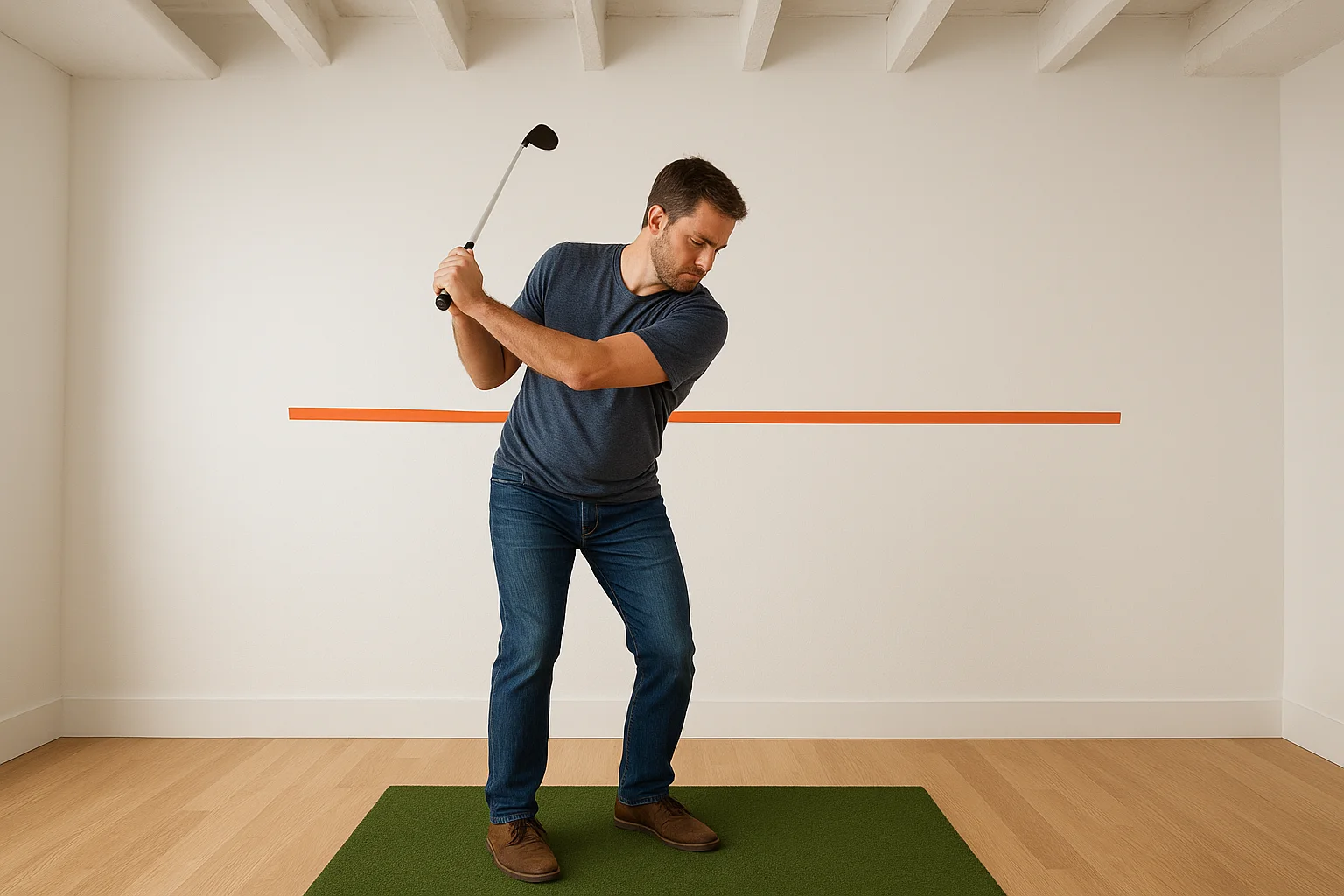
The most reliable way to verify clearance before committing to a room is a simple physical test. Tape a string or lightweight dowel to the end of your longest driver so the total length matches the club shaft, then take slow, deliberate practice swings in the actual space. Film the motion from the side and from behind so you can review where the club tip reaches at the top of your backswing. This takes ten minutes and costs nothing, but it gives you direct evidence of whether the room works for your specific swing before any equipment gets ordered or installed.
How launch monitor choice affects clearance
The technology you use to track your shots plays a direct role in your golf simulator ceiling height requirements, and most people don't factor this in until they're looking at installation specs. Launch monitors fall into two primary categories based on where they need to sit in the room: overhead-mounted radar units and floor-positioned camera systems. Each type places different demands on your vertical space, and choosing the wrong one for a low-ceiling room can create clearance problems that the room's structural dimensions never caused.
Overhead Radar Units
Radar-based launch monitors require a mount above and behind the hitting position, typically attached to the ceiling or a dedicated structure near the ceiling line. This position gives the radar a clear line of sight to track ball flight from launch through carry. The mounting hardware, bracket, and the unit itself can drop 6 to 12 inches below the ceiling, which comes directly out of your usable swing clearance, especially if the mount falls within your backswing arc rather than safely to the side.
If you're working with a ceiling below 10 feet, verify the exact mounted dimensions of any radar unit before you purchase, because the listed device size rarely reflects the full ceiling-to-bottom clearance you'll lose after installation.
Some radar systems can mount to a side wall or sit on a tripod positioned well behind the hitting bay, which reduces the ceiling impact significantly. Check each specific unit's recommended placement options before you rule out a room based on ceiling height alone, because the same radar technology can sometimes be repositioned in ways that reclaim the clearance you need.
Floor-Positioned Camera Systems
Camera-based launch monitors like the SkyTrak or Garmin Approach R10 sit on the floor or a small stand beside or just behind the ball. They use high-speed cameras and optical sensors to capture club and ball data at the point of impact, which means they need no overhead position at all. These systems impose zero additional ceiling clearance requirements beyond what your swing itself demands, making them the more practical choice for spaces where ceiling height is already working against you.
For most recreational golfers building a home simulator, camera-based units represent a smart compromise when the alternative is either a room that doesn't physically work or a significant structural renovation just to accommodate an overhead mount. The technology gap between these systems and radar units has narrowed enough that the clearance benefit is usually worth more than the data difference.
Low-ceiling layouts that still feel playable
A room that falls short of the ideal 10-foot target isn't automatically a dead end. Tight spaces can still produce a functional simulator setup if you make deliberate decisions about how you configure the room and which clubs you prioritize. The goal is to match your layout choices to your actual golf simulator ceiling height requirements rather than forcing a setup designed for a taller space into a room that can't support it.
Shift Your Hitting Position Forward
Moving your hitting position closer to the screen reduces the arc your club needs to travel through before impact, which effectively lowers the ceiling demand during the follow-through phase. When you stand further back in the room, your swing has more horizontal space to complete, but the backswing arc often rises higher as a result. Positioning yourself 7 to 8 feet from the screen instead of 10 or more brings the swing into a tighter horizontal envelope and can reduce the peak height your club reaches at the top.
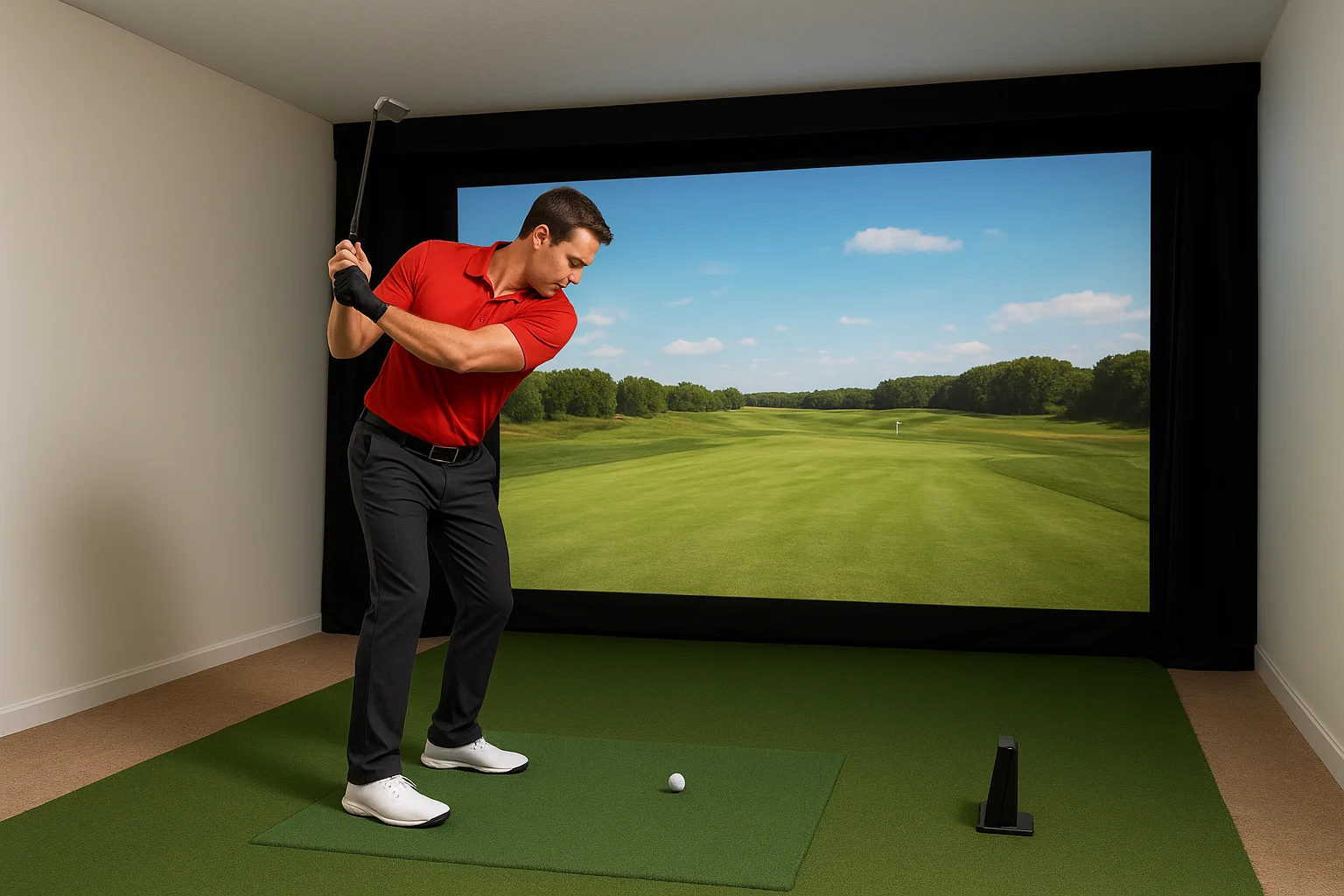
Shifting forward works best with camera-based launch monitors since their floor-level placement doesn't depend on a specific distance from the hitting position the way some radar units do.
You do need to verify that your screen still captures the full width of your shot dispersion from the closer position. Wide-angle screens and larger enclosures handle the forward shift better than compact impact panels, so factor screen dimensions into this decision before you rearrange the room.
Prioritize Irons and Mid-Length Clubs
Shorter clubs trace lower arcs, which means a low-ceiling room can still deliver a genuinely useful practice environment if you focus your sessions on irons, hybrids, and fairway woods rather than the full driver. For most golfers, 70 to 80 percent of real scoring improvement comes from iron consistency, approach shots, and short game work, not from driver distance.
You can still test your driver swing with a restricted backswing drill using the simulator for impact data and ball flight feedback, without committing to a full, ceiling-threatening arc. Many golfers find that building iron and approach shot habits indoors transfers directly to lower scores on the course, making a low-ceiling room a legitimate training tool even if it can't handle every club in the bag.
| Club Type | Typical Ceiling Demand | Low-Ceiling Friendly? |
|---|---|---|
| Driver (45-48" shaft) | Highest | Only with 9.5+ ft clearance |
| Fairway Woods | Moderate-High | Workable at 9 ft for most |
| Hybrids and Long Irons | Moderate | Yes for most golfers |
| Mid and Short Irons | Lower | Yes, comfortable at 8.5+ ft |
Safety details that affect ceiling clearance
Ceiling height isn't only a performance variable. It's also a direct safety factor, and treating it as one changes how you should evaluate your room before building. When a club makes contact with a ceiling, it doesn't just leave a scuff mark. The force of a full swing transferred through a rigid shaft and into an overhead surface can snap a club, ricochet debris, or redirect the grip into your face with real force. Understanding the specific safety risks tied to clearance keeps you focused on the right details during planning.
The Risk of a Redirected Club
A driver traveling at the top of a backswing carries significant momentum. If that clubhead clips a ceiling tile, a joist, or even a low-hanging cable, the sudden change in the shaft's direction of travel can whip the handle end toward your head, hands, or face before you have time to react. This isn't a theoretical concern; it happens in simulator setups where golfers assumed they had enough room based on a rough visual estimate rather than a measured check.
Your golf simulator ceiling height requirements aren't just about comfort or swing quality. They're about keeping yourself and anyone else in the room physically safe during every session.
Graphite shafts are particularly vulnerable to this kind of impact because they don't bend and absorb force the way steel shafts do. A graphite shaft that contacts a hard surface at speed can shatter, and the resulting fragments move fast. If you're in a room where clearance is genuinely tight, wearing a glove and keeping bystanders out of the hitting area during driver swings is a reasonable precaution regardless of how confident you feel about your mechanics on any given day.
Keeping Bystanders Clear
Any person standing within the arc of your swing introduces a safety variable that ceiling clearance alone doesn't account for, but the two risks compound each other in a tight room. A low ceiling restricts your swing arc predictability, which means your club is more likely to travel an unexpected path if it contacts an overhead surface and deflects mid-swing. Children, pets, and anyone unfamiliar with the space should remain outside a clearly defined safety zone that extends at least 8 feet behind and 5 feet to each side of your hitting position during any active session.
Marking that boundary clearly on the floor with tape before your first session is a simple step that most home simulator owners skip and nearly all professional installers recommend.
Quick wrap-up
Getting your golf simulator ceiling height requirements right before you spend a dollar on equipment is the single most important planning step you can take. Your actual usable clearance depends on your height, your swing plane, your mat thickness, your launch monitor placement, and every overhead obstacle in the room. Nine feet is the practical minimum for most golfers, but 10 feet gives you the freedom to swing every club in the bag without second-guessing your backswing.
Tight spaces still work when you configure them deliberately, prioritize the right clubs, and account for safety from the start. Every variable in this guide connects directly to the others, so treat the whole picture together rather than checking one number and moving on. If you're planning a dedicated simulator room in the Boise or Meridian area and want a professional assessment before you commit, contact the Treasure Valley Solutions team to get started.
Need Expert Help?
Ready to implement these solutions in your own home or business?
Our Services
View All Services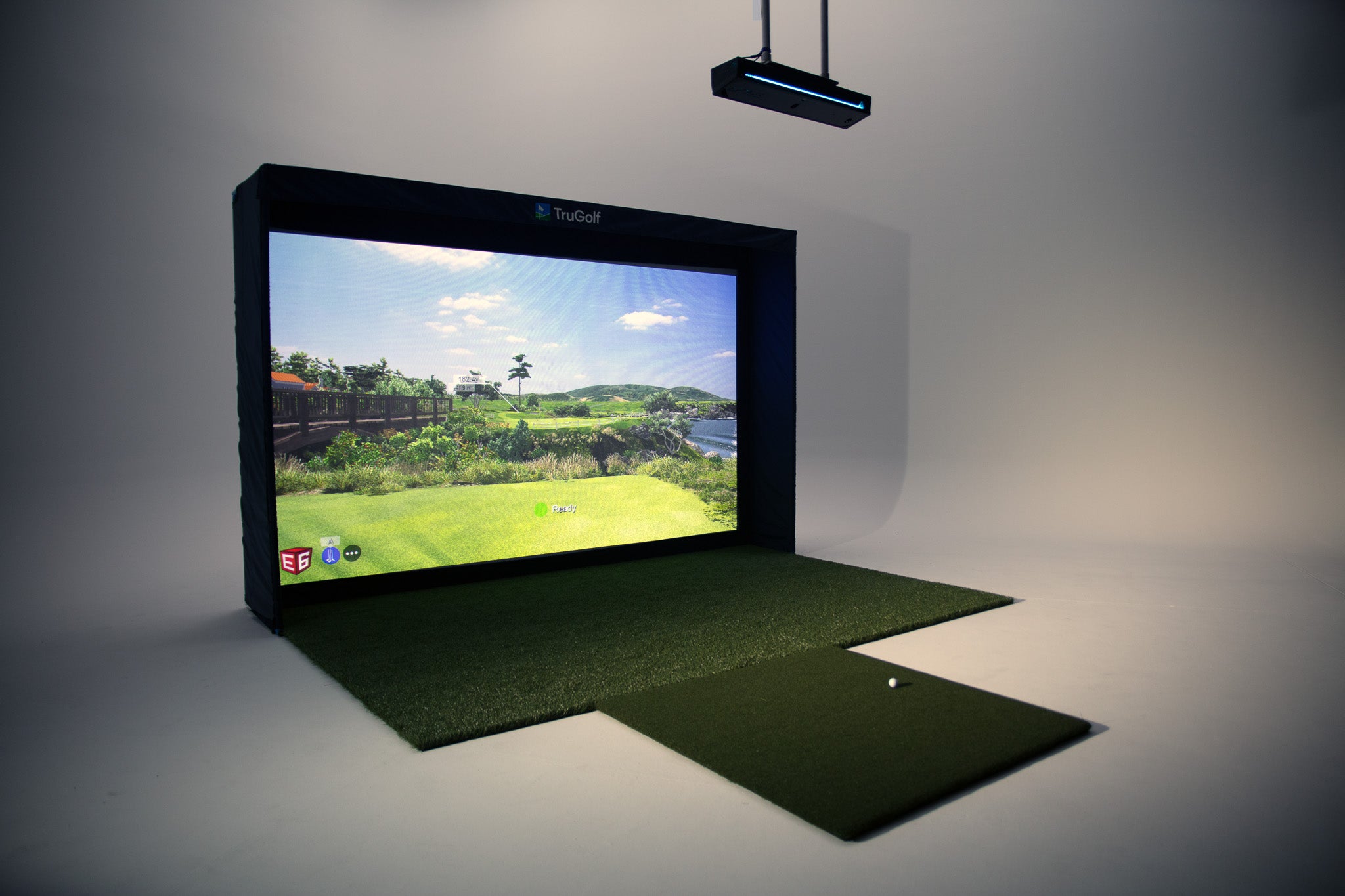
Serving the Treasure Valley
Local installation in your city