 (208) 991-3502
 Meridian, ID



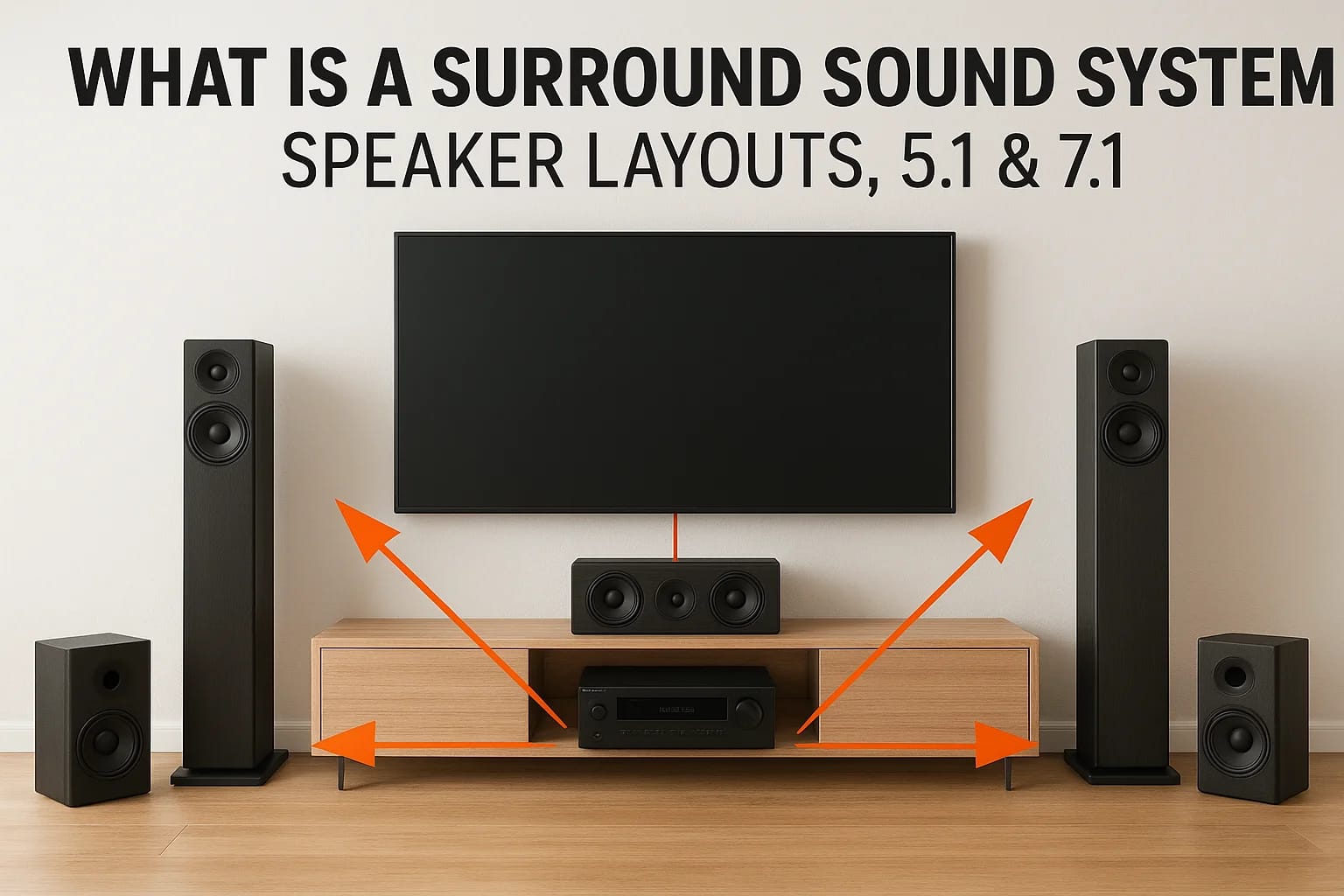

You've probably heard the term thrown around in conversations about home theaters, but what is a surround sound system, exactly? At its core, it's an audio setup that places multiple speakers around a...
What Is a Surround Sound System? Speaker Layouts, 5.1 & 7.1
You've probably heard the term thrown around in conversations about home theaters, but what is a surround sound system, exactly? At its core, it's an audio setup that places multiple speakers around a room to create a three-dimensional sound experience, one where helicopters fly overhead, dialogue anchors to the screen, and explosions rumble beneath your feet.
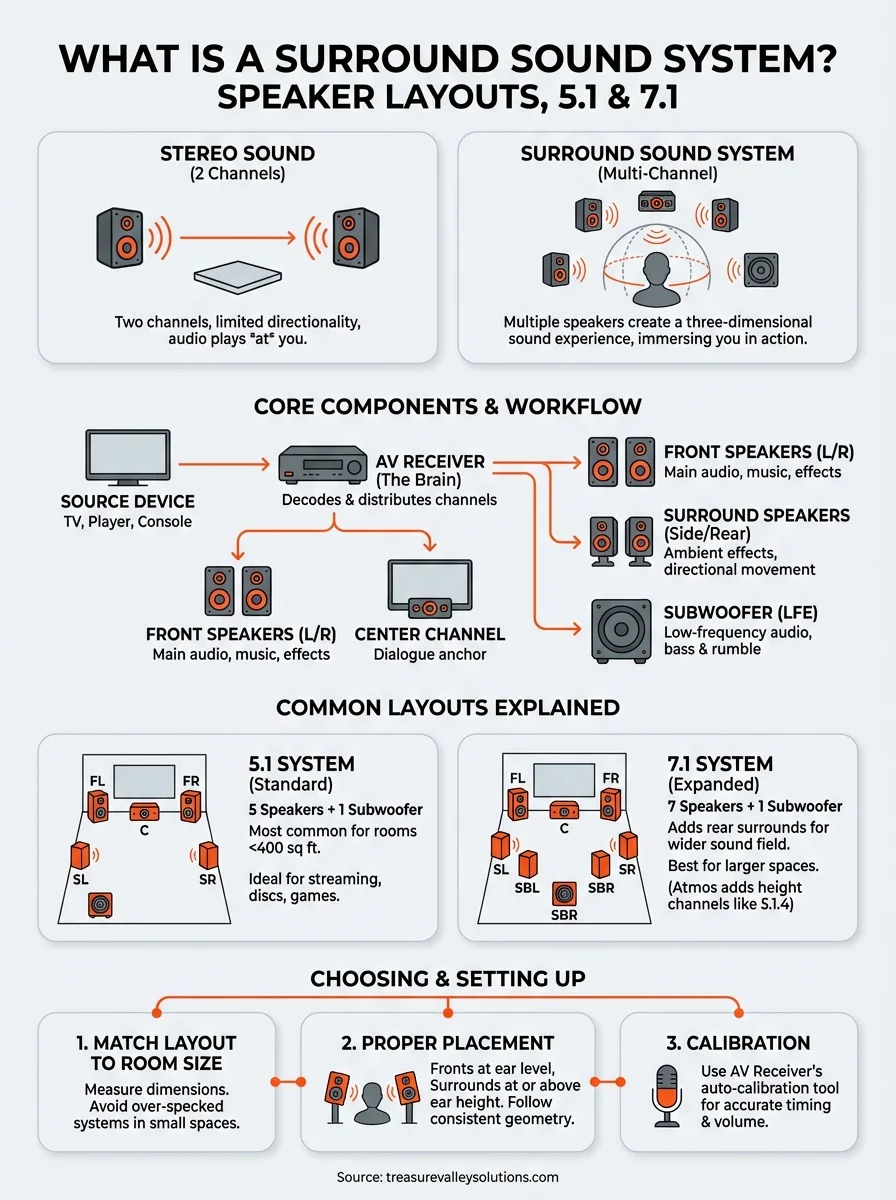
Unlike a soundbar or a pair of stereo speakers that push audio from one direction, a surround sound system distributes sound across dedicated channels and speaker positions. Each speaker handles a specific role, from center-channel dialogue to rear ambient effects, which is how movies, music, and games pull you into the action instead of just playing at you. The difference is immediately noticeable the first time you experience it.
At Treasure Valley Solutions, we've been designing and installing custom home theater systems across the Boise and Meridian area since 2014, so we know this technology inside and out. This guide breaks down the core components of a surround sound system, explains how popular configurations like 5.1 and 7.1 work, and helps you understand which layout makes sense for your space.
Why surround sound feels more immersive
Your brain is wired to locate sound sources in three-dimensional space. When you hear a noise, your ears register tiny differences in timing and volume between the left and right sides of your head, and your brain uses that data to pinpoint where the sound is coming from. A traditional stereo setup uses two speakers, so your brain only receives left-right directional information, which limits how realistic the audio feels.
How your brain processes directional audio
Surround sound systems take advantage of this natural hearing process by placing speakers in front of you, beside you, and behind you. When a car races across the screen, the audio moves from your front-left speaker, past your side channels, and into your rear speakers. Your brain interprets that movement as real spatial audio, not just a sound effect coming from a box on a shelf.
The more accurately sound matches the visual action on screen, the more your brain treats the experience as real rather than recorded.
This is why movie studios mix audio specifically for multi-channel playback. They build each scene with layered audio tracks assigned to specific speaker positions, so the sound designer controls exactly where every effect, voice, and piece of music lands in the room.
Why stereo alone can't replicate the effect
Stereo speakers do a solid job with music, but they were never designed to recreate the full three-dimensional soundstage that a film or game requires. With only two audio channels, everything collapses into a flat horizontal plane. Dialogue, effects, and background noise all compete for the same two speaker positions.
Surround sound solves this by separating audio into dedicated channels and assigning each one a physical location in the room. The result is a listening environment where sound has depth, height (in Dolby Atmos setups), and directional movement. That separation is the core reason understanding what is a surround sound system matters in practice: it is a spatial audio tool, not just a louder version of stereo.
How a surround sound system works
A surround sound system routes audio through a central processor that reads encoded sound data from your source, decodes it, and distributes each channel to the correct speaker. The process happens in milliseconds, and the result is audio that matches the action on screen with spatial precision and accuracy.
The role of the AV receiver
The AV receiver is the brain of the operation. It accepts audio signals from your source devices, including your TV, Blu-ray player, streaming device, or game console, then amplifies and directs each channel to its designated speaker. Without a receiver, you have no way to split a multi-channel audio signal and send it to five, seven, or more separate speakers in the correct positions around the room.
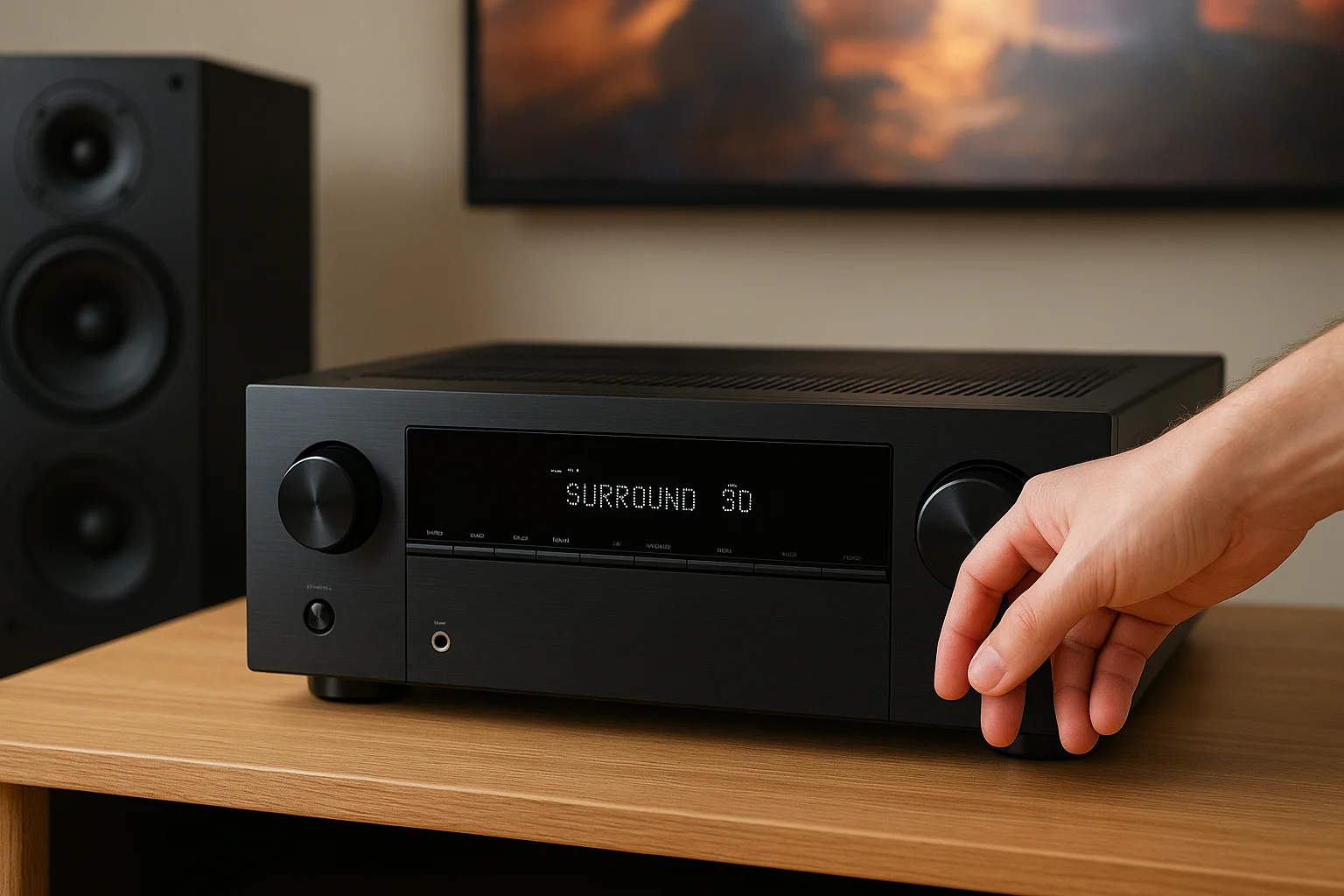
How audio signals get decoded
Modern surround sound formats like Dolby TrueHD and DTS:X embed multiple audio channels into a single encoded stream. Your receiver reads that stream and extracts each layer, sending dialogue to the center channel, ambient effects to the surrounds, and low-frequency rumble to the subwoofer. Understanding what is a surround sound system at this level helps you see why the receiver's decoding capability matters as much as the speakers themselves.
The quality of your receiver directly affects how accurately each channel is reproduced, which is why it deserves as much attention as any speaker in the room.
Each decoded channel reaches its speaker with the correct timing and volume, ensuring the seamless, wraparound sound your ears register as real spatial audio rather than a recording playing from a box.
The core parts of a surround sound system
Understanding what is a surround sound system becomes much clearer once you know what each component actually does. Every part in the chain serves a specific function, and removing or downgrading any one of them affects the overall performance of the setup.
Speakers: front, center, and surround
Your front left and right speakers carry the bulk of the music, effects, and cinematic atmosphere in any scene. The center channel speaker, positioned directly above or below your screen, locks dialogue to the image so voices stay anchored to the actor's mouth rather than drifting across the room. Surround speakers, placed to your sides or behind your seating position, handle ambient effects and directional movement that give the room its sense of depth.
Skimping on the center channel is one of the most common mistakes in home theater setups, since it handles the majority of spoken dialogue in any film.
Getting speaker placement right matters as much as speaker quality. Even a well-rated set of speakers will underperform if they're pointed at the wrong angle or positioned too far from your listening area.
The subwoofer
The subwoofer handles all low-frequency audio, specifically the bass and sub-bass content that standard speakers can't reproduce accurately. Explosions, engine rumbles, and deep musical notes all route through this single driver, and you feel that output as much as you hear it. Most subwoofers connect to the receiver through a dedicated LFE (low-frequency effects) channel, which keeps low-end audio separate from your main speakers so each component focuses on what it does best.
Common surround sound layouts explained
The numbers in a surround sound configuration tell you exactly how many speakers and subwoofers the system uses. The first number represents the main speaker count, and the second number represents the subwoofers. Once you understand that shorthand, comparing layouts becomes straightforward.
5.1: The standard starting point
A 5.1 system includes five speakers and one subwoofer: front left, front right, center, and two surround speakers placed to your sides or just behind your seating position. This is the most common home theater layout and covers the full range of what is a surround sound system at its most practical level.
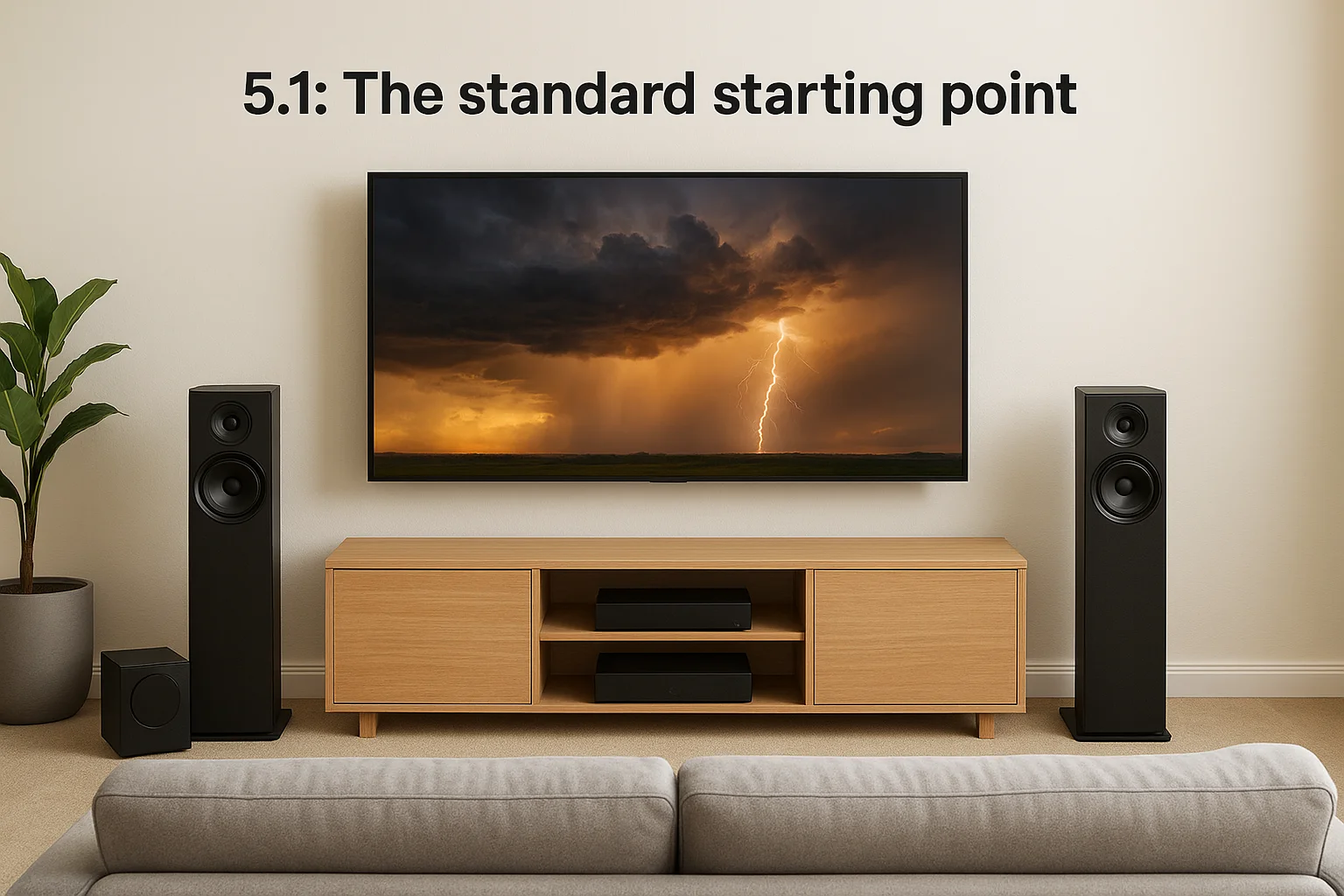
Most streaming platforms, Blu-ray discs, and games are mixed with a 5.1 audience in mind, which means you get the full intended audio experience without needing additional hardware. For most rooms under 400 square feet, a well-configured 5.1 setup is the right call.
7.1 and height channels
A 7.1 layout adds two more surround speakers, typically placed directly to your sides while the original rear surrounds shift further behind your seating area. This creates a wider, more enveloping sound field and works best in larger rooms where the extra channel separation has enough physical distance to be distinctly audible.
A 7.1 system only outperforms a 5.1 system when the room is large enough to justify the additional speaker positions.
Formats like Dolby Atmos and DTS:X go further by adding overhead or upward-firing speakers, introducing height as a third dimension. These configurations, labeled 5.1.4 or 7.1.2, let audio move directly above your head for effects like rainfall, low-flying aircraft, or falling debris.
How to choose and set up the right system
Picking the right surround sound system comes down to three practical factors: room size, budget, and how you plan to use the space. Before you buy anything, measure the room and identify where your seating will land relative to the screen. Those two numbers shape every other decision you make.
Match the layout to your room size
Your room dimensions determine which configuration actually delivers on its promise. Understanding what is a surround sound system in theory is useful, but applying that knowledge to your specific space is what produces results you can hear. A 5.1 setup works well in most living rooms and dedicated home theaters under 400 square feet, while larger, open spaces benefit from a 7.1 or Atmos layout where additional speaker positions have enough physical separation to be audible.
Buying more speakers than your room can support wastes money and creates audio overlap that degrades the listening experience rather than improving it.
Placement and calibration
Speaker placement follows consistent geometry: front speakers should sit at ear level and angle toward your primary seating position, while surround speakers work best positioned at or slightly above ear height to your sides or rear. Getting the angles and distances correct before running cables saves hours of troubleshooting later.
Most AV receivers include an automatic calibration tool that uses a small microphone to measure speaker distances, levels, and room acoustics. Running that calibration process after installation is not optional; it is the step that ties the entire system together and ensures every channel hits your ears at the right time and volume.
Final takeaways
Understanding what is a surround sound system starts with recognizing that it's a spatial audio tool built from specific components working together. Your AV receiver, speakers, and subwoofer each handle a defined job, and the layout you choose should match your room size and how you use the space. A 5.1 setup covers most homes well, while larger rooms or dedicated theaters benefit from 7.1 or Atmos configurations.
Getting this right the first time saves you from buying hardware that doesn't fit your space or reconfiguring a system that was never set up correctly. The biggest gains come from proper placement and calibration, not from buying the most expensive gear on the market.
If you're ready to build a home theater that actually performs, see examples of our installed systems to get a sense of what's possible, and reach out to our team in Meridian to start planning your setup.
Need Expert Help?
Ready to implement these solutions in your own home or business?
Our Services

Home theater design and installation planned around your room, viewing goals, and equipment scope.

Expert TV Mounting Treasure Valley Homeowners & Businesses Trust

Explore whole-home audio, commercial sound, Sonos setup, and surround sound installation in the Treasure Valley.
Serving the Treasure Valley
Local installation in your city