 (208) 991-3502
 Meridian, ID



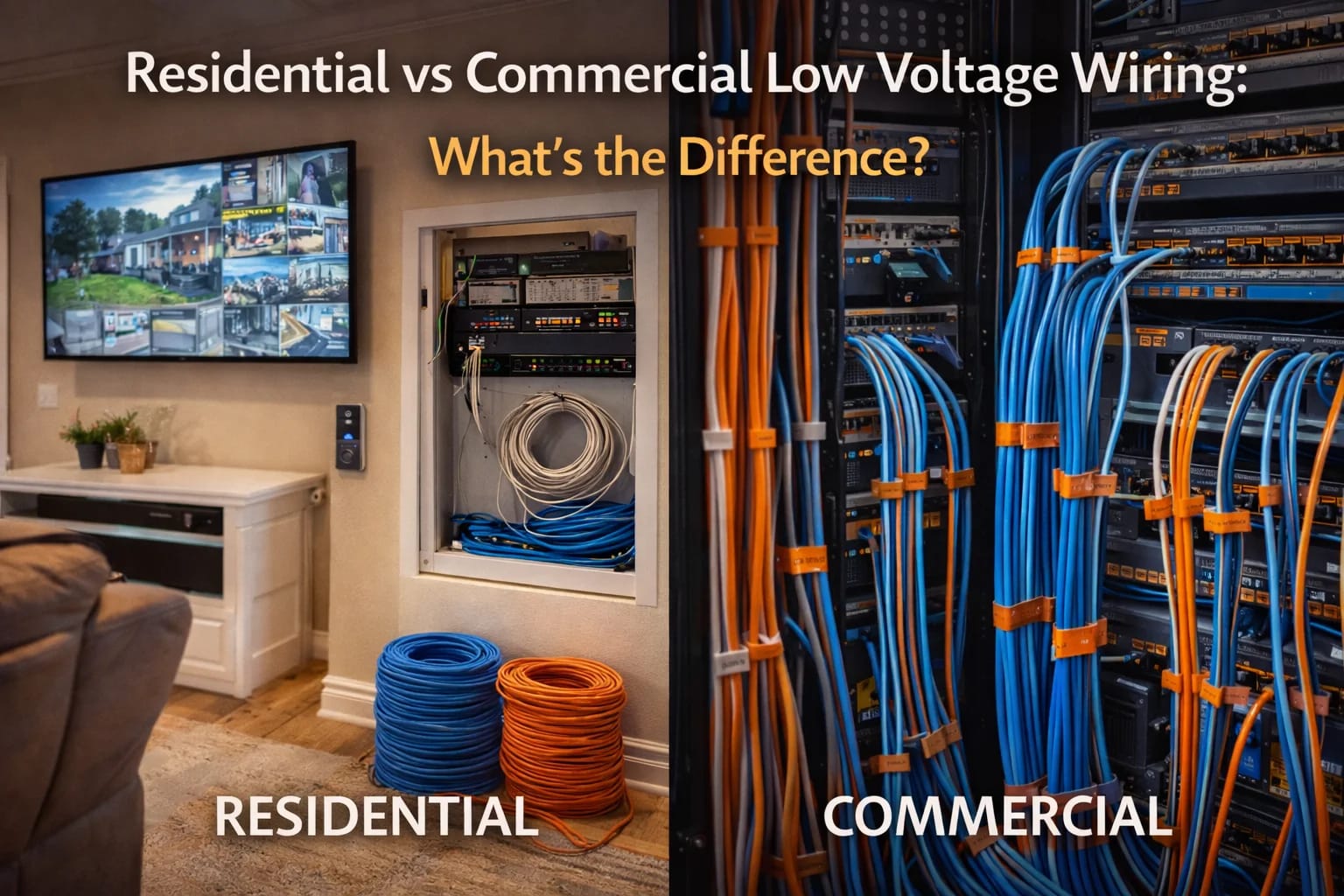

Residential and commercial low voltage wiring serve different needs. Learn how they differ in design, scale, and planning—and why it matters long term.
Low voltage wiring is used in both homes and commercial buildings, but the similarities often end there. While the same types of cables may appear on the surface, the way low voltage systems are designed, installed, and maintained differs significantly between residential and commercial projects.
For homeowners, builders, and business owners across the Treasure Valley, understanding these differences helps set realistic expectations and prevents costly mistakes—especially when a project crosses the line between residential and commercial environments.
This guide explains how residential and commercial low voltage wiring differ, why those differences exist, and how they affect long-term performance and flexibility.
Different Environments, Different Priorities
The most important difference between residential and commercial low voltage wiring is how the space is used.
Homes are designed around comfort, convenience, and lifestyle. Commercial buildings are designed around reliability, scalability, and uptime. Those priorities shape how low voltage systems are planned from the start.
In a home, low voltage wiring supports daily living—streaming, working from home, security, and convenience. In a business, low voltage wiring supports operations, communication, safety, and revenue-generating activities. When systems fail in a commercial space, the impact is often immediate and costly.
That difference in risk drives very different design decisions.
Residential Low Voltage Wiring: Lifestyle-Focused Design
Residential low voltage wiring is typically designed to support how people live in the home.
This often includes:
Reliable internet and Wi-Fi coverage
Home offices and remote work
Audio and video systems
Security cameras and doorbells
Smart lighting and automation
Residential systems prioritize clean aesthetics, ease of use, and minimal visibility. Equipment is often centralized in discreet locations, and systems are designed to blend into the home rather than stand out.
Flexibility matters, but residential wiring is usually designed around a known set of users and predictable usage patterns.
Many homeowners first encounter these systems while exploring technology services available through
👉 https://treasurevalleysolutions.com/services/
Commercial Low Voltage Wiring: Performance and Scalability
Commercial low voltage wiring places much heavier emphasis on structure and scalability.
In offices, retail spaces, restaurants, and other commercial environments, low voltage systems must support:
Multiple users and devices simultaneously
Business-critical internet and networking
Security, access control, and surveillance
Conference rooms and presentation systems
Future tenant or layout changes
Commercial wiring is often more extensive, more organized, and more thoroughly documented. Systems are designed with growth in mind, knowing that spaces may be reconfigured, expanded, or leased to new tenants over time.
Downtime in a commercial space isn’t just inconvenient—it can directly affect revenue and operations.
Code, Standards, and Documentation
Another major difference lies in standards and documentation.
Commercial low voltage wiring is typically subject to stricter codes, industry standards, and inspection requirements. Cabling must be labeled clearly. Pathways must be accessible. Documentation is often required for future maintenance or tenant improvements.
Residential wiring, while still required to meet safety standards, usually involves fewer formal documentation requirements. That doesn’t mean documentation isn’t valuable—it simply isn’t always enforced the same way.
In practice, commercial projects demand a higher level of organization from day one.
Scale and Complexity
Scale plays a significant role in how low voltage wiring is approached.
A residential project may involve dozens of cables. A commercial project may involve hundreds or thousands. Managing that scale requires different planning, coordination, and installation practices.
Commercial systems often include structured cabling layouts, dedicated equipment rooms, and redundant pathways to ensure reliability. Residential systems are typically simpler, but still benefit from thoughtful design—especially in larger homes.
The bigger the project, the more critical planning becomes.
New Construction vs Tenant Improvements
The residential vs commercial distinction becomes especially important in tenant improvement (TI) projects.
TI projects often involve upgrading existing commercial spaces to meet the needs of new tenants. These projects require low voltage wiring that can integrate with existing infrastructure while remaining flexible for future changes.
Poorly planned low voltage wiring in TI projects often leads to repeated rework each time a tenant changes. Well-planned wiring supports faster turnovers and lower long-term costs.
This kind of forward-thinking approach mirrors broader planning strategies outlined within
👉 https://treasurevalleysolutions.com/solutions/homeowner-solutions/
and adapts them to commercial environments.
Why One Size Doesn’t Fit All
One of the most common mistakes is treating residential and commercial low voltage wiring as interchangeable.
Applying residential practices to commercial spaces can result in systems that don’t scale or meet operational demands. Applying commercial complexity to residential projects can add unnecessary cost without meaningful benefit.
The best results come from designing systems that match the actual use case, not just the type of cable being installed.
When Residential and Commercial Worlds Overlap
Some projects blur the line between residential and commercial.
Examples include:
Home offices with business-level needs
Multi-family developments
Short-term rentals and hospitality spaces
Live-work environments
In these cases, low voltage wiring must strike a balance between residential comfort and commercial reliability. These hybrid projects benefit the most from experienced planning that understands both worlds.
Frequently Asked Questions
Is residential low voltage wiring cheaper than commercial?
Often, yes—but scale, complexity, and performance requirements matter more than labels.
Can commercial wiring be used in homes?
Yes, but it’s not always necessary and may increase cost without added benefit.
Do commercial projects require more documentation?
Yes. Documentation is critical for maintenance and future changes.
Are the cables themselves different?
Sometimes, but the biggest differences are in design, layout, and organization.
Does professional planning matter more for commercial projects?
Yes—but it adds value to residential projects as well.
Choosing the Right Approach for Your Project
Low voltage wiring is not just about cables—it’s about designing systems that match how a space is actually used.
For Treasure Valley homeowners, residential wiring should support comfort and convenience without unnecessary complexity. For businesses, commercial wiring must deliver reliability, scalability, and long-term flexibility.
Understanding the difference ensures projects are built to perform today—and adapt tomorrow—without costly rework.
Need Expert Help?
Ready to implement these solutions in your own home or business?
Our Services

Home theater design and installation planned around your room, viewing goals, and equipment scope.
Expert TV Mounting Treasure Valley Homeowners & Businesses Trust

Explore whole-home audio, commercial sound, Sonos setup, and surround sound installation in the Treasure Valley.

Complete home automation and control.
Serving the Treasure Valley
Local installation in your city